Author Archives: michaeljglass

100 – Venom

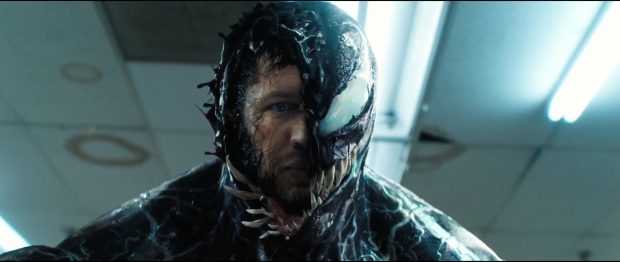
Venom utterly charms the pants off us, its bizarre knockabout body horror surprising us with a great sense of humour and unexpected variations on the idea of a dweeb made more masculine. From the trailer, Mike was worried about the broadness of Tom Hardy’s accent – actually, it’s tonally perfect as broadness is exactly what the film is going for in every respect, in the very best way.

Hardy is superb, giving his all to a role that demands physical dexterity and comic ability; the CGI bowls José over; the sense of Hardy’s body being shared by another physical entity, rather than being merged with it, is tactile and interesting. Mike’s also been watching the Sam Raimi Spider-Man trilogy recently, in which Venom appears, and holds court on a trend in the villains he sees Venom as adhering to. And the dog is so funny.

The podcast can be listened to in the players above or on iTunes.

With José Arroyo of First Impressions and Michael Glass of Writing About Film.
99 – Climax

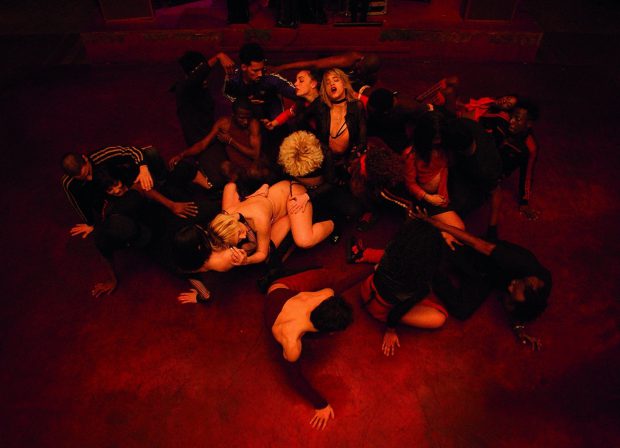
A group of dancers parties the night away, but someone has spiked the sangria with LSD. There are extraordinarily long takes, sex, drugs, violence, and horror. Yes, it’s a Gaspar Noé film.

Climax is a singular cinematic escape into a vision of Hell. Boy, there’s a lot going on. We grapple with the film’s themes of sex, violence, drugs, youth, dance, sexuality, nationality, culture, and whatever else we can remember of its insane 96 minutes. We discuss what we did and didn’t like about the dancing – the pros and cons of the way it’s shot – and what value there is in extraordinary cinematic violence in a world in which footage of horrific real-life violence is commonplace. We discuss the detail of Climax‘s cinematography and editing and the effects they have on our experiences, particularly shooting upside-down and inserting almost subconsciously brief flashes of black frames in otherwise normal cuts. We’re reminded of Do the Right Thing, The Exterminating Angel, and Salò, and indeed Climax wears its influences on its sleeve. José reads it allegorically, finding reference to Europe, cultural power, and race, though so far adding it all up remains beyond us.

It fired Mike up enough to have a go at a guy who’d had his phone on during the cinema, but it enveloped José so completely that he didn’t even notice the distraction. And Mike made a film like this once! As he puts it, “Not as good as this, probably, but a lot shorter.” You can see that here if you like:

In short, Climax is certainly worth your time. There’s so much going on and we’ll be seeing it again when the mac screens it in November.

The podcast can be listened to in the players above or on iTunes.

With José Arroyo of First Impressions and Michael Glass of Writing About Film.

98 – A Simple Favor

“From the darker side of director Paul Feig”, as the ubiquitous advertising has it, and the film doesn’t disappoint. A Simple Favor pairs Anna Kendrick with Blake Lively as the least compatible friends you can imagine, friends with dark secrets and desires. We find Feig a complete master of tone, able to control the film’s descent into some very, very murky places without ever losing its ability to remain light and likeable. It’s a quite an achievement.

We discuss the way the film makes the female characters prominent and diminishes the role of men, eschewing the typical noir hero role for Kendrick’s Nancy Drew escapades, and the pleasure in seeing her character develop and assume control. The use of flashback is interesting and at some points quite brilliant, with important plot points being conveyed through subtle eyeline matches and just a few short shots recontextualising things we already know, or think we know. Mike finds the plot grows a little overcomplicated towards the end, and indeed predicted one or two developments – normally he prides himself on his gullibility – but these are nitpicks, at best, in a hugely entertaining film.

And it’s a film noir played for laughs! José can’t stress that enough.

The podcast can be listened to in the players above or on iTunes.

With José Arroyo of First Impressions and Michael Glass of Writing About Film.

97 – The House with a Clock in Its Walls

We’re disappointed with The House with a Clock in Its Walls, a children’s horror fantasy that insults its audience’s intelligence by assuming that this is the kind of simplistic shit kids love. We find some aspects of its design to enjoy but for the most part find it close to charm-free and not up to the standards of its stars – though Mike is keen to point out it’s probably director Eli Roth’s best film, which isn’t saying much.

The podcast can be listened to in the players above or on iTunes.

With José Arroyo of First Impressions and Michael Glass of Writing About Film.
96 – Skate Kitchen

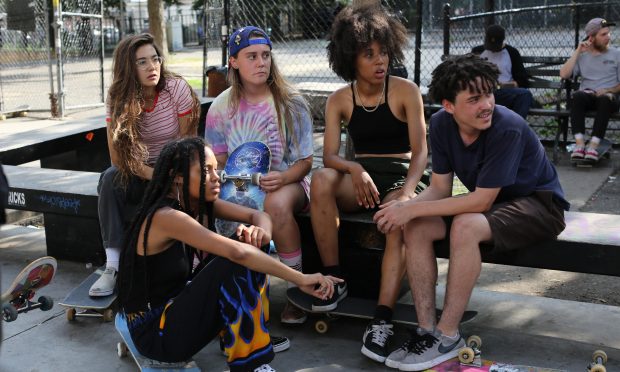
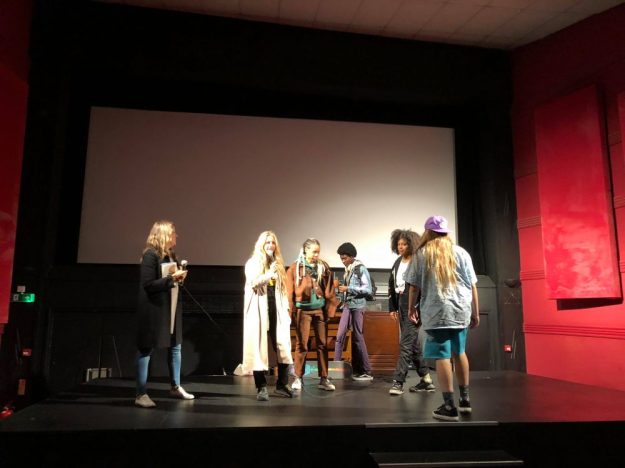
First of all, huge thanks to the Electric Cinema in Birmingham for not only screening a preview of irresistible hangout flick Skate Kitchen, but for hosting a Q&A with director Crystal Moselle and some of the cast – not professional actors, but girls who genuinely hang out and skate in New York City under the name “Skate Kitchen”, and whose daily lives form the basis of the film. A chance meeting on a train led to Moselle shooting a short film with them and ultimately this feature. Moselle has been here before: her debut, The Wolfpack, also came about due to her curiosity about a group of people she came across in New York, but that was a documentary, and Skate Kitchen is narrative fiction.

Indeed, the narrative works to bring out the best of the setting and people, structuring the documentary aspects to avoid losing much focus while bringing out observations of these girls’ lives that feel deeply authentic, pointed, and original. It follows a teenage skater with a rebellious streak becoming part of the Skate Kitchen collective, the changes to her life as she grows up away from home, and the inevitable conflicts between the girls and the boys who dominate the skate culture they want a part of.

We discuss the nuances in the film’s construction of a divorced family in which both parents are nonetheless present, and in which the child is given agency over her relationships with them; the wholesomeness of the girls’ interactions, particularly with one of their dads; the dimensionality of the boys, particularly in terms of sexual desire and their interactions with girls – and the way the girls’ bodies are displayed not as passive, simply intended to look sexy, but as active and really, really fucking talented. Watching them skate is, just like watching the horse breaking in The Rider – also played by non-professional actors using their real-life skills – a pleasure in which the film allows us to indulge deeply.

Finally, Mike wants to apologise for the sound quality in this episode. He forgot to plug the mic in.

The podcast can be listened to in the players above or on iTunes.

With José Arroyo of First Impressions and Michael Glass of Writing About Film.

95 – King of Thieves

A heist movie for the twinkly wrinklies, with a nostalgic and homophobic angle we disliked. Based on the true story of the 2015 Hatton Garden burglary, King of Thieves features an all-star British cast and one joke: they’re all old.

Mike is keen to give the film credit for its charm early on, as well as its sensitive depiction of the sense of loss felt by Michael Caine’s recent widower. But the film is uninspiringly shot, incompetently and unwisely edited – it’s absolute mayhem – and when it swaps its charm for aggression after the heist, it loses all interest. Ray Winstone comes in for particular criticism from José, and Mike explains why he found The Theory of Everything wanting.

The podcast can be listened to in the players above or on iTunes.

With José Arroyo of First Impressions and Michael Glass of Writing About Film.
94 – The Rider

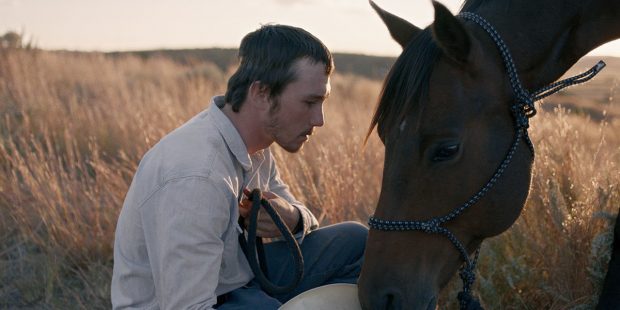
A contemporary Western played by non-professional actors and based closely on their real lives, The Rider is both heartfelt and riddled with cliché. Brady is one of a group of young men in the American Midwest who ride bucking horses and bulls, risking severe injury and death, in what can be seen at once as both a vital act of keeping tradition alive and a tacit admission that the opportunities offered by America are dwindling and serve to keep people in their place. Mike also describes it as “a stupid sport”.

José sees a kinship with American Animals in its portrayal of young American men with no sex lives or apparent interest in sex lives; Mike believes it’s a film that will flatter those who like to pride themselves on seeing “quality” cinema. There are scenes of beauty, including those with a former rider profoundly injured and restricted to life in an assisted living facility – Brady’s love for his friend, expressed throughout the film, is touching. And the horse wrangling is simply spectacular and worth it for its own sake.

A film with deep flaws, an indulgence in cliché, visual unoriginality, and too rosy a view on its subject matter, but nonetheless with flashes of beauty.

The podcast can be listened to in the players above or on iTunes.

With José Arroyo of First Impressions and Michael Glass of Writing About Film.

93 – Cold War

Cold War is Paweł Pawlikowski’s follow up to the Academy Award winning Ida. We delighted in the Midlands Arts Centre’s fabulous projection system, which Mike says makes these beautifully lit and composed images “sing”, allowing their poetry to resonate. The film is unashamedly a love story, framed in a 4:3 ratio that best frames faces and sharpens the focus on the feelings they express, in glistening black and white.

Cold War begins unusually in that the love each of the protagonists has for the other is never in doubt. The problem, the threat, the barrier, is how the geopolitics of the post-war period interrupt that love – the whole world is against them! We discuss the resonances of the film’s setting, the period 1949-1964, and the significance of the film moving back and forth from Paris and several Eastern Bloc countries; with settings in the Polish countryside, Warsaw, Berlin Yugoslavia, Zagreb and then back to Poland. Is part of the theme that in the Eastern Bloc they’re forced to prostitute their art whilst capitalist countries encourage the prostitution of the self?

José swoons over the sadness, sexiness and romance of the film. Mike draws attention to a certain sketchiness and notes that Tomasz Kot looks like he belongs in a Stella Artois ad whilst admiring his performance and that of Joanna Kulig as Zula. José loves it so much he wants to see it again to further explore the patterning of images and sounds. Mike feels he’s seen enough but is willing to go along, particularly since the film is unexpectedly short at only 85 minutes. It’s certainly good, but precisely how good is Cold War is the question that overhangs the podcast.

The podcast can be listened to in the players above or on iTunes.

With José Arroyo of First Impressions and Michael Glass of Writing About Film.
92 – Crazy Rich Asians

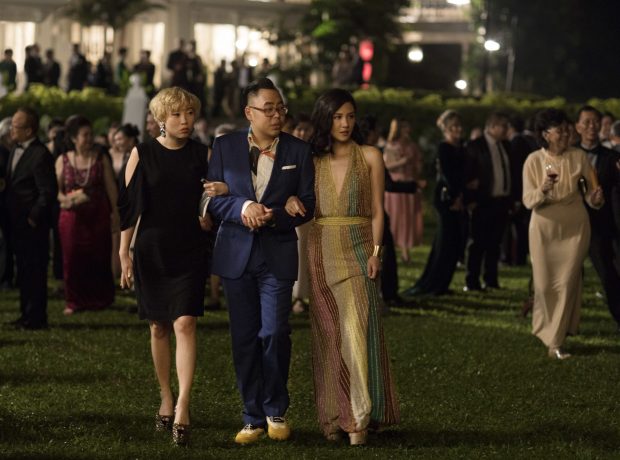
An utterly charming, friendly rom-com set in and amongst the very wealthiest of the Singaporean elite, Crazy Rich Asians is also full of odd tensions and problematic complexities. In one sense a highly specifically Chinese story of a second-generation American immigrant’s return to Asia and the conflict she experiences in negotiating her way into a world that finds her somewhat unwelcome; on the other a genre comedy that would feel no different were the characters all white. It’s a friction that bubbles under everything, but the film is so light and likeable that it never spoils anything.

We find Michelle Yeoh’s performance as the intimidating mother-in-law a delight, her character completely avoiding the one-dimensional dragon mom stereotype. On the other hand, there are stereotypes in which the film does indulge, though we disagree on how critical we should be of that. Thinking back to Searching, Mike feels that that film’s joy of seeing ethnicity have no bearing at all on anything is not replicated here, as the film’s insistence on themes of separation from one’s background and identity come into conflict with its desire to be no different from any generic white rom-com. Jose doesn’t find this an issue, instead sinking into the diasporic aura of the film. We discuss the film’s occasional TV movie feel, its use of music, its depiction of class through accents, and the way the opening sets up a much darker, more subversive film than we get.

And above all, it’s really, really funny.

The podcast can be listened to in the players above or on iTunes.

With José Arroyo of First Impressions and Michael Glass of Writing About Film.

91 – American Animals

An imperfect combination of documentary and dramatisation, American Animals gives us a lot to talk about. Its story of four college students embarking on a heist raises ideas of privilege, ambition and hope (or lack thereof), self-image, and above all, masculinity. In its self-conscious invocation of the kinds of films twenty-something white guys adore, such as Fight Club and Reservoir Dogs, American Animals builds a portrait of the modern young man with which Mike sympathises but which José cannot tolerate.

Neither of us finds the film without deep flaws, and indeed we could not claim to have really enjoyed it. But it is valuable and leads to a lively debate. We use the phrase “American masculinity” a lot without burdening ourselves with defining it, and Mike observes that all films with American in the title are full of themselves.

The podcast can be listened to in the players above or on iTunes.

With José Arroyo of First Impressions and Michael Glass of Writing About Film.