We look at another supposed love letter to cinema, Empire of Light, which stars the beautiful Dreamland Cinema in Margate as the titular Empire, the best-developed character in an otherwise lacklustre film. Its themes of racism, patriarchy, mental illness and cinema as escapism form more of a patchwork quilt than a tapestry, and the film is thin throughout. Still, it did the job of activating our memories of cinemagoing and working in cinemas, which we discuss, and despite his knowing it shouldn’t have, the story worked emotionally on Mike. It’s really not good though.
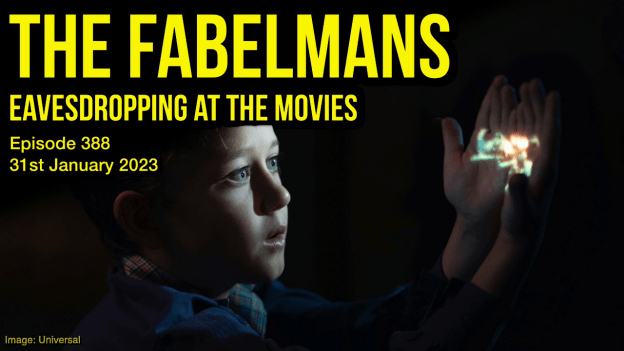
Steven Spielberg’s long-awaited semi-autobiographical reminiscence of his childhood is here, and it’s perfect. Too perfect. José swoons over the way The Fabelmans transports him to its place and time and shows love and understanding to everybody it depicts, but has to admit that a few rougher edges here and there would have done it a favour. There’s only so much drama in the life of Spielberg’s young avatar, Sammy Fabelman, and that which there is is on the tame side. But Spielberg’s love for his parents is obvious and appealing, as is his love for cinema, which he’s unafraid to get specific about – the sequences that show Sammy making and screening films convey an interest in the aesthetics, technicalities, and effects of film, rather than giving it the far vaguer “magic of the movies” treatment such “love letters to cinema” often offer.
The Fabelmans is as unwilling to explore the dark side of humanity as we’re used to Spielberg being, but it avoids his proclivity for schmaltz, and José loved it. So there.
A film Mike was doing his damndest to avoid seeing but eventually agreed to, Babylon is an epic period comedy-drama about the excess and industrialisation of Hollywood in the ’20s and ’30s, and an epic bomb at the box office. Its aesthetics, characterisations, use of race and class, vulgarity, set pieces, bizarre ending and more are up for discussion. Did Mike have as terrible a time as he anticipated?
Cate Blanchett’s performance as the title character is the highlight of the otherwise unutterably deflating Tár. What begins as an unexpectedly captivating profile of a world-class musical conductor and promises to develop into a story of sexual and psychological intrigue ultimately fails to satisfy when it refuses to offer thrills and drama – not to mention plot resolution. We pick through our problems with it, including what we find implausible, its reactionary attitudes and low opinion of young people, and its embrace of ambiguity and lack of interest in developing the story of Tár’s downfall.
We disagree on Till, which dramatises the events surrounding the infamous lynching of Emmett Till, a black fourteen-year-old boy abducted, tortured, and shot in Mississippi in 1955, and his mother’s decisive actions following the crime, which included having his mutilated body shown in a public funeral service with an open casket, and having brutal photographs of it published in the press. Emmett’s murder and Mamie’s activism forced the USA to confront the reality of its racism and catalysed the civil rights movement – of course, progress made subsequently was not instant and vast racial inequality and injustice is present in the country to this day, but the passing of the Civil Rights Act in 1964 might not have happened if not for the events of nine years prior.
While Till‘s story has often been told and referenced in music, documentary and other media, it’s surprising to say the least that it’s taken this long to be the subject of a major feature film. Perhaps it’s the visceral nature of the case, the importance of the imagery of Emmett’s body that has led to such reticence, and, as José suggests, nervous anticipation of what might be depicted could keep audiences away. That imagery in Till is shocking and upsetting, but the film keeps a tactful eye on what it shows, and refuses to depict Emmett’s torture and murder.
Still, while we agree on the sensitivity and care with which we feel the film handles these crucial elements, we disagree on almost everything else. José sees in Till an intelligent, complex exploration of racism and power structures; Mike finds amateurism in its visual compositions and excess in its orchestral score. It’s a valuable film and one that never indulges in smugness or didacticism, but we refuse to provide a coherent opinion as to whether it’s good or not.
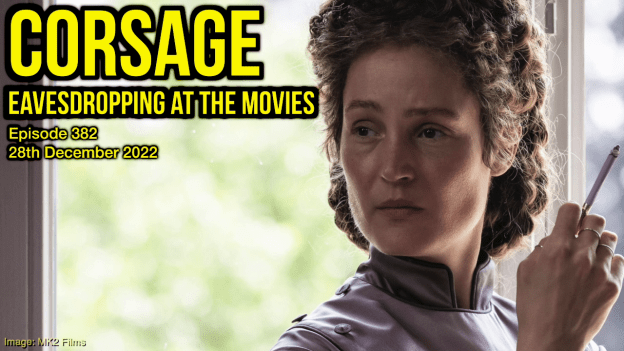
An icon across continental Europe though barely known in the UK, the life of Sisi, or Sissi – Empress Elisabeth of Austria to you – has been dramatised often, including in a famous trilogy of films depicting her youth that made Romy Schneider a star. In Corsage, the role is played by Vicky Krieps, and the perspective we’re given is of a woman whose societal purpose it is to bear children and look beautiful reaching the age of 40, a milestone that focuses her mind. It’s a film made by women about the particular effect that ageing has on women under patriarchy, but is it complex and insightful or predictable and obvious? With José Arroyo of First Impressions and Michael Glass of Writing About Film.
Playwright and filmmaker Martin McDonagh, best known in cinema for his breakthrough comedy-drama In Bruges and, most recently, the critical and financial success of Three Billboards Outside Ebbing, Missouri, on which we podcastedtwice, reunites with the stars of the former for an exploration of a male friendship, its dissolution, and the subsequent fallout.
The Banshees of Inisherin offers something of a chamber play: it might not be set in a single room, but the titular island of Inisherin is isolated, barely populated, and promises little by way of escape or a future. Brendan Gleeson’s Colm begins to feel this keenly, and abruptly declares his hitherto long friendship with Colin Farrell’s Pádraic over, intending to devote his life to his music. We discuss how depression might play into his actions, the role of the island in inhibiting ambition, the difficulty an intelligent actor has in playing dumb, the balance of comedy with drama in comparison with McDonagh’s other films, the peculiar masculinity of the way the breakup plays out, how the story might be seen as a modern myth, and how convincing the sense of place is.
There’s a lot to admire about The Banshees of Inisherin, which is arguably McDonagh’s best film, and (equally arguably) his least flawed – which sounds like damning with faint praise for a filmmaker whose work is typically interesting and novel, admittedly, but those flaws have sometimes cast large shadows over otherwise wonderful work (looking at you, Three Billboards). Here, such issues are easier to accept, and it’s consequently easier to enjoy the film’s achievements. In short – see The Banshees of Inisherin.
Gaspar Noé dials down his typical cinematic spectacle to bring us a slow and moving exploration of dementia and how it drives a loving couple apart. He still has one visual trick up his sleeve, however: Vortex uses splitscreen to show us two lives lived in close proximity but not shared. His cameras follow their subjects individually, sometimes observing them go about separate activities, sometimes occupying almost the same perspective as the characters sit together and engage in conversation, nearly giving us a unified widescreen shot that captures both husband and wife in the same frame – but never being able to. But while Vortex is given structure by its visual design, what it depicts is as crucial as how it depicts it. It’s not a sentimental film, but neither is it harsh – and it’s well worth your time.
We’ve seen a lot of the multiverse lately, and Everything Everywhere All at Once brings to it a combination of Gen Z existential angst and mid-life where-did-things-go-wrong woe, in a frantic comic-action-sci-fi wrapper. It’s a lot of things in one, and we discuss as many of them as we can remember, including its campness, puerility, basis in multi-generational immigrant life, film references, endless endings, and much more. It’s full of life and imagination, and despite its unevenness, easy to recommend.
If the Academy of Motion Picture Arts and Sciences is to be believed, CODA, a comedy-drama about the tension caused in a deaf family when the one child who can hear wishes to pursue a career in singing, is the best film of 2021. The Academy of Motion Picture Arts and Sciences is not to be believed, and the fact that a straight-to-video Hallmark film can win the most prestigious award in cinema is a damning indictment of film culture today. Still, taken on its own merits, CODA is perfectly likeable and you’ll enjoy spending time in its company. But really. This isn’t good enough.