Tag Archives: drama

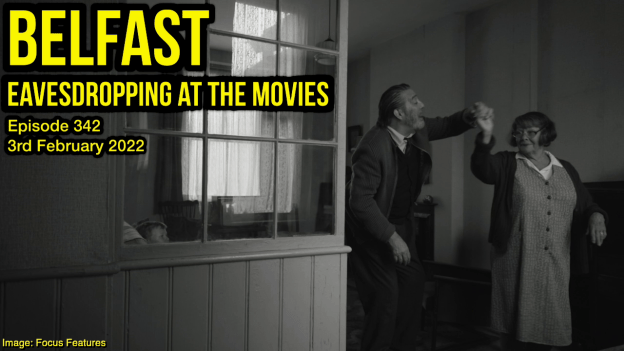
342 – Belfast

Listen on the players above, Apple Podcasts, Audible, Google Podcasts, or Spotify.

Kenneth Branagh writes and directs a drama based on his own childhood in Belfast, at the time the Troubles began. We discuss the portrayal of a happy family, the lack of effect almost every visual decision has, problems with the storytelling, and the nostalgia that runs throughout the film. It’s not a skilful film, but it is a likeable one.

With José Arroyo of First Impressions and Michael Glass of Writing About Film.
339 – Parallel Mothers

Listen on the players above, Apple Podcasts, Audible, Google Podcasts, or Spotify.

José gives Mike a history lesson on the Spanish Civil War, the scars it left on Spanish culture and society, and filmmaker Pedro Almodóvar’s own relationship to it and the dictatorship to which it led, under which he grew up and which fell in the few years prior to his ascent to prominence. His new film, Parallel Mothers, inspires this review of the past, embroiled as it is in confronting Spain’s modern history and, José argues, adapting elements of it to the melodrama of motherhood that forms its primary plot – a plot which is used to explore questions of lies, psychic violence, and instrumentality that are part of the film’s critique of Spain’s Pact of Forgetting, its political and cultural agreement to avoid confronting the legacy of the Civil War and Franco’s dictatorship, which the itch to scratch historical memory is seen to disturb.

It’s a film with serious flaws, and a disappointment given Almodóvar’s estimable body of work, especially the masterpiece that was his most recent film, Pain and Glory, but a film that creates this kind of discourse is to be valued. It’s pat, one-dimensional, and with a leadenness of tone that isn’t typical of Almodóvar, whose sense of humour is usually so reliable – but still worth seeing.

With José Arroyo of First Impressions and Michael Glass of Writing About Film.

336 – The Lost Daughter

Listen on the players above, Apple Podcasts, Audible, Google Podcasts, or Spotify.

Maggie Gyllenhaal’s debut feature as a director, The Lost Daughter, paints a powerful portrait of Leda, a middle-aged woman for whom motherhood never came naturally, and whose exposure to a young family on holiday ferociously reminds her of her experience of raising two daughters. It’s a film that bravely and forcefully repudiates the notion that motherhood should be natural to women, the key expectation of them, and joyful.

We discuss Olivia Colman’s performance and the appealing ordinariness she’s conveyed on television and in film for two decades, and Gyllenhaal’s direction of a script she wrote, which arguably omits too much context for some of what we see, but which is at its core devoted to telling its story visually, taking opportunities to spend time exploring Leda’s state of mind – although it could work through some of Leda’s behaviour more convincingly. Nonetheless, The Lost Daughter is a striking, expressive film that tells a story we don’t often hear, about a kind of person we don’t often see.

With José Arroyo of First Impressions and Michael Glass of Writing About Film.

335 – The Power of the Dog

Listen on the players above, Apple Podcasts, Audible, Google Podcasts, or Spotify.

We talk subverted expectations, how an artificial performance makes sense on a character who’s pretending to be something he’s not, the way in which forty years of oppression eats into a person’s soul, rejection of familial expectations and the performance of unspoken fraternal duty, and more, in our discussion of Jane Campion’s fascinating, complex, and beautiful drama, The Power of the Dog.

With José Arroyo of First Impressions and Michael Glass of Writing About Film.

333 – The Hand of God

Listen on the players above, Apple Podcasts, Audible, Google Podcasts, or Spotify.

Paolo Sorrentino reaches into his childhood to tell a story that’s in equal parts comic and tragic, with access to the off-kilter and fabulistic, in The Hand of God – whose title references that infamous goal scored by Diego Maradona, who Sorrentino semi-seriously credits with saving his life – as he dramatises here. We discuss the imagery, the familial banter, the curious opening scene, choosing Naples over Rome, and an oddball friendship with a happy-go-lucky smuggler.

With José Arroyo of First Impressions and Michael Glass of Writing About Film.

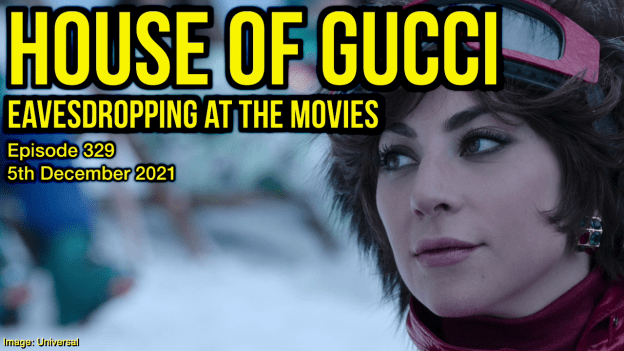
329 – House of Gucci

Listen on the players above, Apple Podcasts, Audible, Google Podcasts, or Spotify.

A true story of love, ambition, passion, betrayal, and retribution, House of Gucci is entertaining, interesting, and beautifully played… so why isn’t it good enough? We discuss its lack of seriousness of purpose, its failure to express itself with visual flair and use the camera to show us things we really need to see, and how it would have benefitted from giving Lady Gaga’s Patrizia the unambiguous spotlight, rather than making her part of an ensemble. House of Gucci is a film that we have no problem recommending, but given everything it could have been, to come away feeling like it’s a trifle is disappointing.

With José Arroyo of First Impressions and Michael Glass of Writing About Film.
328 – Spencer

Listen on the players above, Apple Podcasts, Audible, Google Podcasts, or Spotify.

As he did with 2016’s Jackie, director Pablo Larraín explores the life, image, and legacy of a woman publicly struck by tragedy in Spencer, a fabulistic biopic that imagines a Christmas holiday spent with the royal family at Sandringham, during which Princess Diana struggles with the knowledge of her husband’s affair and the watchful eyes of both the royals and the paparazzi.

We discuss our own relationships to both Larraín and Diana, and consider how the film draws on various aspects of the princess’s public image in painting a portrait of a woman losing her mind. The film is set squarely within that mind, and Mike argues that it uses several tropes and techniques common to horror in order to dramatise Diana’s fracturing mental state. José expresses his love for Kristen Stewart’s outstanding lead performance, one that doesn’t impersonate but evokes, and conveys differing stages of psychosis with subtlety.

We don’t agree on everything, and the film isn’t perfect, but Spencer is a really remarkable, expressive exploration of an iconic figure.

With José Arroyo of First Impressions and Michael Glass of Writing About Film.

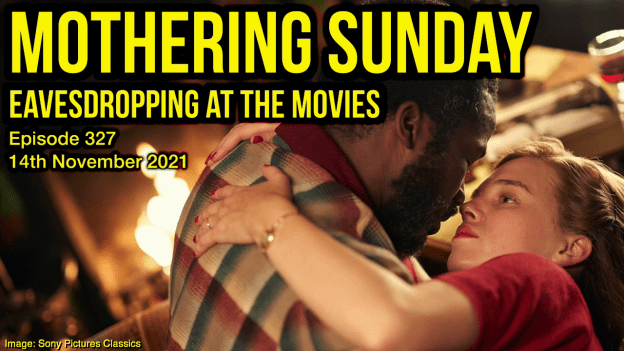
327 – Mothering Sunday

Listen on the players above, Apple Podcasts, Audible, Google Podcasts, or Spotify.

A film of surprising delights – certainly for Mike, who hates anything that looks like it could appear on ITV – Mothering Sunday tells the story of one key 1924 day in the life of a young maid. It’s a film filled with grief and lust, beautifully shot and featuring the best of British acting, Colin Firth and Olivia Colman’s performances subtly modulated and multifaceted. It’s imperfect, failing to engage with race as it perhaps should, and a framing device feels rather unnecessary – but it’s a moving and sensitive film.

With José Arroyo of First Impressions and Michael Glass of Writing About Film.
323 – The Last Duel

Listen on the players above, Apple Podcasts, Audible, Google Podcasts, or Spotify.

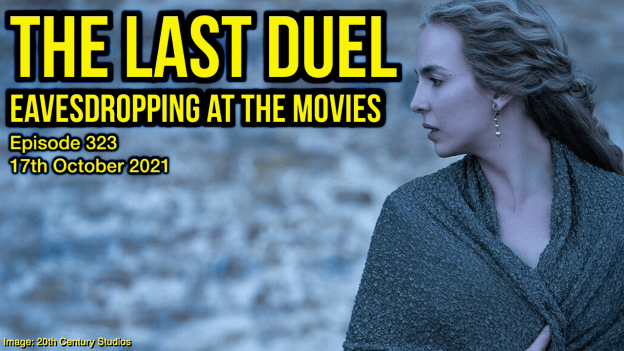
Don’t believe the trailer, which gives a poor impression of what’s in store: Ridley Scott’s latest historical epic is lighter on the action than you’d expect, and, for a blockbuster, formally adventurous. Based on true events that took place in 14th century France, The Last Duel tells the story of a lifelong feud and a sexual assault… then it tells it again, and then once more. Three perspectives are brought to bear on the events, those of Jean (Matt Damon), a soldier and vassal; Marguerite (Jodie Comer), his wife and the daughter of a treacherous lord; and Jacques (Adam Driver), his oldest friend, and squire to a count – each controls a third of the film, shaping the story as they understand it. It’s an ambitious project, drawing consciously on narratives and discourses around patriarchy and sexual assault whose importance to our cultural conversation have become increasingly established in recent years – but does it work?

Richard Brody’s review of the film in the New Yorker helps to shape our discussion, and can be found here: https://www.newyorker.com/culture/the-front-row/the-last-duel-reviewed-ridley-scotts-wannabe-metoo-movie

With José Arroyo of First Impressions and Michael Glass of Writing About Film.
318 – Undine

Listen on the players above, Apple Podcasts, Audible, Google Podcasts, or Spotify.

The fairytale figure of the undine has been used and developed in the arts for two hundred years, and Christian Petzold, whose Transit we loved, brings his clear-eyed but sensitive aesthetic to it in Undine. Paula Beer plays the titular character with transparent emotion, in the opening scene regretfully informing her ex-boyfriend, as he dumps her, that she will have to kill him. It’s a moment that captures the timbre of the film that follows – fantastical, potent, full of drama, but grounded throughout.

We also discuss Undine‘s knowing and deliberate setting against a sociopolitical backdrop, the film devoting significant time to Undine’s lectures on the history of Berlin, tying them and the city to her relationships, and the way the film conveys the tactility of new lovers, unable to keep from touching each other. We disagree on the film’s greatness – to Mike, it’s something of a trifle, particularly in comparison with Transit, but José is in deep love with it. But we’re agreed that it’s well worth your time.

With José Arroyo of First Impressions and Michael Glass of Writing About Film.