Tag Archives: comedy

131 – Green Book

It’s already being portrayed as the film that will undeservedly win Best Picture for its cuddly, comfortable, comedy-drama version of American racism in the Sixties, but do we dissent from that view? Green Book tells the true story of a road trip through the Deep South shared by jazz pianist Doctor Don Shirley (Mahershala Ali) and his Italian-American driver Tony (Viggo Mortensen).

Mike immediately seizes upon Tony’s inconsistent characterisation, the film using other characters to describe him as deeply racist, but his actual interactions with Shirley consisting of essentially polite microaggressions rather than real malevolence and anger. José also takes issue with the revelation that Shirley is gay, Tony having no problem with it, saying that in his regular job as a bouncer he sees it all the time – the film makes no attempt to explain how he can be entirely understanding and accepting of sexuality while intolerant of skin colour. Mortensen, though, is very characterful, imbuing Tony with entertaining irreverence, and the love Tony displays for his wife, writing her letters every day, is very sweet.

Ali doesn’t match Mortensen’s level of performance, though he is perhaps asked less of, largely remaining aloof throughout the film. Again, we find problems in Shirley’s characterisation. The film sets him up as a fish out of water, not just as a gay, black man in the Deep South, but also amongst other black people – it’s a quirk too far to believe that he’s never heard a Chubby Checker or Little Richard record. And the movements made in the film’s final minutes to engineer a classic happy ending (at Christmas, no less) are as predictable and obvious as they come, but Mike is moved by the ending nonetheless, leaving the cinema with a smile on his face.

Despite the character issues, lack of subtlety (every aspect of the issues it depicts is explained in dialogue), weak visual storytelling (this film doesn’t appear to actually know that it’s being shown in cinemas, so fully does it lack any sense of cinematic nous or style), and project of delivering an unchallenging, white man’s version of racism in which everyone can learn to get along without having to face any hard truths, we found things to like in Green Book, and recommend it as long as you keep your expectations low.

The podcast can be listened to in the players above or on iTunes.

With José Arroyo of First Impressions and Michael Glass of Writing About Film.

129 – Vice

Adam McKay brings the confrontational, fourth-wall-breaking style he employed in The Big Short to a story of lust for power, hidden agendas, opportunism, and as near as makes no difference a coup d’état of the American government, engineered from inside the White House. Christian Bale plays Dick Cheney as he transforms from a brainless layabout into the de facto President of the United States, operating with scary, virtually boundless power to do whatever he wishes. It’s energetic, interesting, self-aware, and makes statements and accusations as bold as you’re likely to see in mainstream cinema. But it’s difficult to trust, says only what you’d like to hear, narrates where there are obvious opportunities to dramatise, and, fundamentally, fails to do what a biopic should: develop and convey an understanding of who its subject is and why. We weren’t impressed with much more than the makeup, unfortunately – though it is brilliant makeup.

We also have a browse through the Oscar nominations, why not.

The podcast can be listened to in the players above or on iTunes.

With José Arroyo of First Impressions and Michael Glass of Writing About Film.
117 – Sorry to Bother You

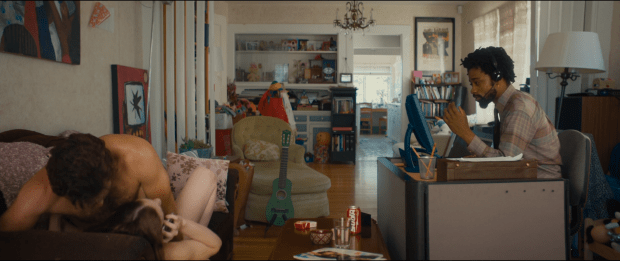
A surprising, imaginative comedy full of dark twists and scathing observations, Sorry to Bother You fires us up. There’s so much going on in it that we love. It builds a forceful critique of modern capitalism, drawing on black stereotypes, animal imagery, and factory cities to develop a thesis of 21st century capitalism as thinly veiled slave labour. Everything is available for commodification and absorption by the establishment; the system is able to tolerate dissent by co-opting it. But there is a vital resistance movement, embodied exceptionally by the coruscating Tessa Thompson, and though the film depicts a deeply unfair world in which power is entrenched, there is plenty of room for hope and joy, even through something as simple as a sigh when confronted with the latest absurdity.

The film is a kaleidoscope of ideas, always on its toes, always unpredictable, absolutely restless, and although we feel it lacks a certain visual finesse and overall coherence, the benefits of its madnesses far outweigh their costs.

Hugely recommended.

The podcast can be listened to in the players above or on iTunes.

With José Arroyo of First Impressions and Michael Glass of Writing About Film.

116 – The Marvellous Mabel Normand

Flatpack’s Silent Night series continues with a screening, at Birmingham Cathedral, of The Marvellous Mabel Normand, a programme of four silent comedy shorts from the BFI National Archive. Normand was the leading silent comedienne of her day but neither Mike nor José was familiar with her, and the programme provides a great introduction to her work, as not just a star but also a director.

We saw Mabel’s Blunder (1914), which she directed, Mabel’s Dramatic Career (1913), His Trysting Place (1914) and Should Men Walk Home? (1927). Each stars Normand, and alongside her are such names as Mack Sennett, Oliver Hardy, Eugene Pallette and one Charlie Chaplin.

José finds himself in thrall to Normand’s magnetism and emotional openness, finding her incandescent with screen presence. The nuances she brings to her physical and facial performances, the way she types or jumps out of the way of an onrushing car, light up the screen and make her memorable.

Mike, it must be said, is less impressed, suggesting that she doesn’t elevate some weak material as a better actor might, though that’s not to say he sees nothing to appreciate about her performances. But what he takes away above all else is how seeing one Chaplin film amongst other silent shorts provides incontrovertible proof of his comedic genius, His Trysting Place a geyser of creativity and comic charm.

We also consider how key figures of silent comedy are remembered or not, particularly thinking of the disparity between Mack Sennett’s importance and name recognition, and how Chaplin remains a worldwide icon perhaps to an extent comparable only to religious figures. José holds forth on the talents and career of Leo McCarey, director of Should Men Walk Home?, and we discuss the programme’s newly commissioned score by The Meg Morley Trio, who performed it live during the screening.

The podcast can be listened to in the players above or on iTunes.

With José Arroyo of First Impressions and Michael Glass of Writing About Film.
100 – Venom

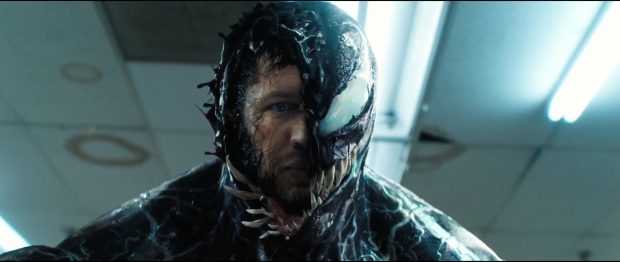
Venom utterly charms the pants off us, its bizarre knockabout body horror surprising us with a great sense of humour and unexpected variations on the idea of a dweeb made more masculine. From the trailer, Mike was worried about the broadness of Tom Hardy’s accent – actually, it’s tonally perfect as broadness is exactly what the film is going for in every respect, in the very best way.

Hardy is superb, giving his all to a role that demands physical dexterity and comic ability; the CGI bowls José over; the sense of Hardy’s body being shared by another physical entity, rather than being merged with it, is tactile and interesting. Mike’s also been watching the Sam Raimi Spider-Man trilogy recently, in which Venom appears, and holds court on a trend in the villains he sees Venom as adhering to. And the dog is so funny.

The podcast can be listened to in the players above or on iTunes.

With José Arroyo of First Impressions and Michael Glass of Writing About Film.

98 – A Simple Favor

“From the darker side of director Paul Feig”, as the ubiquitous advertising has it, and the film doesn’t disappoint. A Simple Favor pairs Anna Kendrick with Blake Lively as the least compatible friends you can imagine, friends with dark secrets and desires. We find Feig a complete master of tone, able to control the film’s descent into some very, very murky places without ever losing its ability to remain light and likeable. It’s a quite an achievement.

We discuss the way the film makes the female characters prominent and diminishes the role of men, eschewing the typical noir hero role for Kendrick’s Nancy Drew escapades, and the pleasure in seeing her character develop and assume control. The use of flashback is interesting and at some points quite brilliant, with important plot points being conveyed through subtle eyeline matches and just a few short shots recontextualising things we already know, or think we know. Mike finds the plot grows a little overcomplicated towards the end, and indeed predicted one or two developments – normally he prides himself on his gullibility – but these are nitpicks, at best, in a hugely entertaining film.

And it’s a film noir played for laughs! José can’t stress that enough.

The podcast can be listened to in the players above or on iTunes.

With José Arroyo of First Impressions and Michael Glass of Writing About Film.

95 – King of Thieves

A heist movie for the twinkly wrinklies, with a nostalgic and homophobic angle we disliked. Based on the true story of the 2015 Hatton Garden burglary, King of Thieves features an all-star British cast and one joke: they’re all old.

Mike is keen to give the film credit for its charm early on, as well as its sensitive depiction of the sense of loss felt by Michael Caine’s recent widower. But the film is uninspiringly shot, incompetently and unwisely edited – it’s absolute mayhem – and when it swaps its charm for aggression after the heist, it loses all interest. Ray Winstone comes in for particular criticism from José, and Mike explains why he found The Theory of Everything wanting.

The podcast can be listened to in the players above or on iTunes.

With José Arroyo of First Impressions and Michael Glass of Writing About Film.
92 – Crazy Rich Asians

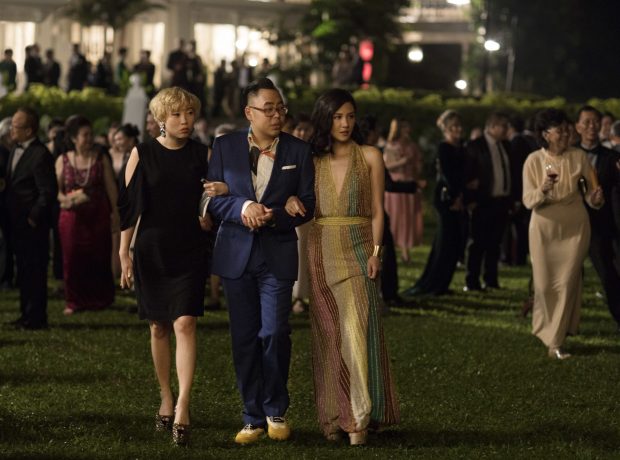
An utterly charming, friendly rom-com set in and amongst the very wealthiest of the Singaporean elite, Crazy Rich Asians is also full of odd tensions and problematic complexities. In one sense a highly specifically Chinese story of a second-generation American immigrant’s return to Asia and the conflict she experiences in negotiating her way into a world that finds her somewhat unwelcome; on the other a genre comedy that would feel no different were the characters all white. It’s a friction that bubbles under everything, but the film is so light and likeable that it never spoils anything.

We find Michelle Yeoh’s performance as the intimidating mother-in-law a delight, her character completely avoiding the one-dimensional dragon mom stereotype. On the other hand, there are stereotypes in which the film does indulge, though we disagree on how critical we should be of that. Thinking back to Searching, Mike feels that that film’s joy of seeing ethnicity have no bearing at all on anything is not replicated here, as the film’s insistence on themes of separation from one’s background and identity come into conflict with its desire to be no different from any generic white rom-com. Jose doesn’t find this an issue, instead sinking into the diasporic aura of the film. We discuss the film’s occasional TV movie feel, its use of music, its depiction of class through accents, and the way the opening sets up a much darker, more subversive film than we get.

And above all, it’s really, really funny.

The podcast can be listened to in the players above or on iTunes.

With José Arroyo of First Impressions and Michael Glass of Writing About Film.

87 – The Happytime Murders

Raunchy, vulgar, adult puppet comedy. You’d think it’d be right up our street. But The Happytime Murders is incompetent, embarrassing and infantile, with almost no comic instinct – the couple of moments that drew laughs from us did so primarily through sheer insistence and excess. Mike tries to reckon with what the difference is between the likes of this and something like Team America: World Police, which he likes but is superficially similar. José can’t comprehend how simply bad the filmmaking is. A conversation about Melissa McCarthy ensues, with differing opinions on her talent, but her box office appeal is not in question – at least until now.

The podcast can be listened to in the players above or on iTunes.

With José Arroyo of First Impressions and Michael Glass of Writing About Film.

84 – BlacKkKlansman

We breathlessly debate BlacKkKlansman, Spike Lee’s comic drama based on the true story of Ron Stallworth, a black police officer who infiltrated the Ku Klux Klan in the 1970s. With limited time – Mike has to leave for work at some point and he’ll only let himself be so late – we dig right in. Discussed is the film’s point of view on culture and particularly cinema, arguing that a single film can wield the power to affect an entire nation; John David Washington’s performance, the influences we can see in it, and whether a more charismatic star might have been beneficial; our attitudes to Lee’s pamphleteering and the pros and cons of propagandistic cinema; the film’s direct address of Trump’s America and its tragic, somewhat surprising ending; and more.

We question whether the film’s comic treatment of David Duke, head of the KKK, carefully undercuts our delight in mocking him or dangerously indulges it. Duke is rendered a figure of fun in some notable and hilarious scenes, but the film ensures we recognise that he has never gone away. And Mike is particularly affected by Adam Driver’s character, a Jew in name only who, through being threatened by the KKK and confronted by Ron, is forced to reckon with his identity and the fact that it’s been easy for him to ignore it for most of his life. (The Howard Jacobson article he references is linked here: https://www.theguardian.com/world/2018/apr/07/howard-jacobson-jews-know-what-antisemitism-is-and-what-it-isnt-to-invent-it-would-be-a-sacrilege)

As we acknowledge in the podcast, we unfortunately missed the first few minutes of the film, which is only one reason we want to see it again. Mike is bursting with thoughts and can’t get them all out; Jose vacillates on the film’s artistic value, though not its cultural value. There’s much, much more to consider in BlacKkKlansman than we were able to in this podcast and we shall return to it.

The podcast can be listened to in the players above or on iTunes.

With José Arroyo of First Impressions and Michael Glass of Writing About Film.