Tag Archives: World War II

439 – The Brutalist

Listen on the players above, Apple Podcasts, Audible, Spotify, or YouTube Music.

We visit BFI Southbank for a 70mm screening of The Brutalist, Brady Corbet’s epic period drama. It’s a super-sized film – 215 minutes, not including the intermission – and it deserves a super-sized podcast, for which we’re joined, as we occasionally are, by Mike’s brother, Stephen, who’s already seen the film once. It’s an extraordinarily complex, subtle and absorbing film that draws on countless themes and parts of history in telling its story of a Hungarian Holocaust survivor and architect who escapes to America and finds a wealthy client enamoured with him.

We dig in to the film’s themes with breathless enthusiasm, and talk sex, racism, the immigrant experience, long takes, rape, capitalism, doing things for effect, art, aspiration, jealousy, the value of 70mm, and much more. José describes The Brutalist as his film of the year; Mike ponders whether he likes it more than the Robbie Williams monkey movie.

With José Arroyo of First Impressions and Michael Glass of Writing About Film.
394 – Oppenheimer

Listen on the players above, Apple Podcasts, Audible, Google Podcasts, or Spotify.

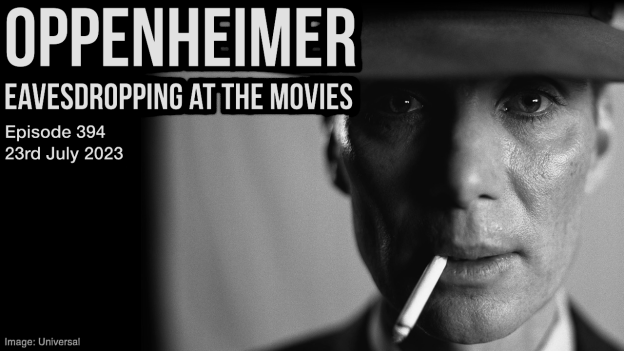
The second half of our Barbenheimer double bill takes us to the BFI IMAX in London to see Oppenheimer, the complex story of J. Robert Oppenheimer’s infamous role in the development of the atomic bomb during World War II, the creation and use of which changed history. Writer-director Christopher Nolan, as he has done increasingly over his career, makes extensive use of IMAX 70mm film to tell the story, but as well the spectacle and landscape we’re used to it showing off, here it’s devoted to the intimate.

We’re joined by Mike’s brother and previous guest Stephen to discuss the film, and consider the use of IMAX for close-ups and portraiture, as well as the story’s structure and how the editing and music create pace, the film’s implicit attitude towards Communism, whether Florence Pugh is treated unfairly, the way in which black-and-white footage is used to convey a shift in perspective, how the attacks on Hiroshima and Nagasaki are handled, the Stan Brakhage-esque imagery that conveys the radical sense that all matter is energy waiting to be unleashed, and much more. For José, it’s Nolan’s best film. It certainly deserves to be seen on an IMAX screen.

With José Arroyo of First Impressions and Michael Glass of Writing About Film.
301 – Come and See

Listen on the players above, Apple Podcasts, Google Podcasts, or Spotify.

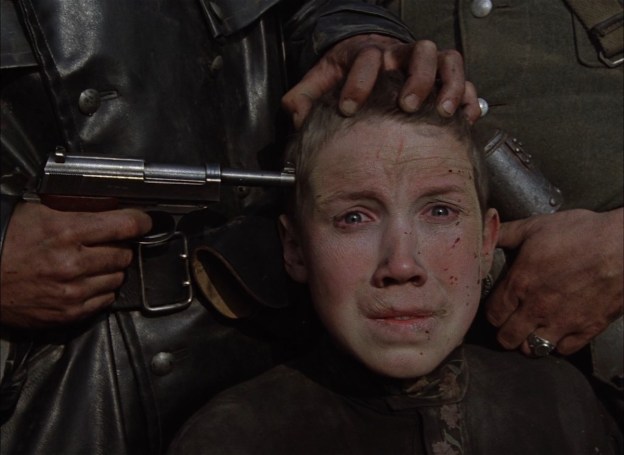
We explore Come and See, a 1985 Soviet film whose reputation precedes it – it’s regarded as one of the greatest war films of all time. In 1943 Belarus, a young teenager, Flyora, joins the resistance, but as he travels from village to village across Nazi-occupied Belarus, experiencing worsening horrors and atrocities brought upon the locals, the extent to which he is out of his depth gradually becomes clearer and clearer.

Part of Come and See‘s reputation is of being hard to watch, something we both take issue with – it goes to some deeply unpleasant places, but it’s a gradual descent rather than an onslaught. That the film is regarded as such a trial has likely caused some filmgoers to unnecessarily avoid an experience that they would value. While it depicts shocking imagery and events, it’s shot with an ethical eye – everything that’s shown has a purpose, and that which would be excessively prurient is often avoided.

We also consider the use of supernatural and fairytale aesthetics to place us in the mind of an innocent teenager, and the repeated portrait photography that shows the deepening scars the film’s events leave upon him. We also discuss the film’s view of Hitler and how it espouses a kind of great man theory in placing him as an icon at the centre of the Nazis’ crimes, and the explosion of audiovisual imagination that is the final scene.

Come and See is a beautifully made expression of the hideous costs of war on the innocent, and on our humanity. It’s imaginative, intelligent, moving and shocking, and, we might add, beautifully restored. If you’ve avoided it on the basis of its notoriety, we urge you to reconsider. It’s truly great.

With José Arroyo of First Impressions and Michael Glass of Writing About Film.
260 – The Garden of the Finzi-Continis

Listen on the players above, Apple Podcasts, Google Podcasts, or Spotify.

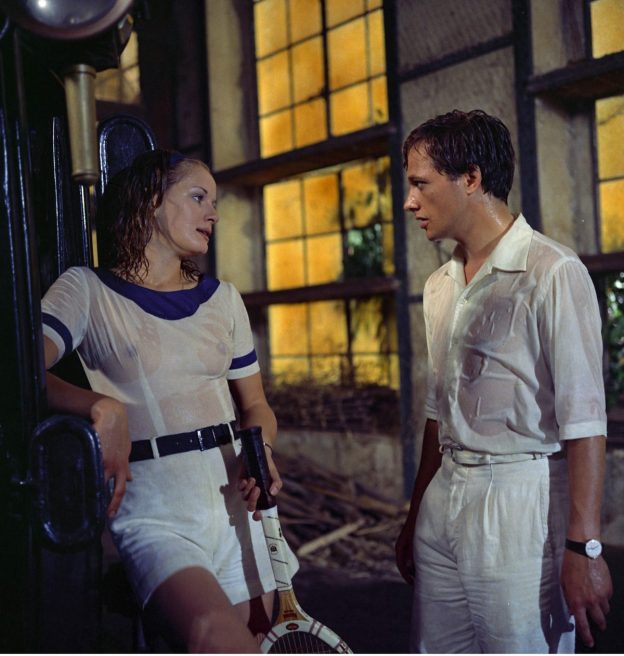
The winner of the 1971 Oscar for Best Foreign Language Film, Vittorio De Sica’s The Garden of the Finzi-Continis tells an aching story of doomed love within a wealthy Jewish community in Fascist Italy. The 1938 racial laws, enforcing the segregation of Italian Jews, have just been introduced, but the titular family’s titular garden offers insulation from the rising tide of fascism – for a while.

Mike finds the film’s love triangle somewhat banal, but is impressed with the subtly observed way in which the central characters allow themselves to remain comfortably ignorant of the increasingly hostile and dangerous Italy beyond their walls; comparisons to frogs in saucepans abound, not to mention the present-day normalisation of absurd corruption and violence in the Greatest Country in the World™. José is more keen on the romance, but still, the film’s sociopolitical side remains our focus. We consider the film’s use of physical space, the ways in which the Jewish characters can navigate it without being suspected by the racist public, but find themselves eager to retreat to safety as the film develops. We note that The Garden of the Finzi-Continis was made 25 years after the end of the Second World War, but 50 years prior to today: it’s now conspicuously an historical artefact that speaks to the time in which it was made, and whose proximity to the horrors it dramatises is necessary to keep in mind. And Mike reflects on his relationship with his Jewishness in this day and age, and how the film demonstrates that whatever divisions we may find among ourselves, to those who hate us, there’s no distinction.

It’s also Bonfire Night – well, the day after, but it’s a Friday evening so the festivities continue – and we celebrate by closing the window and trying to ignore the fireworks going off outside.

With José Arroyo of First Impressions and Michael Glass of Writing About Film.

223 – Army of Shadows

Listen on the players above, on Apple Podcasts, or on Spotify.

Jean-Pierre Melville draws upon his experiences in the French Resistance for 1969’s Army of Shadows, which depicts an ensemble including Lino Ventura, Simone Signoret and Paul Meurisse working to disrupt the Nazi occupation of France, rescuing Resistance members from captivity, operating safehouses… and killing informants.

Army of Shadows‘ view of the Resistance is far from romantic, showing the ordinary people who comprise it being driven to extreme measures in the cause of remaining hidden and evading capture, and the threat of capture and death hanging over them at all times. We compare it to The Great Escape, a caper in which prisoners of war work towards a big victory – there’s nothing of the sort in Army of Shadows, the Resistance only ever staying one step ahead of the Nazis pursuing them. Resistance itself is the victory, and it comes with costs.

We think about continuities between this film and Melville’s other work. The isolation felt in Un flic and Le Doulos comes through here, the Resistance members needing to work together but constantly suspicious of one another, as anyone could turn informant; emotional connection is a danger, as it can be used as a thumbscrew. But the film depicts the courage of the Resistance, the inhumanity of the situations into which they’re forced, and elicits a range of feelings simultaneously. It’s a complex, intelligent, essential film.

With José Arroyo of First Impressions and Michael Glass of Writing About Film.
106 – Casablanca

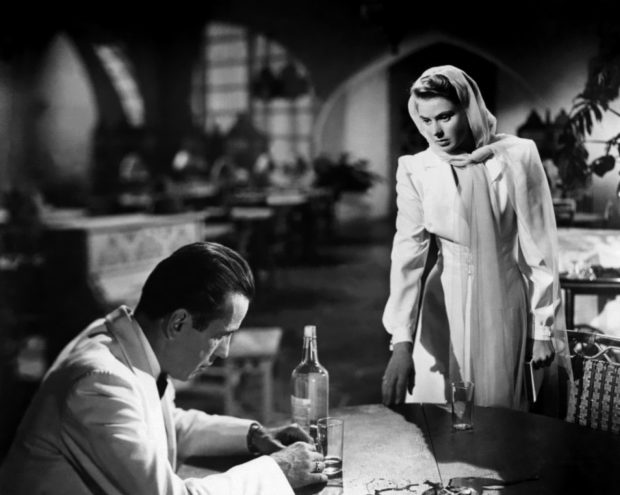
One of us has seen it countless times. The other has never seen it. Fortunately for José, Mike instantly falls in love with Casablanca.

In a way, the pressure was on for Mike to enjoy it, as it’s considered one of the greatest films of all time, and its screenplay in particular held up as a shining example of the craft. And how effortless it is to enjoy it! José notes how rare it is in cinema to see a man suffer for love, as Rick does, and the film’s romance is intense and unapologetic. We swoon over the elegance of Michael Curtiz’s direction, the sheer beauty of the cinematography – nobody these days is shot like Ingrid Bergman is here – and the rich cast of characters, played by one of the all-time great supporting casts.

José considers how the refugee situation and politics depicted – that of a war-torn world relocating regular people to geographic and bureaucratic purgatory – haven’t gone away, and Mike picks up on Madeleine Lebeau’s Yvonne, a minor character whose story recapitulates Rick’s in microcosm. The Marseillaise scene in particular gives us a lot to talk about. And so does much, much more.

It’s a good film. Who knew?

The podcast can be listened to in the players above or on iTunes.

With José Arroyo of First Impressions and Michael Glass of Writing About Film.

35 – Darkest Hour

A chamber piece about history which evokes a combination of Rembrandt and an old photograph. We discuss how Joe Wright might be getting short shrift as a director and the excellence of the performances: Gary Oldman, Kristin Scott Thomas, Ben Mendelsohn and Lily James are all marvellous. We discuss how the film is not the life of Churchill but a few defining weeks in his life, and how it depicts the political side of the chaos in Nolan’s Dunkirk.

Mike highlights how the cemeteries of Belgium and northern France tell a very different story from the official one in relation to Britain’s ‘going it alone’ in the two World Wars, and declares that one scene of clearly fabricated fantasy undermines any notion of historical verisimilitude. We discuss how the film’s emotional manipulations are cheap but how one finds oneself responding to the film’s jingoism. We are in agreement that Nigel Farage wants to be Oldman’s man-of-the-people Churchill – the entire film is rather Brexity.

José would really like to see a film that focuses on the relationship between Clemmie and Winston, played of course by Scott Thomas and Oldman, and there’s a wonderful volume of letters full of sketches of kitties and piggies called Speaking For Themselves that he wishes someone would draw on for a film. (He didn’t say that in the podcast but he wants to make it known here.)

The podcast can be listened to in the player above or at this link.

With José Arroyo of First Impressions and Michael Glass of Writing About Film.