Tag Archives: IMAX

478 – Spider-Man: Brand New Day

Listen on the players above, Apple Podcasts, Audible, Spotify, or YouTube Music.

We’ve tuned out of Marvel on the podcast for a little while, but one of the eternally entertaining superheroes, Spider-Man, reignites our interest with Brand New Day. With Doctor Strange having cast a spell at the end of 2021’s No Way Home to make the entire world forget Peter Parker, for reasons that Doctor Strange presumably cast another spell to make us forget, Peter, newly isolated, returns to fighting street-level crime in New York City while pining for his old relationships and suffering severe headaches. Can he revive his former life? Surely it wouldn’t be a Marvel film if an enormously significant, cliff-hanging event had permanent consequences.

Still, even for those as cynical as it’s possible to be about the MCU, Brand New Day has plenty to recommend it. It aims for thematic depth – though how fully that’s achieved is up for discussion – and is genuinely moving. Indeed, certain moments move the audience to cheer and applaud, which in turn moves Mike to harrumph bitterly. Destin Daniel Cretton, directing his second MCU entry following Shang-Chi and the Legend of the Ten Rings, demonstrates a gift for working with actors and a strong instinct for staging action, although Cineworld does its best to undermine those virtues with its poor projection.

We also return to our discussion of IMAX and The Odyssey, asking whether the frame’s envelopment of the visual field impedes filmmakers’ ability to express through composition and framing, and considering whether there’s something fundamentally anti-democratic about making films whose fullest form can only be experienced at a handful of cinemas around the world.

With José Arroyo of First Impressions and Michael Glass of Writing About Film.
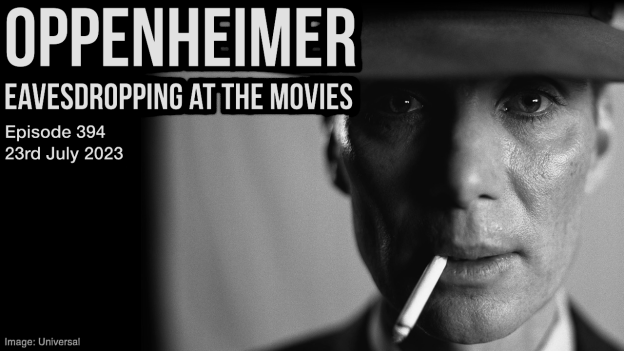
394 – Oppenheimer

Listen on the players above, Apple Podcasts, Audible, Google Podcasts, or Spotify.

The second half of our Barbenheimer double bill takes us to the BFI IMAX in London to see Oppenheimer, the complex story of J. Robert Oppenheimer’s infamous role in the development of the atomic bomb during World War II, the creation and use of which changed history. Writer-director Christopher Nolan, as he has done increasingly over his career, makes extensive use of IMAX 70mm film to tell the story, but as well the spectacle and landscape we’re used to it showing off, here it’s devoted to the intimate.

We’re joined by Mike’s brother and previous guest Stephen to discuss the film, and consider the use of IMAX for close-ups and portraiture, as well as the story’s structure and how the editing and music create pace, the film’s implicit attitude towards Communism, whether Florence Pugh is treated unfairly, the way in which black-and-white footage is used to convey a shift in perspective, how the attacks on Hiroshima and Nagasaki are handled, the Stan Brakhage-esque imagery that conveys the radical sense that all matter is energy waiting to be unleashed, and much more. For José, it’s Nolan’s best film. It certainly deserves to be seen on an IMAX screen.

With José Arroyo of First Impressions and Michael Glass of Writing About Film.

384 – Avatar: The Way of Water – Second Screening

Listen on the players above, Apple Podcasts, Audible, Google Podcasts, or Spotify.

Listen to our previous podcast on Avatar: The Way of Water here.

We take a trip to London to see Avatar: The Way of Water again, this time on the biggest screen in the country at the BFI IMAX, in high frame rate and 3D. We discuss the difference in experience between seeing it here and at the IMAX Digital cinema at Cineworld Broad Street, where we saw it previously. Mike questions why the film switches between 24fps and 48fps, rather than sticking with the high frame rate throughout – director James Cameron describes how HFR assists in making 3D imagery less difficult to resolve, and implies that he limits its use to avoid the so-called “soap opera effect” that made the Hobbit films and Gemini Man look so cheap, but Mike doesn’t buy that it’s necessary to keep returning to 24fps, and thinks Cameron’s a big scaredy-cat. José, on the other hand, can’t seem to tell the difference between the frame rates at all.

We also discuss what a second viewing of the film brings into focus that we hadn’t put our finger on before, Mike comparing it to the nature documentaries that IMAX have produced for years, and José implores the film community to drop its snootiness and embrace the opportunity to see such a marvellous spectacle while it’s still in cinemas. It’s really special.

The James Cameron interview we refer to in the podcast is available here.

With José Arroyo of First Impressions and Michael Glass of Writing About Film.