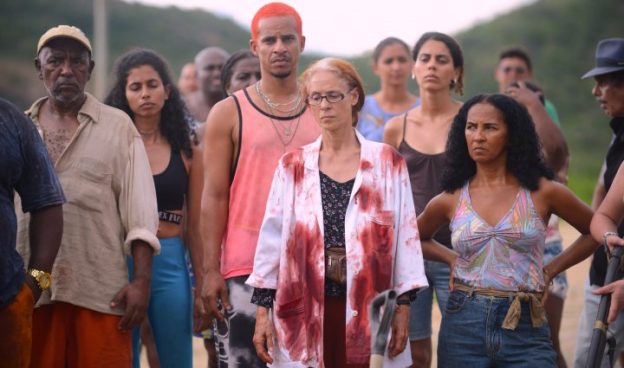
A political parable, satire, thriller, high-concept actioner, horror, and Western all at once, 2019 Cannes Jury Prize winner Bacurau is a wild experience and well worth your time. Set in a tiny, remote village in a near-future Brazil, we’re given a portrait of life within an open, tolerant community under the thumb of a distant but powerful mayor, and shortly after the funeral of one of the town’s elders, things start going awry.
To say more would be to spoil the surprises, and we encourage you to check the film out knowing as little as possible. As a fable, it’s a potent piece of work – themes of political abuses, the ownership and withholding of water conferring power, and the value of community and the knowledge of history are all made manifest as Bacurau straddles its genres and provides its thrills. It’s a film that’s as open to interpretation as it is clear about what it thinks – its clunkiness in this respect a positive for Mike while occasionally a little overegged for José. But quibbles here and there pale in significance to Bacurau‘s boldness and intelligence, and you should see it.
We may be living under lockdown conditions, but no virus can stop us, and to prove it we’re taking on Steven Soderbergh’s 2011 thriller Contagion, about a virus that rips through every country on Earth, the scientific work to stop it, and the social decay that it leaves in its wake. Suggested as a podcast by an irony-seeking Mike, it backfires as it actually just frightens him.
At least, for a while. We think about the film in the context of the COVID-19 pandemic currently upon us, of course, praising what we recognise in the film’s imagined crisis, remarking upon the differences. Much of what it depicts feels very true to life, and it strongly evokes panic and a sense of uncertainty; on the other hand, the difference less than a decade makes is thrown into sharp relief with the film’s essentially competent and well-intentioned government response to the disease, a far cry from the lies and bluster being spouted by certain American presidents today – something that would have been not only unimaginable but laughable at the time of the film’s release. José notes that a high proportion of the public worry in our current outbreak comes down to its economic effects, which again, Contagion does not imagine as even a minor point.
It’s a well-made film, tightly plotted and paced, juggling several plots and sets of characters, understanding keenly how and when to jump between them, and its staging, editing and cinematography bring to life the paranoia of living in a society in which any surface innocently touched by any stranger’s hand could spread a deadly disease, and the fear and confusion engendered by a lack of trust in the government and loud countervailing voices. Contagion uses its characters and scenes as representative of ideas as much as, or more than, things in and of themselves, which Mike argues leaves it emotionally distant and overly simplistic – though there’s plenty of room for debate, particularly over Matt Damon’s performance.
All in all, Contagion is an impressive piece of thriller fiction whose successes and failures are both given oxygen in the light of very recent developments. If you watch it, be prepared to be made even more paranoid than you currently are… because the world we’re living in now is even more insane.
A legal drama about the biggest corruption scandal you’ve never heard of, Dark Waters tells the story of lawyer Robert Bilott’s twenty year long fight to expose chemical manufacturer DuPont’s decades of knowing and unapologetic poisoning of a town, a country, and the entire world. Visited by a West Virginian farmer named Wilbur Tennant, whose livestock are falling prey to unusual medical conditions and dying, Bilott – a corporate lawyer who works to help chemical companies pollute within the law – files a lawsuit, and slowly begins to uncover the company’s secrets.
For José, it’s a film that fits neatly amongst director Todd Haynes’ previous work, which often focuses on power relations and the struggles of the oppressed, sidelined or disenfranchised. For Mike, it might be a new Spotlight, another film about the exposure of vast, historical, institutional wrongdoing. But don’t believe the trailer that makes it look all blood and thunder – Dark Waters, though compelling and dramatic, is a slow burner, methodical and careful, and with a scope that looks beyond the details of the law. The town of Parkersburg, WV is shown in portrait, with shots evocative of Depression-era photography, and Bilott is an interesting character, a man who appears uncomfortable within his own body, whose determination to uncover the truth grows alongside his paranoia that something bad will happen to him, and whose relationship with his wife is a constant that is reframed intriguingly in the film’s final movement.
Dark Waters is a fascinating, intelligent, complex thriller that gives its themes room to express themselves and is full of details and moments that speak to entire inner lives and ways of thinking. Make sure you see it.
(Mike would also like to apologise to Bucky Bailey, one of DuPont’s most unfortunate victims and perhaps the film’s central emotional tentpole, for referring to him as Bucky Barnes, who is the guy from the Avengers films who sports a prosthetic arm and does nothing interesting.)
It’s one of José’s films of the year; it leaves Mike cold. Bong Joon-ho’s Parasite depicts social inequality in South Korea through a lower-class family that cons its way into working for an upper-class family. We pick our way through the film’s structure; its motif of staircases that delineate status and power relations; the way poverty carries with it an inescapable smell, intolerable to the upper class; the two families’ experiences of nature and the desire for sunshine.
It builds on some aspects of horror, but cannot at all be considered one, either in genre or affect – though the fact that its trailers sold it as such might have something to do with Mike’s frosty response. It’s an allegorical thriller, every character standing in place of a class or group of people, and its construction is intelligent, thoughtful and tight. For José, it works on a visceral level, the mood and tone emphasising and combining with the structure and metaphor; for Mike, it’s a flat experience, a clever essay with definite interpretations and little feeling.
But it’s clearly touched a nerve, connecting with worldwide audiences. It speaks not just to conditions in South Korea but a global system of oppression and inequality under capitalism. We may not agree on what it makes us feel, but it’s potent food for thought and offers much to discuss. Don’t miss it.
Also in this episode, we take a look at the upcoming Oscars, which eager cinephiles will be able to watch yesterday.
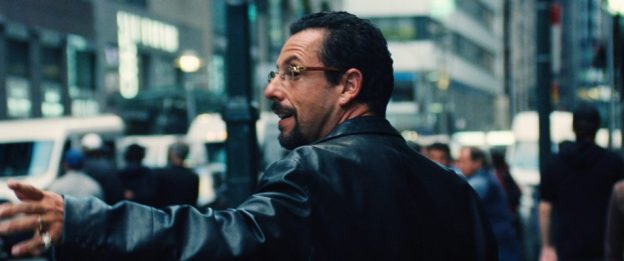
Independent filmmakers Josh and Benny Safdie team up with Adam Sandler for Uncut Gems, an energetic, evolving crime thriller set in Manhattan’s Diamond District. By the time we meet Sandler’s Jewish jeweller, Howard, he’s already embedded within a web of competing interests, desires and debts, as well as a gambling addiction – and the tension only mounts as problems grow worse.
The Safdie brothers and Sandler are all Jewish New York natives, the writer-directors in particular growing up, in part, around the Diamond District, where their father worked. There’s a specificity to the location and culture that the film captures beautifully, a richness to Howard’s characterisation, and the world he inhabits, that feels authentically observed. Howard’s need to take risks never allows the tension to settle – he can’t help but invite further trouble upon himself, so neither does the film let us calm down for a second.
Uncut Gems is a complex, character-oriented, engrossing work of edge-of-your-seat genre entertainment, and a terrific follow-up to the Safdies’ 2017 thriller Good Time, which we discuss a little bit (but not too much because José hasn’t finished it yet). Both Good Time and Uncut Gems are available on Netflix, and well worth your time. The Safdie brothers might not just be good – they might be greats.
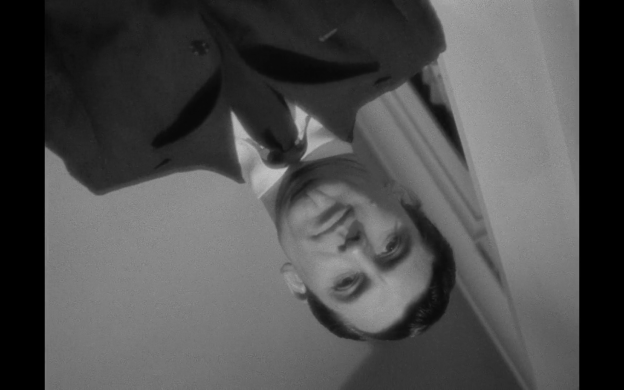
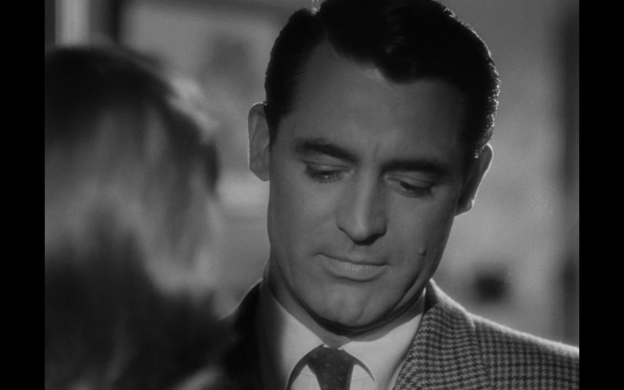
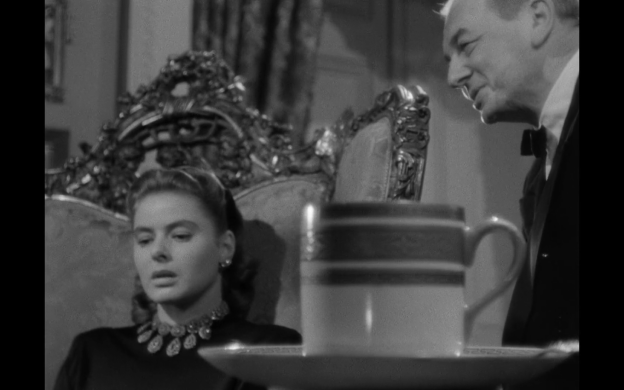
Considered by some to be his best film, Alfred Hitchcock’s Notorious comes to the MAC in a beautiful 4k restoration. We explore its sumptuous close-ups, complex characterisation and smart, effective editing, which elicited big responses from the audience, and José tells us about Ben Hecht, the film’s screenwriter.
The podcast can be listened to in the players above or on iTunes.
Cold Weather is a mumblecore crime thriller, if it is indeed possible to conceive of such a thing, which it must be, because Cold Weather is one. Gentle, leisurely, and with a close focus on character relationships and foibles, it’s a pleasant and surprisingly engrossing film, more evidence of the reliability of MUBI’s curation. Never has a brother-sister amateur detective duo been so laid back.
José has issues with the ending, Mike has an issue with the crime story, but neither takes issue with the film’s strength: its characters’ relationships. Whether between adversarial brother and sister, amicable exes, or newly bonding buddies, these are smartly observed and efficiently rendered, and the film relishes moments such as a familial debate over who gets to drive, and a detour in which a character hopes that taking up pipe smoking will allow him to think like Sherlock Holmes. With the exception of some self-consciously ‘art filmy’ shot choices, the film is well directed by Aaron Katz, who maintains a precise and agreeably unhurried tone throughout, and earns characterful performances from his cast. José also remarks upon the cinematography, some later scenes shot during dusk capturing Portland’s natural light and industrial landscape beautifully.
It’s the least interesting of the three films we’ve recently explored on MUBI (the other two being O Fantasma and Border), but this low-key indie is lovely to spend time with, and worth a glance.
The podcast can be listened to in the players above or on iTunes.
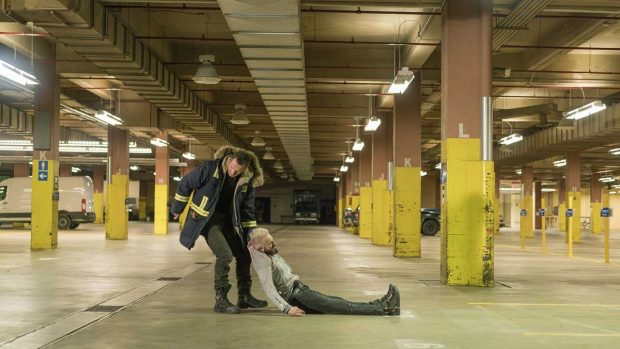
Remaking his own film, Hans Petter Moland brings us a revenge thriller, starring – who else? – Liam Neeson as a model citizen turned remorseless killer on the trail of those responsible for his son’s murder. Sounds like typical Neeson fare, but Cold Pursuit leaps between dramatic and blackly comic tones with verve, and offers something much more interesting and original than you’re likely to expect.
We find lots to like in it, including its magnificent lighting and compositions, interesting and welcome inclusion of a group of Native American characters, as well as a commentary on their relationship to the very whitest America there is (the film being set in a Colorado ski town), and some surprisingly tender moments between adults and children, and people in love.
We highly recommend it, it’s a huge amount of fun!
The podcast can be listened to in the players above or on iTunes.
In response to José’s excursion into the world of Michael Curtiz a few months ago, Mike has picked four films of his own to discuss, the first being writer-director Dennis Gansel’s 2008 high school drama Die Welle (The Wave). Based on the true story of a 1967 social experiment, Die Welle follows one week in a high school in which, as an exercise intended to teach his pupils about the methods and dangers of fascism, a teacher creates a fascist movement, named The Wave, that rapidly spirals out of control.
Die Welle is first and foremost remarkable for convincingly depicting the seductive aspects of fascist movements, such as the shared symbols that engender group unity and, indeed, simply the positivity of being a member of a like-minded group. Mike compares it to Starship Troopers, claiming that it doesn’t just argue its case but actually makes it work on its audience – rather than seeing why The Wave is appealing to the kids, you feel it too. José discusses what sets it apart from your typical high school movie and how an even greater focus on the kids, rather than the teacher, might have strengthened it.
The classroom scenes allow the film to develop its arguments about fascism through ersatz Socratic dialogues, the teacher’s seminar-style classes allowing pupils to make competing points in quick succession, clashing with each other as they do so. But Mike points out that perhaps all is not what it seems: one student, for instance, goes unchallenged when she claims that high unemployment and social injustice are social conditions that favour dictatorship, but the world in which these children live bears few markers of such sociopolitical problems, yet they enthusiastically join and build their movement. Indeed, one motivation behind the experiment is the students’ belief that Germany, having already experienced a fascist dictatorship, is immune from another. Perhaps, the film suggests, we aren’t quite as clever and protected as we’d like to congratulate ourselves on being.
Aside from the film’s central thesis, there are minor details in its world that pique our interest, José noticing the students’ access to and expertise in the use of image editing and web design software; Mike picking up on the educated, liberated attitude to sex the characters display (it’s hard to imagine an American high school movie treating sex with similar freedom and confidence). We remark upon how believable the characters are (with perhaps one exception) in their interactions and responses to the nascent movement.
Neither of us can claim that it’s a perfect film – there’s little in it that is visually expressive, and its mechanisms are too openly displayed, with some characters too clearly intended to represent ideas and serve plot functions. But Die Welle is an enormously engaging, intelligent, and rather bold exploration of the mechanisms and appeal of fascism that enthusiastically uses cinematic affect to convey its message that we may all be more susceptible to its dangers than we think.
The podcast can be listened to in the players above or on iTunes.
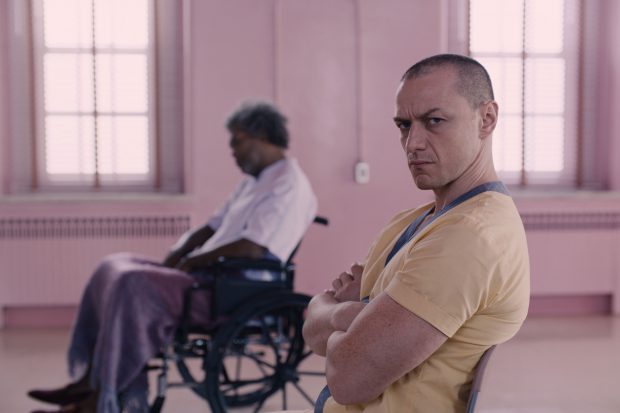
Concluding a trilogy two decades in the making, Glass brings together the characters of 2000’s Unbreakable and 2016’s Split in an unconventional superhero showdown. We both enjoyed it, though it’s a bit of a trifle, but it’s enjoyably oddball and features a particularly brilliant performance from James McAvoy. And we appreciate M. Night Shyamalan’s direction, staging and camerawork, which, while occasionally a little stilted and ‘filmmakery’, for want of a better word, is thoughtful and always strives to create interesting and meaningful imagery.
The film feels significantly affected by the Marvel Cinematic Universe’s influence on comic book movies and their public acceptance; there are things that Glass does, ways it behaves, that are difficult to imagine having made as much sense prior to that series. Indeed, this trilogy is a universe of sorts, with characters from different films being brought together in a shared world.
The podcast can be listened to in the players above or on iTunes.











 Eavesdropping at the Movies