Tag Archives: thriller

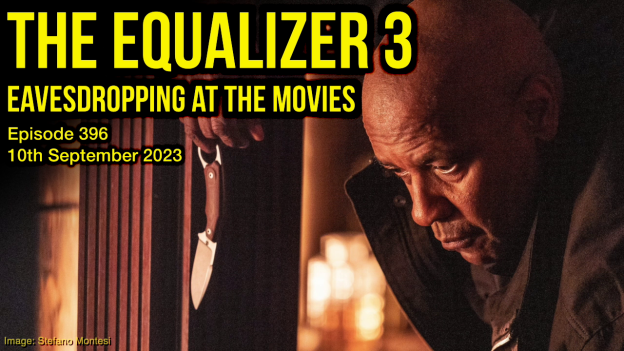
396 – The Equalizer 3

Listen on the players above, Apple Podcasts, Audible, Google Podcasts, or Spotify.

Listen to our podcast on The Equalizer 2 here.

Denzel Washington returns for the third and final instalment of the Equalizer trilogy, in which former government assassin Robert McCall devotes his time and skills to avenging for the little guy. This time, he finds himself in Mediterranean Europe, embroiled in a fight to protect a coastal town from terrorisation by the Camorra, the Mafia of southern Italy.

The Equalizer 3 shares the contemplative tone and pervasive sense of loss of its predecessors. Here, there’s a focus on physical infirmity and vulnerability, a gunshot McCall receives early on forcing a long recuperation, slow, careful approaches to walking down stairs, and the use of a cane. Action erupts quickly and violently, emphasised by director Antoine Fuqua’s camera and editing – McCall is wounded, but maintains his ruthlessness and murderous efficiency.

We compare the action and Washington to Rambo: Last Blood and its star, Sylvester Stallone, which took a similarly staccato approach to its action, clearly informed by Stallone’s age and inability to move as gracefully as he used to – this film is doing something similar, but less thuggishly, if no less violently. We question the ease with which moral decisions are made in this world, in which right and wrong are easily distinguished and the involvement of a vigilante is sold as an obvious necessity and benefit; the film’s look, which fails to show off its spectacular location; and some of its writing and contrivances, particularly concerning Dakota Fanning’s character, a CIA analyst contacted by Robert, and the Camorra. And we discuss McCall as a neurodivergent superhero.

The Equalizer 3 is a flawed film with a fair bit of dumbness to overlook, but it is easy to do so when the portrait it paints of local life and close community is so absorbing and inviting, and its star has such presence, warmth, and intelligence. It’s an easy film to recommend, bearing in mind that it’s a work of vigilante fantasy. After all, if Batman’s allowed to take the law into his own hands when the institutions around him fail, why shouldn’t Denzel be? At least he doesn’t pretend not to kill people.

With José Arroyo of First Impressions and Michael Glass of Writing About Film.

390 – Knock at the Cabin

Listen on the players above, Apple Podcasts, Audible, Google Podcasts, or Spotify.

Like his previous film, Old, M. Night Shyamalan’s Knock at the Cabin is an intriguing, self-contained, efficient thriller – although not nearly as satisfying as it could be. The setup: A family staying at that classic American horror location, the cabin in the woods, is taken hostage by four invaders who’ve had visions of the apocalypse.

To say more would rob the film of some of its surprise, and its ability to keep you questioning what will happen is one of its pleasures – so think twice about listening to the podcast before you see it, because we spoil everything! There’s a lot to like, including its portrayal of a same-sex couple so unremarkable that the characters’ sexuality barely needs addressing (although more affection shown between them would have been welcome) and Dave Bautista’s calm but imposing presence as the leader of the intruders. But it’s so keen to have its sceptical protagonists arguing with what their opponents tell them that it doesn’t explore the dramatic and moral questions it has the opportunity to, and it’s too eager to be tasteful. When even José’s asking for gruesomeness you know you’ve shown too much restraint.

Knock at the Cabin is an interesting and engaging film but rather thin and could do with showing more bravery and style. Worth a look, though.

With José Arroyo of First Impressions and Michael Glass of Writing About Film.
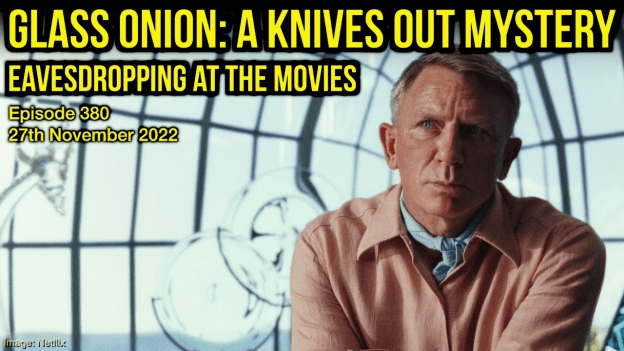
380 – Glass Onion: A Knives Out Mystery

Listen on the players above, Apple Podcasts, Audible, Google Podcasts, or Spotify.

There’s an unwelcome element of particularly American and ill-fitting barbarism in Glass Onion: A Knives Out Mystery, a film that we hoped would be cleverer and more charming than it is. It’s also more of a straightforward thriller than a whodunnit, with one particular alteration to the murder mystery formula meaning that so much is kept from the audience that it stops being fun to play along. There’s still enough here to enjoy, but we’d like the third film to be more like the first, please.

With José Arroyo of First Impressions and Michael Glass of Writing About Film.

379 – The Old Dark House

Listen on the players above, Apple Podcasts, Audible, Google Podcasts, or Spotify.

If you’re tempted to explore this cult classic, the restored DVD and Blu-Ray of The Old Dark House is available as part of Eureka Entertainment’s Masters of Cinema series.

José gave an introduction to the MAC’s screening of The Old Dark House, a 1932 comedy horror directed by James Whale, focusing on queerness. James Whale was openly gay – although what it meant to be openly gay in the 1930s is up for discussion – and knowledge of his sexuality has led to interpretations of his work in that light, including Frankenstein (1931) and The Invisible Man (1933). The Old Dark House arguably invites such readings more explicitly than those, with the demeanour of Ernest Thesiger as Horace Femm (not to mention his surname), the relationship between Morgan (Boris Karloff) and Saul (Brember Wills), and the casting of a woman in the role of patriarch, with actress Elspeth Dudgeon credited as John Dudgeon.

As well as its queerness, we discuss its preponderance of tropes and how well they cohere, its use of distorted imagery, its pacing and more.

With José Arroyo of First Impressions and Michael Glass of Writing About Film.
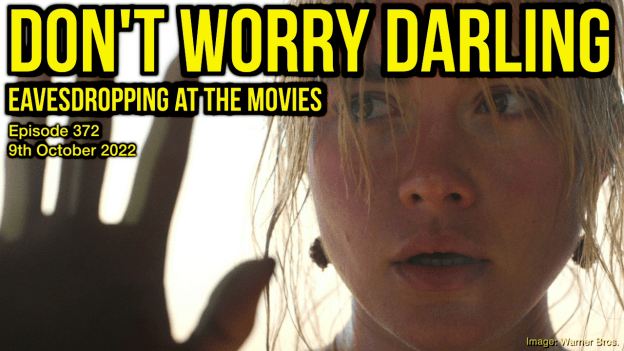
372 – Don’t Worry Darling

Listen on the players above, Apple Podcasts, Audible, Google Podcasts, or Spotify.

Don’t Worry Darling, Olivia Wilde’s second feature as director, after Booksmart, which we loved, is an irredeemable mess of a psychological thriller. We pick through its carcass in an attempt to figure out which bit of it we liked the least.

With José Arroyo of First Impressions and Michael Glass of Writing About Film.

371 – Beast

Listen on the players above, Apple Podcasts, Audible, Google Podcasts, or Spotify.

The absence of presence that is Idris Elba, who we’d like to like one day, stars in Beast, a Jurassic Park knock-off that pitches him against both his distant daughter and an excessively affectionate lion. It’s a film that Mike enjoyed unironically but can’t claim to find much quality in; José, showing off, provides a coherent response, seeing the film’s weaknesses and having no fun.

It’s a mechanical film in more ways than one. The character relationships crash inelegantly into place, the action hasn’t met an idea from a better film that it didn’t try to copy – and the seats share the load, tilting and rumbling along with the images. For reasons beyond our understanding, our local Cineworld offered Beast only in 4DX, the theme park-style augmented exhibition format that purports to enhance the cinematic experience through practical effects such as moving seats, wind, and strobe lighting. It’s a technology that José despises to its core, arguing that it betrays a lack of trust in the film’s own ability to excite its audience, while Mike, who is in his thirties, likes filling himself up with fizzy liquid and sugar and being shaken around all afternoon.

Still, no amount of physical animation can either distract from or add to the vacuum of cinematic substance that is Idris Elba, Beast‘s central problem and central lack. It makes for a film you won’t regret ignoring.

With José Arroyo of First Impressions and Michael Glass of Writing About Film.

368 – Psycho (1960)

Listen on the players above, Apple Podcasts, Audible, Google Podcasts, or Spotify.

We visit the MAC for a screening of the new 4k restoration of Psycho, one of the most analysed films of all time, and arguably director Alfred Hitchcock’s most famous. It’s a film we’ve both seen several times, but not for a few years, and in the cinema setting for which it’s meant, instead of the classroom, there’s a renewed and reinvigorated wonder to its imagery and editing.

We share our feelings about this screening, remark upon things we’d forgotten or had never noticed before, discuss how elements of the film have aged, and compare it to Brian de Palma’s Dressed to Kill, which was, shall we say, inspired by Psycho, and which we recently saw. We find plenty of room for criticism, but although we conclude that Psycho works for us more as a collection of a few iconic scenes than a thoroughly engrossing story from beginning to end, those scenes shine, and nowhere more vividly than on a cinema screen.

With José Arroyo of First Impressions and Michael Glass of Writing About Film.

362 – Dressed to Kill

Listen on the players above, Apple Podcasts, Audible, Google Podcasts, or Spotify.

Problematic and protested against upon its release in 1980, and remaining so today, Dressed to Kill is nonetheless stylish and engrossing, showing off some truly great filmmaking. We talk Psycho and cinema’s transgender villains, why Nancy Allen should have been a star, Brian De Palma’s greatest deaths, and the version of Michael Caine that José doesn’t like.

With José Arroyo of First Impressions and Michael Glass of Writing About Film.

341 – Nightmare Alley (1947)

Listen on the players above, Apple Podcasts, Audible, Google Podcasts, or Spotify.

Listen to our discussion of 2021’s Nightmare Alley here.

We explore 1947’s Nightmare Alley, directed by Edmund Goulding, and compare it to Guillermo del Toro’s new adaptation of the material, which we find superior in almost every way. Mike in particular finds, in the reflection of Goulding’s version, useful ways to appreciate del Toro’s, which at first blush he found uninspiring. We discuss the portrayal and use of the geek, the differences in the introduction of the protagonist (played by Tyrone Power and Bradley Cooper in the old and new films respectively), del Toro’s greater focus on mood and scene setting, and how thoroughly Goulding’s film adheres to the noir genre. And we express our joy at seeing del Toro’s version at the grand reopening of the Electric, the UK’s oldest working cinema, which we completely forgot to do in the last podcast.

With José Arroyo of First Impressions and Michael Glass of Writing About Film.

340 – Nightmare Alley (2021)

Listen on the players above, Apple Podcasts, Audible, Google Podcasts, or Spotify.

Listen to our discussion of 1947’s Nightmare Alley here.

We talk swoony visuals, alcoholism, a femme fatale pastiche, moral descent, Bradley Cooper’s sexual presence and more in our discussion of Nightmare Alley, Guillermo del Toro’s adaptation of William Lindsay Gresham’s 1946 novel of the same name.

With José Arroyo of First Impressions and Michael Glass of Writing About Film.