Tag Archives: thriller

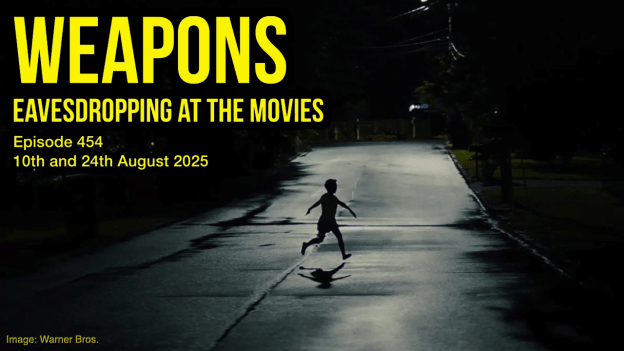
454 – Weapons

Listen on the players above, Apple Podcasts, Audible, Spotify, or YouTube Music.

One of the most hotly-anticipated horror films in recent memory, Weapons begins with seventeen third-grade children in a Pennsylvania town mysteriously waking up at 2:17am one Wednesday and running from their homes into the darkness. The shocking, unexplained disappearance and imagery of an empty classroom alone suggest an allegory of school shootings, and we ask what else can be read into the film, and discuss the depth with which it handles its themes. We have our issues with Weapons but enjoy it very much all the same, and find a lot to like. It’s probably just a little overpraised.

Two weeks later, with the film still on his mind, Mike opens up further discussion and proposes that maybe there’s more to it than he gave it credit for – or that you have to be American to properly get it.

With José Arroyo of First Impressions and Michael Glass of Writing About Film.

453 – The Shrouds

Listen on the players above, Apple Podcasts, Audible, Spotify, or YouTube Music.

A psychosexual thriller that’s neither psychosexual nor thrilling enough, The Shrouds is a disappointment. There’s great promise to businessman Vincent Cassel’s invention of a technologically advanced shroud that creates a 3D model of the decaying body it houses, when we’re shown the lust with which he observes his deceased wife’s corpse. The film is peppered with recurrent imagery of her disfigured body, and its importance to Cassel’s character is constantly reinforced, but the film is too talky, its imagery too bland, and its plot too convoluted to make the most of it. A shame.

With José Arroyo of First Impressions and Michael Glass of Writing About Film.
437 – Babygirl

Listen on the players above, Apple Podcasts, Audible, Spotify, or YouTube Music.

Nicole Kidman gives a compelling, vulnerable performance in Babygirl, as a woman for whom sexual satisfaction requires her to relinquish the power she otherwise projects throughout her life, and who begins an affair with a much younger man she finds herself unable to resist. Unfortunately, that’s the only significant thing to recommend about the film, which we find superficial, badly thought out, and most crucially of all for Mike, nowhere near steamy enough. It’s good fun to discuss, though, and gives us opportunity to reminisce about sneaking into films we weren’t allowed to see when we were kids. Stick around to learn José’s Looney Tunes technique for fooling the ticket guy.

With José Arroyo of First Impressions and Michael Glass of Writing About Film.

434 – Conclave

Listen on the players above, Apple Podcasts, Audible, Spotify, or YouTube Music.

You wait for ages for a film about a group of people sequestered in a room, questioning each other, keeping secrets, and repeatedly voting, and two come along at once. But while Juror #2‘s protagonist wrestled with his conscience, Conclave‘s Cardinal Lawrence, played by Ralph Fiennes, has little trouble consistently acting out of principle – sadly, many of his colleagues vying for the Catholic Church’s vacant papacy don’t share his clarity.

Conclave is a marvellously entertaining mystery and thriller, a chamber play in which Fiennes’ performance is a complex and deeply felt standout amongst a number of engaging, if less rich, star turns from Stanley Tucci, John Lithgow and Isabella Rossellini. We discuss whether the film is an advert for the Church, how it engages with religion, the striking visual design, liberalism vs. conservatism, representations of gender and nationality… and that magnificent twist. Spoilers within!

With José Arroyo of First Impressions and Michael Glass of Writing About Film.

433 – Juror #2

Listen on the players above, Apple Podcasts, Audible, Spotify, or YouTube Music.

A film whose brilliant conceit is so simple and compelling we can’t believe we’ve never seen it before, Juror #2 tells the story of a juror whose responsibility it is to assess the guilt of a defendant who he knows is innocent of murder – because it was the juror who did it.

Summoned to serve on a jury and quickly recognising the details of the case, Nicholas Hoult’s Justin realises that the deer he hit with his car one dark, stormy night was in fact the defendant’s girlfriend, for whose supposed murder he is on trial. So begins a morality play of sorts, Justin wanting to do the right thing and keep an innocent person from prison, but unwilling to expose himself as the real, if accidental, killer.

It’s a film that sets two institutions, the family and the court, at war. Justin’s wife has a baby on the way, and is there any wrong that can’t be justified by the protection of the family? We discuss this in the particular light of director Clint Eastwood’s reputation as a lifelong conservative, Mike suggesting that the distrust the film shows towards the legal system, a government institution, has precedent in Eastwood’s other work, but its critique of the sanctity of the family is surprising and invigorating.

Juror #2 is a thoroughly engrossing exploration of a terrific idea, and you’ll take its questions home with you long after it ends. What would you do? Are you sure?
With José Arroyo of First Impressions and Michael Glass of Writing About Film.

424 – Trap

Listen on the players above, Apple Podcasts, Audible, Spotify, or YouTube Music.

After a long time off, we return with M. Night Shyalaman’s new thriller, Trap, in which Josh Hartnett’s doting dad, Cooper, takes his daughter to see her favourite pop star at a massive arena gig, but finds himself surrounded and hunted by the FBI.

We discuss the ways in which Shyamalan gives Cooper opportunities for escape but closes them off; the unusually disappointing lack of imagination and expression in some of the visual design and shot selection (something we’re used to finding so interesting from Shyamalan); the attempt to sell a psychological background to Cooper, which is somehow neither intelligent nor daft enough; the production of the music and Saleka Night Shyamalan’s performance as Lady Raven; Mike’s fickleness in choosing whom to root for; and José’s joy at seeing Hayley Mills. But despite picking at flaw after flaw, as we always do, we had a great time in Trap, and recommend it.

With José Arroyo of First Impressions and Michael Glass of Writing About Film.

412 – The Goldfinger

Listen on the players above, Apple Podcasts, Audible, Google Podcasts, or Spotify.

In 2002, Tony Leung and Andy Lau starred in the Hong Kong classic Infernal Affairs, which Martin Scorsese remade in the US as The Departed; twenty years on, the inspiration flows in the opposite direction, Scorsese’s The Wolf of Wall Street a clear reference point for this fictionalised tale of real-life stock market manipulation, deeply embedded corruption, and the growth of a multi-billion-dollar company from meagre beginnings on the back of scams, confidence, and lies, with Leung starring as the charming, oleaginous company founder, and Lau as the anti-corruption official on his tail. We had terrific fun in The Goldfinger.

Which isn’t to say it’s a perfect film. We have our issues. The imagery could be more expressive – though director Felix Chong (another Infernal Affairs alumnus: he wrote the trilogy) clearly has an eye for visual impact, and there’s lots to be impressed by. We’d like to know why Lau’s corruption investigator believes that chasing Leung’s CEO is worth the disruption and danger to his family, beyond simply justice. We’d like any similar insight into what drives Leung, beyond simply greed. And if it is simply justice and greed, we’d like it to be better sold, bigger and brasher. We’d like the clash between the two to be more explosive. And the rather pat ending induces eye-rolling. But never mind all that. The Goldfinger is an entertaining and exciting tale of the rise and fall of a business empire that lived and died based on the fundamental corruption of the system and interests that built and supported it.

With José Arroyo of First Impressions and Michael Glass of Writing About Film.

404 – The Killer

Listen on the players above, Apple Podcasts, Audible, Google Podcasts, or Spotify.

David Fincher’s precise, controlled direction is a perfect match for Michael Fassbender’s precise, controlled performance in this lean but complex story of a botched assassination, revenge, and the hitman’s attempts to reassert precise control over his life.

We discuss the world in which The Killer is set and the way in which its title character operates, lives, and sees his place within it; the functions we see in its premise of a murderer-for-hire bored with his job, be it a critique of capitalism or a satire on work; the many names he assumes and what we take from the fact that they’re all drawn from sitcoms; the extraordinary audiovisual craft that we’re used to seeing from Fincher and thankfully not inured to; how the film uses noir and thriller tropes and where it might overplay them; the film’s obsession with process and procedure and why Mike likes playing it more than watching it; and more.

The Killer is a brilliantly conceived and assembled thriller filled with cinematography and editing to admire, and a lot to chew on despite its slight appearance. See it.

With José Arroyo of First Impressions and Michael Glass of Writing About Film.

396 – The Equalizer 3

Listen on the players above, Apple Podcasts, Audible, Google Podcasts, or Spotify.

Listen to our podcast on The Equalizer 2 here.

Denzel Washington returns for the third and final instalment of the Equalizer trilogy, in which former government assassin Robert McCall devotes his time and skills to avenging for the little guy. This time, he finds himself in Mediterranean Europe, embroiled in a fight to protect a coastal town from terrorisation by the Camorra, the Mafia of southern Italy.

The Equalizer 3 shares the contemplative tone and pervasive sense of loss of its predecessors. Here, there’s a focus on physical infirmity and vulnerability, a gunshot McCall receives early on forcing a long recuperation, slow, careful approaches to walking down stairs, and the use of a cane. Action erupts quickly and violently, emphasised by director Antoine Fuqua’s camera and editing – McCall is wounded, but maintains his ruthlessness and murderous efficiency.

We compare the action and Washington to Rambo: Last Blood and its star, Sylvester Stallone, which took a similarly staccato approach to its action, clearly informed by Stallone’s age and inability to move as gracefully as he used to – this film is doing something similar, but less thuggishly, if no less violently. We question the ease with which moral decisions are made in this world, in which right and wrong are easily distinguished and the involvement of a vigilante is sold as an obvious necessity and benefit; the film’s look, which fails to show off its spectacular location; and some of its writing and contrivances, particularly concerning Dakota Fanning’s character, a CIA analyst contacted by Robert, and the Camorra. And we discuss McCall as a neurodivergent superhero.

The Equalizer 3 is a flawed film with a fair bit of dumbness to overlook, but it is easy to do so when the portrait it paints of local life and close community is so absorbing and inviting, and its star has such presence, warmth, and intelligence. It’s an easy film to recommend, bearing in mind that it’s a work of vigilante fantasy. After all, if Batman’s allowed to take the law into his own hands when the institutions around him fail, why shouldn’t Denzel be? At least he doesn’t pretend not to kill people.

With José Arroyo of First Impressions and Michael Glass of Writing About Film.

390 – Knock at the Cabin

Listen on the players above, Apple Podcasts, Audible, Google Podcasts, or Spotify.

Like his previous film, Old, M. Night Shyamalan’s Knock at the Cabin is an intriguing, self-contained, efficient thriller – although not nearly as satisfying as it could be. The setup: A family staying at that classic American horror location, the cabin in the woods, is taken hostage by four invaders who’ve had visions of the apocalypse.

To say more would rob the film of some of its surprise, and its ability to keep you questioning what will happen is one of its pleasures – so think twice about listening to the podcast before you see it, because we spoil everything! There’s a lot to like, including its portrayal of a same-sex couple so unremarkable that the characters’ sexuality barely needs addressing (although more affection shown between them would have been welcome) and Dave Bautista’s calm but imposing presence as the leader of the intruders. But it’s so keen to have its sceptical protagonists arguing with what their opponents tell them that it doesn’t explore the dramatic and moral questions it has the opportunity to, and it’s too eager to be tasteful. When even José’s asking for gruesomeness you know you’ve shown too much restraint.

Knock at the Cabin is an interesting and engaging film but rather thin and could do with showing more bravery and style. Worth a look, though.

With José Arroyo of First Impressions and Michael Glass of Writing About Film.