Tag Archives: slasher

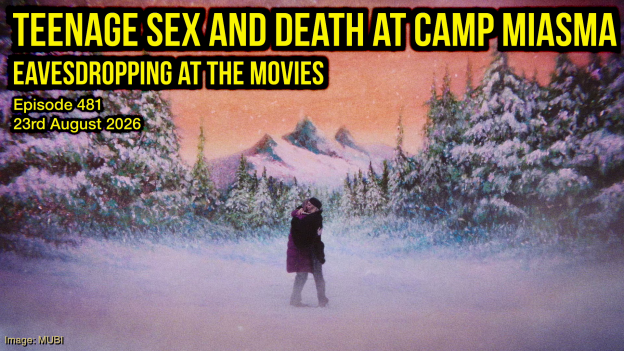
481 – Teenage Sex and Death at Camp Miasma

Listen on the players above, Apple Podcasts, Audible, Spotify, or YouTube Music.

Horror is surely the most deconstructed genre in film, the slasher the most deconstructed subgenre therein, and Teenage Sex and Death at Camp Miasma may be the most deconstructy of all such cinematic deconstructions. It tells the story of a young, queer, indie filmmaker hired to resurrect a problematic slasher series of yesteryear, the Camp Miasma films, which feature a box-headed villain who periodically emerges from a lake to murder teens who are drinking too much and forcing themselves on each other. Attempting to decide what she wants her reboot to be, she revisits the first film and meets its reclusive star, the enigmatic look in whose eye, in that first film, she’s desperate to understand.

Mike gets on with Teenage Sex and Death; José does not. What José finds cutesy and aimless, Mike sees originality and charm in. Writer-director Jane Schoenbrun is keen to have their cake and eat it, building in criticism of Gen Z-esque reevaluations of old media by modern standards while engaging in them all the same. This is a film loaded with irony – but its love of its subject matter is obvious.

It’s easy to argue that Teenage Sex and Death is at odds with itself when its former final girl (a delightfully drawling, glamorous Gillian Anderson) encourages the visiting filmmaker to cast off her intellectual pretensions and simply enjoy the “flesh and fluids”, but it’s a film that has plenty of room for ambiguity and blurring of the lines between points of view, and reality, media and fantasy. To some, the ambiguities will be approached as a problem to solve – just what is reality and what isn’t, at the end of the day? – but for Mike, they’re Schoenbrun’s way of following Anderson’s advice.

It’s not a perfect film and there will be those to whom it fails to speak at all (one of them is on this podcast), but Teenage Sex and Death at Camp Miasma is at the very least interesting, and an eager addition to the groaning shelves of self-referential horror media.

With José Arroyo of First Impressions and Michael Glass of Writing About Film.

443 – Final Destination Bloodlines

Listen on the players above, Apple Podcasts, Audible, Spotify, or YouTube Music.

The slasher series without a slasher returns for its sixth instalment, fourteen years after we last saw it. Where Halloween gave us Michael Myers, Friday the 13th, Jason Voorhees, and A Nightmare on Elm Street, Freddy Krueger, Final Destination made death the villain – perhaps more accurately, Death, but we never see a cloaked man wielding a scythe. Where the figure of the slasher killer could, in principle, be evaded and even beaten, Final Destination‘s Death, non-corporeal and omnipresent, carries a key threat of inevitability. Nobody escapes Death.

In each Final Destination film, one character’s premonition of catastrophe gives them the chance to save themselves and others from death, but Death won’t take being cheated lying down, and sets its sights on pursuing its near-victims to the graves they’re currently avoiding. How? Through elaborate, Rube Goldberg-esque accidents, of course. We discuss the ways in which Final Destination Bloodlines‘ set pieces work, how they focus on small moments and individual stories, and how they’re a nightmare for the naturally anxious. José isn’t shy of expressing his dislike of the film; Mike, the opposite, and he does his best to explain the appeal of watching so many people perish in such gruesome ways. We even ask whether a slasher series could be made with which José would see eye to eye, and imagine what it might look like.

With José Arroyo of First Impressions and Michael Glass of Writing About Film.

368 – Psycho (1960)

Listen on the players above, Apple Podcasts, Audible, Google Podcasts, or Spotify.

We visit the MAC for a screening of the new 4k restoration of Psycho, one of the most analysed films of all time, and arguably director Alfred Hitchcock’s most famous. It’s a film we’ve both seen several times, but not for a few years, and in the cinema setting for which it’s meant, instead of the classroom, there’s a renewed and reinvigorated wonder to its imagery and editing.

We share our feelings about this screening, remark upon things we’d forgotten or had never noticed before, discuss how elements of the film have aged, and compare it to Brian de Palma’s Dressed to Kill, which was, shall we say, inspired by Psycho, and which we recently saw. We find plenty of room for criticism, but although we conclude that Psycho works for us more as a collection of a few iconic scenes than a thoroughly engrossing story from beginning to end, those scenes shine, and nowhere more vividly than on a cinema screen.

With José Arroyo of First Impressions and Michael Glass of Writing About Film.

348 – X (2022)

Listen on the players above, Apple Podcasts, Audible, Google Podcasts, or Spotify.

Referential and reverential of classic slashers from decades past, Ti West’s X is likely just the sort of thing the dedicated horror fan wants to see – but to Mike, it’s a pretty unsophisticated and tedious imitation of much better films, and to José, it’s unpleasant, racist, sexist, and ageist. But on the plus side, no film has made him – a man who is decidedly not delighted by being frightened – jump and yell with the kind of regularity and energy that X inspired, which really livened things up for Mike. Unfortunately for you, José won’t be watching it a second time, and if you can’t drag him along, it’s not worth it.

With José Arroyo of First Impressions and Michael Glass of Writing About Film.

297 – Spiral

Listen on the players above, Apple Podcasts, Google Podcasts, or Spotify.

Listen to our podcast on Jigsaw here.

Cinema is back! And to celebrate, we see the new spin-off of the Saw series, Spiral, which… is not a good film. But it gives us much to think on, especially the surprisingly big names of its cast, which includes Chris Rock, Samuel L. Jackson, and Max Minghella. Slasher series don’t traditionally accommodate stars, but, beyond the fact that they’re typically too expensive, Spiral offers a warning against their presence: the screentime they require pulls too much attention away from the thrills, the reason we’re really there. The deaths we’re accustomed to enjoying in Saw films just aren’t given to us in sufficient excess or quantity in Spiral; Chris Rock’s protagonist, a detective hunting a Jigsaw copycat, dominates the story. As if catching the murderer is more exciting than watching him work. Honestly.

Despite our disappointment in the film, we enjoy our return to the cinema after nine months away, José finding a new appreciation for the meditative quality of submitting himself to a movie he can’t pause in a darkened room, after a year of experiencing a fractured, distracted mental state watching streaming media. Mike likes the bigness of the screen, and that’s as far as his introspection takes him. In an increasingly vaccinated Britain, this return to the cinema is more optimistic than the shaky and short-lived reopening of last summer, and feels like it stands a good chance of lasting. And a damn good thing, too. We’ve missed it.

With José Arroyo of First Impressions and Michael Glass of Writing About Film.