Tag Archives: psychological

466 – Nuremberg

Listen on the players above, Apple Podcasts, Audible, Spotify, or YouTube Music.

Russell Crowe shines in Nuremberg as Hermann Göring, who became the face of the Nazi Party following Hitler’s suicide and the end of the war, as he’s held in custody and probed by a psychiatrist as the titular trials approach. Indeed, while a mediocre film, its actors’ performances are a pleasure – with the exception of Rami Malek, whose psychiatrist is twitchy, busy, and a failure. A shame that he’s the protagonist, then.

We discuss the film’s structure and screenplay: José contends that Malek’s character is not just badly played but an irrelevance, and the drama would be much better served by focusing on Michael Shannon’s prosecutor; Mike criticises what he claims is a stupid person’s idea of clever writing.

And there’s more to think about: how Nuremberg compares to Bridge of Spies, which similarly depicted a novel trial that had obvious implications beyond the courtroom, and Judgment at Nuremberg, the other major dramatisation of the trials; the film’s tone, which is able to handle moments of humour but sometimes veers into the overly glib and kitsch; the present-day rise of fascism and the genocide in Gaza to which the film speaks; the use of real footage of Holocaust victims and the purpose to which it’s put; and whether we think that its critique of the Catholic Church for its support of the Nazis, and suggestion that dropping the atomic bomb on Japan was an unjustifiable atrocity, are surprising and bold things for a mainstream American film to do… or not particularly impressive, and shouldn’t people just know this stuff anyway?

With José Arroyo of First Impressions and Michael Glass of Writing About Film.

453 – The Shrouds

Listen on the players above, Apple Podcasts, Audible, Spotify, or YouTube Music.

A psychosexual thriller that’s neither psychosexual nor thrilling enough, The Shrouds is a disappointment. There’s great promise to businessman Vincent Cassel’s invention of a technologically advanced shroud that creates a 3D model of the decaying body it houses, when we’re shown the lust with which he observes his deceased wife’s corpse. The film is peppered with recurrent imagery of her disfigured body, and its importance to Cassel’s character is constantly reinforced, but the film is too talky, its imagery too bland, and its plot too convoluted to make the most of it. A shame.

With José Arroyo of First Impressions and Michael Glass of Writing About Film.
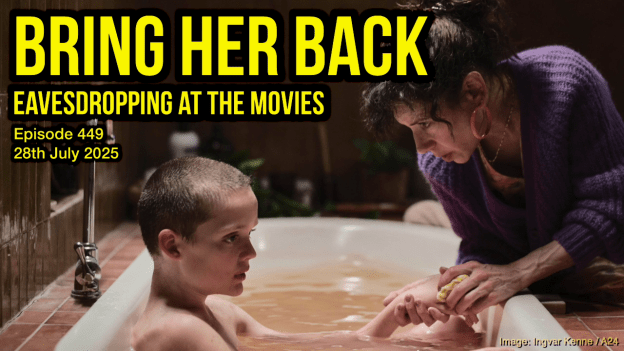
449 – Bring Her Back

Listen on the players above, Apple Podcasts, Audible, Spotify, or YouTube Music.

YouTubers-turned-directors Danny and Michael Philippou demonstrate a real eye for visual design and an ability to create imagery to truly disgusting effect in Bring Her Back, in which Sally Hawkins plays a foster parent whose daughter’s death leads her to search for answers in the occult. The filmmaker twins are 32 years old, which, perhaps unfairly, leads us to ascribe the film’s lack of depth and prioritisation of visual shock to their youth. Bring Her Back shows a certain immaturity, but great potential, and we’re interested to see if the pair’s storytelling and sensitivity to theme improves.

We also discuss child actors in horror, as the film drives Mike to question the ethics of using children as Jonah Wren Phillips is here, both in terms of the desired effect on the audience and the potential unintended effect on the child. Not all unease is good unease, and Bring Her Back makes us ask: what cost is too high for such entertainment?

With José Arroyo of First Impressions and Michael Glass of Writing About Film.
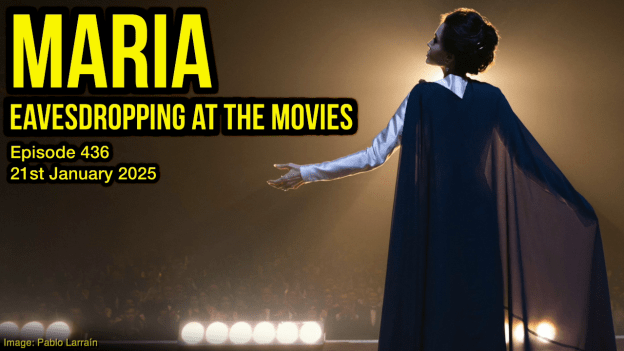
436 – Maria

Listen on the players above, Apple Podcasts, Audible, Spotify, or YouTube Music.

The third film in Pablo Larraín’s trilogy of iconic women, following 2016’s Jackie and 2021’s Spencer, Maria shows us the final week of the life of opera singer Maria Callas, who at the age of 53 is experiencing delusions, hallucinations, and the fear that her once-perfect singing voice has abandoned her. Mike isn’t familiar with Maria Callas; José is (despite worrying before we started recording that he wouldn’t have much to say when expected to explain who she is).

No familiarity with her is required, however, to enjoy the film. Larraín’s elegant direction, Steven Knight’s intelligent screenplay, and Angelina Jolie’s extraordinary, subtle performance combine beautifully to explore Maria’s ego, fears, and passion. Maria’s delusions, in which choirs fill town squares, orchestras back her in her apartment, and a fascinated journalist follows her around Paris chronicling her memories, are evident throughout the film… everywhere but in song. She knows all too well that her voice is leaving her, she hopes for and needs its return, and ultimately, the film renders her struggle with it a fight to hold on to life itself. It’s sympathetic, understandable, and beautiful.

Maria is the best film of Larraín’s impressive body of work, and features perhaps the best performance of Jolie’s. See it.

(We also discuss Robbie Williams, because Mike saw Better Man, the Robbie Williams monkey movie, and is desperate to talk about it.)

With José Arroyo of First Impressions and Michael Glass of Writing About Film.

432 – Heretic

Listen on the players above, Apple Podcasts, Audible, Spotify, or YouTube Music.

Hugh Grant brings his idiosyncratic brand of English charm to the world of horror in Heretic, in which he isolates and tests the faith of two young Mormon missionaries. It’s a film that leaves you asking all sorts of questions, such as, “did anything he was up to actually make any sense?”, but for a horror film so heavy on the dialogue and relatively light on the scares, it’s fabulously enertaining throughout – a real achievement of direction and writing. See it!

With José Arroyo of First Impressions and Michael Glass of Writing About Film.

390 – Knock at the Cabin

Listen on the players above, Apple Podcasts, Audible, Google Podcasts, or Spotify.

Like his previous film, Old, M. Night Shyamalan’s Knock at the Cabin is an intriguing, self-contained, efficient thriller – although not nearly as satisfying as it could be. The setup: A family staying at that classic American horror location, the cabin in the woods, is taken hostage by four invaders who’ve had visions of the apocalypse.

To say more would rob the film of some of its surprise, and its ability to keep you questioning what will happen is one of its pleasures – so think twice about listening to the podcast before you see it, because we spoil everything! There’s a lot to like, including its portrayal of a same-sex couple so unremarkable that the characters’ sexuality barely needs addressing (although more affection shown between them would have been welcome) and Dave Bautista’s calm but imposing presence as the leader of the intruders. But it’s so keen to have its sceptical protagonists arguing with what their opponents tell them that it doesn’t explore the dramatic and moral questions it has the opportunity to, and it’s too eager to be tasteful. When even José’s asking for gruesomeness you know you’ve shown too much restraint.

Knock at the Cabin is an interesting and engaging film but rather thin and could do with showing more bravery and style. Worth a look, though.

With José Arroyo of First Impressions and Michael Glass of Writing About Film.

386 – Tár

Listen on the players above, Apple Podcasts, Audible, Google Podcasts, or Spotify.

Cate Blanchett’s performance as the title character is the highlight of the otherwise unutterably deflating Tár. What begins as an unexpectedly captivating profile of a world-class musical conductor and promises to develop into a story of sexual and psychological intrigue ultimately fails to satisfy when it refuses to offer thrills and drama – not to mention plot resolution. We pick through our problems with it, including what we find implausible, its reactionary attitudes and low opinion of young people, and its embrace of ambiguity and lack of interest in developing the story of Tár’s downfall.

With José Arroyo of First Impressions and Michael Glass of Writing About Film.
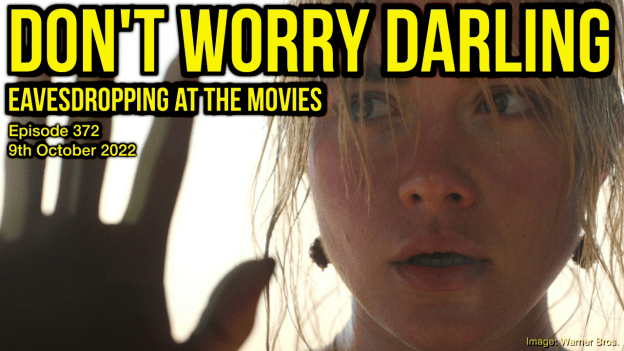
372 – Don’t Worry Darling

Listen on the players above, Apple Podcasts, Audible, Google Podcasts, or Spotify.

Don’t Worry Darling, Olivia Wilde’s second feature as director, after Booksmart, which we loved, is an irredeemable mess of a psychological thriller. We pick through its carcass in an attempt to figure out which bit of it we liked the least.

With José Arroyo of First Impressions and Michael Glass of Writing About Film.

368 – Psycho (1960)

Listen on the players above, Apple Podcasts, Audible, Google Podcasts, or Spotify.

We visit the MAC for a screening of the new 4k restoration of Psycho, one of the most analysed films of all time, and arguably director Alfred Hitchcock’s most famous. It’s a film we’ve both seen several times, but not for a few years, and in the cinema setting for which it’s meant, instead of the classroom, there’s a renewed and reinvigorated wonder to its imagery and editing.

We share our feelings about this screening, remark upon things we’d forgotten or had never noticed before, discuss how elements of the film have aged, and compare it to Brian de Palma’s Dressed to Kill, which was, shall we say, inspired by Psycho, and which we recently saw. We find plenty of room for criticism, but although we conclude that Psycho works for us more as a collection of a few iconic scenes than a thoroughly engrossing story from beginning to end, those scenes shine, and nowhere more vividly than on a cinema screen.

With José Arroyo of First Impressions and Michael Glass of Writing About Film.

358 – Vortex

Listen on the players above, Apple Podcasts, Audible, Google Podcasts, or Spotify.

Gaspar Noé dials down his typical cinematic spectacle to bring us a slow and moving exploration of dementia and how it drives a loving couple apart. He still has one visual trick up his sleeve, however: Vortex uses splitscreen to show us two lives lived in close proximity but not shared. His cameras follow their subjects individually, sometimes observing them go about separate activities, sometimes occupying almost the same perspective as the characters sit together and engage in conversation, nearly giving us a unified widescreen shot that captures both husband and wife in the same frame – but never being able to. But while Vortex is given structure by its visual design, what it depicts is as crucial as how it depicts it. It’s not a sentimental film, but neither is it harsh – and it’s well worth your time.

With José Arroyo of First Impressions and Michael Glass of Writing About Film.