Tag Archives: drama

315 – The Courier

Listen on the players above, Apple Podcasts, Audible, Google Podcasts, or Spotify.

Benedict Cumberbatch gets himself embroiled in the Cuban Missile Crisis in The Courier, a dramatisation of the true story of Greville Wynne, a British businessman recruited by MI6 to smuggle Soviet secrets provided by high-ranking GRU officer Oleg Penkovsky. It’s a film that offers pleasures in its performances and in the telling of a story you likely haven’t heard, but its storytelling is often banal and sometimes unclear, and, José contends, it’s full of tricks and tropes that are just there for effect – and often not very good ones. Steven Spielberg’s Bridge of Spies, set in a similar period of the Cold War and also telling a true story of a citizen’s recruitment to engage in an overseas mission, is an obvious point of comparison, and perhaps The Courier‘s greatest gift is that its mediocrity helps to show off just how assured and polished is Spielberg’s cinematic technique, even if the ideological purposes to which he puts it leave us rolling our eyes.

The Courier isn’t a terrible film, and its performances do make it worth a look… but it isn’t a very good film, either.

With José Arroyo of First Impressions and Michael Glass of Writing About Film.

310 – The Human Voice

Listen on the players above, Apple Podcasts, Audible, Google Podcasts, or Spotify.

Freely based, as the closing credits tell us, on Jean Cocteau’s 1930 play of the same name, The Human Voice sees Spanish auteur Pedro Almodóvar working in the English language for the first time. The play has long been on Almodóvar’s mind, inspiring, significantly, Women on the Verge of a Nervous Breakdown, among other works of his, and this short film joins the pantheon of adaptations of the play, which has seen its single character, a woman speaking on the phone to an unseen, unheard lover, played by such stars as Sophia Loren, Ingrid Bergman, and Anna Magnani.

Here, Tilda Swinton plays that role, bringing to it a sense of reserve that didn’t quite make sense to José until the final sequence and the resolution to the story – perhaps an effect of having seen the play adapted so many times and not having seen the character played this way before. Conversely, Mike feels he instinctively understands the character, remarking upon her change from being out of place, both geographically and emotionally, to her assumption of control of her world and destiny. José, who identifies with Almodóvar’s work like nobody else’s, picks up on the themes, motifs, visual designs, settings and interests that tie The Human Voice to the rest of his oeuvre, and finds where this short fits in and where it doesn’t. Specifically, he argues that Almodóvar’s control of language and knowledge of how people speak is typically overlooked in favour of his visuals, but here becomes obvious precisely because of the decision to use English rather than Spanish, which results in less poetry and nothing memorable throughout the entire monologue.

That flaw is evident but minor in the scheme of the entire film, which is an elegantly made and interesting study both of Swinton’s character and of Almodóvar’s own style and lifelong interests. The Human Voice is on Mubi, and well worth your time.

With José Arroyo of First Impressions and Michael Glass of Writing About Film.

304 – French Exit

Listen on the players above, Apple Podcasts, Google Podcasts, or Spotify.

An offbeat, gentle, surreal, intriguing and slightly camp comic drama, French Exit is a pleasant surprise for us both. Michelle Pfeiffer’s widowed heiress, reduced to selling her late husband’s property, takes what’s left of her life – her cat, adult son, and attitude – to an apartment in Paris, where she resolves to spend her remaining money before ending her life. Sounds hilarious.

And indeed it is, its director, Azazel Jabocs, demonstrating a mastery of tone. We discuss what makes the film work, its visual design, its relationship with and attitude towards money, how that campness José perceives is kept subdued, and more. French Exit isn’t a perfect film by any means, but it is a good one, and a charming way to spend a couple of hours.

With José Arroyo of First Impressions and Michael Glass of Writing About Film.

301 – Come and See

Listen on the players above, Apple Podcasts, Google Podcasts, or Spotify.

We explore Come and See, a 1985 Soviet film whose reputation precedes it – it’s regarded as one of the greatest war films of all time. In 1943 Belarus, a young teenager, Flyora, joins the resistance, but as he travels from village to village across Nazi-occupied Belarus, experiencing worsening horrors and atrocities brought upon the locals, the extent to which he is out of his depth gradually becomes clearer and clearer.

Part of Come and See‘s reputation is of being hard to watch, something we both take issue with – it goes to some deeply unpleasant places, but it’s a gradual descent rather than an onslaught. That the film is regarded as such a trial has likely caused some filmgoers to unnecessarily avoid an experience that they would value. While it depicts shocking imagery and events, it’s shot with an ethical eye – everything that’s shown has a purpose, and that which would be excessively prurient is often avoided.

We also consider the use of supernatural and fairytale aesthetics to place us in the mind of an innocent teenager, and the repeated portrait photography that shows the deepening scars the film’s events leave upon him. We also discuss the film’s view of Hitler and how it espouses a kind of great man theory in placing him as an icon at the centre of the Nazis’ crimes, and the explosion of audiovisual imagination that is the final scene.

Come and See is a beautifully made expression of the hideous costs of war on the innocent, and on our humanity. It’s imaginative, intelligent, moving and shocking, and, we might add, beautifully restored. If you’ve avoided it on the basis of its notoriety, we urge you to reconsider. It’s truly great.

With José Arroyo of First Impressions and Michael Glass of Writing About Film.

298 – Witness for the Prosecution

Listen on the players above, Apple Podcasts, Google Podcasts, or Spotify.

Billy Wilder directs this adaptation of Agatha Christie’s Witness for the Prosecution, a courtroom drama concerning a man on trial for the murder of an old woman – did he do it? What’s up with his wife? Will his lawyer’s nurse catch him smoking? As with Christie’s stageplay, The Mousetrap, upon the film’s conclusion, the audience is kindly asked to refrain from revealing its twists and revelations, but we at Eavesdropping at the Movies respect no such requests. Spoilers within.

Charles Laughton is pleasingly hammy, Marlene Dietrich composed, and Tyrone Power a loud, sweaty, stressed out mess – and somehow mostly in the background, despite his central role as the accused murderer. We discuss their performances and characters, the pleasures and methods of Agatha Christie’s mysteries, and Wilder’s direction, which hopes, in that classic Hollywood style, to render technique invisible. Witness for the Prosecution is an engrossing mystery filled with interesting bits of business that enrich its characters, and a classic.

With José Arroyo of First Impressions and Michael Glass of Writing About Film.
294 – The Two Popes

Listen on the players above, Apple Podcasts, Google Podcasts, or Spotify.

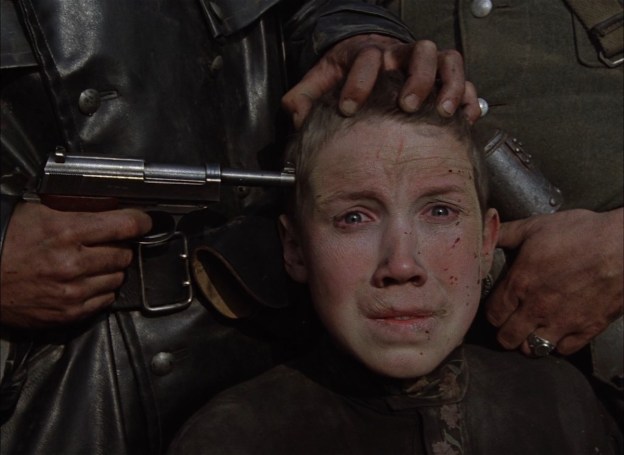
Anthony Hopkins and Jonathan Pryce star as the previous and current Popes respectively, in The Two Popes, an imagined biopic that uses their personas and public profiles as jumping off points to explore a range of ideas. We discuss the success with which the film has been adapted from the original stage play, but the lack of visual artistry it nonetheless exhibits; the ways in which it uses – and ignores – the characters’ histories and mistakes; the sincerity that underpins the entire film; and the rather cheap and simple, if entertaining, use of football to convey Pope Francis as a man of the people. Although we find all sorts of areas to pick at, The Two Popes is easy to recommend – witty, charming, brilliantly performed by Hopkins and Pryce, and keen to explore meaningful ideas with seriousness and solemnity, when the moment calls for it. Worth a look.

With José Arroyo of First Impressions and Michael Glass of Writing About Film.
291 – Sound of Metal

Listen on the players above, Apple Podcasts, Google Podcasts, or Spotify.

A film that offers a beautiful evocation of community, as Riz Ahmed’s drummer suddenly loses most of his hearing and joins a retreat for the deaf, Sound of Metal also feels regrettably, and unforgivably, dishonest in some of the ways it engineers its story. In this respect, we disagree over one of the film’s key scenes, but agree about what it goes on to depict in the final act. Despite the severe problems we have with the film, it has pleasures to offer, including an outstanding central performance from Ahmed, whose wide-eyed, puppy-dog expressions transparently convey fear, anger, worry and determination, sometimes all at once. For Ahmed alone, it’s worth seeing Sound of Metal.

With José Arroyo of First Impressions and Michael Glass of Writing About Film.
289 – The Trial of the Chicago 7

Listen on the players above, Apple Podcasts, Google Podcasts, or Spotify.

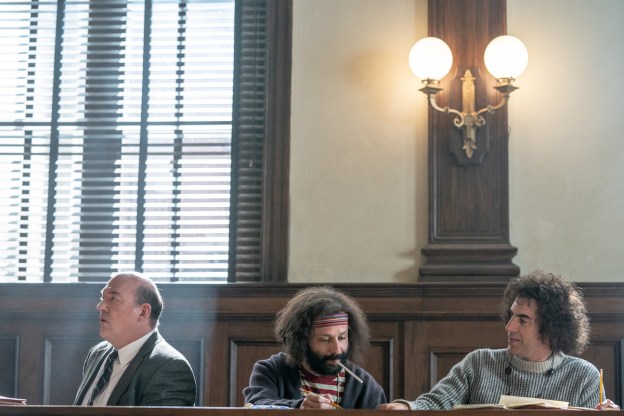
At the Democratic National Convention in Chicago in 1968, riots erupted when thousands of anti-Vietnam War protestors clashed with police. Seeking to crush the energetic counterculture, the US government put on trial a group of eight defendants, some political organisers, some cultural radicals, some with hardly any influence, a pacifist, and a Black Panther, hoping to convict them for conspiracy to incite the riots. Aaron Sorkin’s writing is a good fit for this story, the disparate group of defendants arguing amongst themselves sharply, and many scenes flowing beautifully towards their own internal climaxes; the same cannot be said of his direction, the film lacking much visual flair and instinct for expressive imagery.

We revisit our common theme of British actors playing Americans, José finding more fault with it here than Mike does – we can, at least, agree that Sacha Baron Cohen’s accent is atrocious, his Abbie Hoffman a weak point. Mike expounds upon how much he hates himself for how much he likes Sorkin’s HBO drama The Newsroom, comfort food for the American left, which he sees echoes of here.

We find flaw upon flaw with The Trial of the Chicago 7, but despite every one of them, it’s an immensely watchable film with a terrific ensemble cast and entertaining dialogue. With an awareness of its limitations and economy with the truth, we recommend it.

With José Arroyo of First Impressions and Michael Glass of Writing About Film.

288 – The Father

Listen on the players above, Apple Podcasts, Google Podcasts, or Spotify.

Anthony Hopkins is magnificent as The Father‘s title character, an old man losing his grip on reality to dementia, in debut director Florian Zeller’s adaptation of his own stage play. We discuss the techniques the film uses to situate the audience within the mind of a dementia sufferer, and whether they lose their potency as the film develops. The Father‘s origins on stage are obvious in its sparse setting and focus on dialogue, and we suggest that the raw power of seeing the performances live, an immediacy, is lost here – though the cast, particularly Hopkins and Olivia Colman, are impressive nonetheless. Mike argues that the film somehow lacks enough plot to even fill its 97-minute duration, and would have worked better as a short film – José suggests that it ends up in cliché.

Still, for a while at least, it’s an extraordinarily effective dramatisation of what it might feel like to suffer from dementia, convinced of your own mental acuity while contradicted by everyone and everything around you. The Father doesn’t offer a pleasant experience, but it is a valuable one.

With José Arroyo of First Impressions and Michael Glass of Writing About Film.
287 – Minari

Listen on the players above, Apple Podcasts, Google Podcasts, or Spotify.

A gentle drama about Korean immigrants making a life for themselves in 1980s Arkansas, Minari‘s tone is consistently light, despite some of the upsetting events that occur. Mike argues that it reflects a child’s perspective of life, protected by their parents from the worst of life, or simply not understanding the darkness in what they experience – writer-director Lee Isaac Chung based the film on his own upbringing on a farm in Arkansas. José identifies strongly with the story, commenting on the similarities and differences with his youth as a Spanish immigrant to Canada. Minari is a good-natured film with no room for cynicism, and, for José, a joyous experience to watch.

With José Arroyo of First Impressions and Michael Glass of Writing About Film.