Anthony Hopkins is magnificent as The Father‘s title character, an old man losing his grip on reality to dementia, in debut director Florian Zeller’s adaptation of his own stage play. We discuss the techniques the film uses to situate the audience within the mind of a dementia sufferer, and whether they lose their potency as the film develops. The Father‘s origins on stage are obvious in its sparse setting and focus on dialogue, and we suggest that the raw power of seeing the performances live, an immediacy, is lost here – though the cast, particularly Hopkins and Olivia Colman, are impressive nonetheless. Mike argues that the film somehow lacks enough plot to even fill its 97-minute duration, and would have worked better as a short film – José suggests that it ends up in cliché.
Still, for a while at least, it’s an extraordinarily effective dramatisation of what it might feel like to suffer from dementia, convinced of your own mental acuity while contradicted by everyone and everything around you. The Father doesn’t offer a pleasant experience, but it is a valuable one.
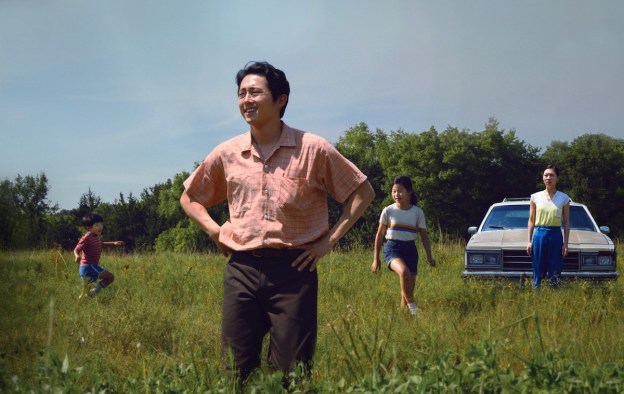
A gentle drama about Korean immigrants making a life for themselves in 1980s Arkansas, Minari‘s tone is consistently light, despite some of the upsetting events that occur. Mike argues that it reflects a child’s perspective of life, protected by their parents from the worst of life, or simply not understanding the darkness in what they experience – writer-director Lee Isaac Chung based the film on his own upbringing on a farm in Arkansas. José identifies strongly with the story, commenting on the similarities and differences with his youth as a Spanish immigrant to Canada. Minari is a good-natured film with no room for cynicism, and, for José, a joyous experience to watch.
The story of a civil rights activist who deserved a biopic long before now, told from the perspective of the man who killed him. Fred Hampton chaired the Illinois chapter of the Black Panther Party, and using his oratorical skills and powers of persuasion formed the Rainbow Coalition, a political movement in which black, white and Puerto Rican organisations combined and worked together. Hampton was identified as a threat by the FBI and his death is considered an assassination under COINTELPRO, the FBI’s illegal programme of disruption of domestic political organisations. He was killed in December 1969 at the age of 21.
We ask whether it’s a problem that Judas and the Black Messiah frames his story as part of his murderer, William O’Neal’s. For José, the entire story is badly conceived, as Hampton should be the clear focus; for Mike, the problem is in the execution, with O’Neal underdeveloped – but it’s possible that this informant thriller genre structure is what allowed the film to get made in the first place. Mike remarks upon Hampton’s pragmatism in contrast to the narratives around Martin Luther King Jr., murdered only a year before Hampton, which arguably tend to convey idealism for the future as opposed to action in the here and now.
Judas and the Black Messiah is an imperfect but important exploration of an extraordinarily impressive man we should have known more about before now.
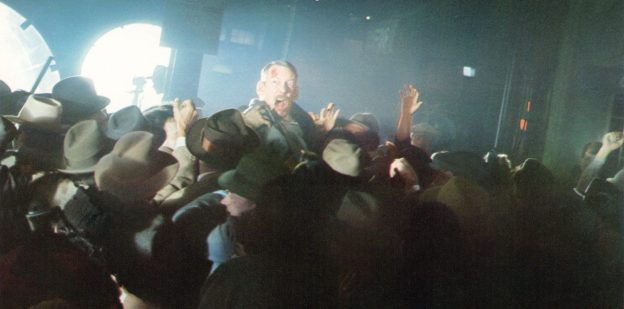
An expensive flop in its day, The Day of the Locust maintains a cult intrigue for its critique of Hollywood and descent into madness. It’s new for both of us, and we discuss the qualities its cast brings, what could be better about its industry commentary, its moments of surprisingly graphic violence, and who, or what, its titular locusts are.
We explore a wonderful Taiwanese film that Netflix forgot it had, A Sun. An intimate yet epic drama about the effects of a single mistake that reverberate through a family and down the years, it’s gorgeously lit and shot, and although it feels as long as it is, every moment is earned and valuable. It asks fundamental questions of its characters and of us, the most important of which is: What does it mean to be a good person?
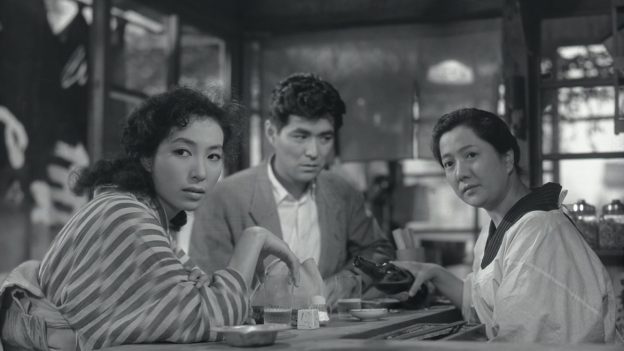
A young, destitute couple seek survival and stability in Yuzo Kawashima’s 1956 drama, Suzaki Paradise: Akashingō (in English, this subtitle is given as Red Light, or Red Light District). Tsutae and Yoshiji spend their last few yen on a bus to anywhere, ending up on the outskirts of Tokyo’s red light district, separated from it only by an ominous bridge that is spoken of by the locals as though fearful, dreaded, even mythical. They take to their new home differently: Tsutae easily finds work as a waitress at a bar, comfortable for reasons that become clear; Yoshiji, a former office worker, has trouble adjusting, and, though it’s not put into words as such, spends much of the film depressed.
We discuss the portrayal of Tokyo’s unfortunates, their attitudes to life and to each other, and the tightrope Kawashima walks between wallowing in poverty porn and sentimentalising the couple’s situation. The motif of the bridge is a potent one, recurring throughout, and we consider how it’s used, what it signifies, and how it combines with the film’s theme of patriarchy and how it oppresses both women and men.
Suzaki Paradise is a concise and potent film, an intelligent dramatisation of social and economic issues in post-war Japan, and an expressive melodrama. It’s worth seeking out.
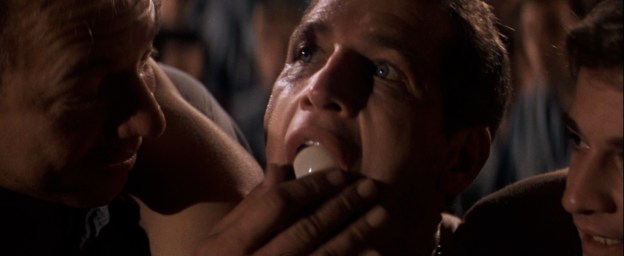
A key film in Paul Newman’s career that gave us one of cinema’s most iconic lines, Cool Hand Luke is known to both Mike and José – but previously seen by neither. The reasons that it became a cultural touchstone remain crystal clear, despite it failing, to a significant degree, to grab us as it might. We question the authenticity and purpose of Luke’s rebellion, the depiction of prison life, and the flimsy Christian allegory that tirelessly insists upon itself. The brutality perhaps seems unfairly tame today, an unavoidable consequence of coming to the film more than fifty years late, but its comedy still works beautifully and Newman’s charm has gone nowhere. It’s a fantasy, we conclude, for the privileged – an ultimately mortal fight against The Man, the point of which may very well be its lack of focus and clarity of purpose. Jesus was crucified for our sins; will we be recounting the story of Luke in two thousand years? Only time will tell.
The winner of the 1971 Oscar for Best Foreign Language Film, Vittorio De Sica’s The Garden of the Finzi-Continis tells an aching story of doomed love within a wealthy Jewish community in Fascist Italy. The 1938 racial laws, enforcing the segregation of Italian Jews, have just been introduced, but the titular family’s titular garden offers insulation from the rising tide of fascism – for a while.
Mike finds the film’s love triangle somewhat banal, but is impressed with the subtly observed way in which the central characters allow themselves to remain comfortably ignorant of the increasingly hostile and dangerous Italy beyond their walls; comparisons to frogs in saucepans abound, not to mention the present-day normalisation of absurd corruption and violence in the Greatest Country in the World™. José is more keen on the romance, but still, the film’s sociopolitical side remains our focus. We consider the film’s use of physical space, the ways in which the Jewish characters can navigate it without being suspected by the racist public, but find themselves eager to retreat to safety as the film develops. We note that The Garden of the Finzi-Continis was made 25 years after the end of the Second World War, but 50 years prior to today: it’s now conspicuously an historical artefact that speaks to the time in which it was made, and whose proximity to the horrors it dramatises is necessary to keep in mind. And Mike reflects on his relationship with his Jewishness in this day and age, and how the film demonstrates that whatever divisions we may find among ourselves, to those who hate us, there’s no distinction.
It’s also Bonfire Night – well, the day after, but it’s a Friday evening so the festivities continue – and we celebrate by closing the window and trying to ignore the fireworks going off outside.
Horror tropes pervade I’m Thinking of Ending Things, Charlie Kaufman’s oddball drama about a girl doubting her relationship, but it can’t be considered a traditional horror. Instead, it turns these tropes inwards, likening a controlling, toxic relationship to an isolated, threatening, haunted house. It’s a fascinating and brilliant idea, but despite the film being well-observed and intriguing, it’s not engaging enough, and offers little opportunity for confident interpretation. Mike has little sympathy for its developing surreality; José wants more humour. Still, it’s an ambitious, interesting film, and worth delving into.
Planet Earth is dying, dust storms are wiping out crops, and all-American single dad, former NASA pilot and corn farmer Matthew McConaughey is our last hope for survival. A “ghost” appears in his daughter’s bedroom, appearing to communicate by affecting gravity, and decoding the messages leads our hero to discover the last remnants of NASA, their observations of a wormhole near Saturn, and their journeys through it to planets that might be able to sustain human life. Eventually convinced of the plan’s value and necessity, McConaughey agrees to lead a mission through the wormhole himself, leaving his family behind, but hoping to rescue them in the long term.
Mike was moved and surprised by Interstellar upon its release in 2014, but on this second viewing moves significantly towards José’s unimpressed response, wondering whether it was simply the novelty of seeing new things to which he responded so positively. He compliments the film’s scientific literacy, but complains that its dedication to incorporating scientific principles and registers can impede what should be dramatic developments, making them dry and clunky; José, who has no ear for science, finds that it’s an irrelevance, unable to tell what might be drawn from reality and what isn’t, and feeling that the film doesn’t dramatise it well.
Everything is rendered through the central family and in particular the father-daughter relationship, strained because of the father’s mission, and consistently the film’s most important consideration, a little simple considering the global nature of Earth’s problems and the countless other families the mission is intended to help. The mission’s revelations and problems affect the entire world, and are discussed as such in dialogue, but we feel only the impact on this family – Interstellar speaks of societal problems but doesn’t show or dramatise them. Mike argues, though, that that central connection is handled well, the most effective shot, in a film full of startling visuals, one of a father’s face looking at his children.
We think about the action, and what it lacks. There are plenty of high-concept set pieces, but all seem to miss something in the execution. And we discuss the black hole scene, the design of that space and what it means, and how, while Mike was totally swept up in it upon first viewing, it quickly falls apart.
We’re glad we’ve seen Interstellar again, and at the IMAX Digital, the best available screening outside of true IMAX – because our response can’t be blamed on watching it on a laptop. We saw it as it should be seen, and emerged disappointed. Oh well.