In the high-concept mould of Speed and Unstoppable, Michael Bay’s Ambulance gives us an ambulance, hijacked by bank robbers, that isn’t allowed to stop moving. It’s a real throwback to the era of genuine stunts, cars flipping over on fire, helicopters flying under bridges, and charismatic villains – with much less charm than you’d like, insultingly mechanical use of archetypes to manipulate your feelings, and low expectations of its audience. We discuss how well or badly it balances its actors, tells its story, uses its milieu to offer a portrait of the society in which it’s set, and more.
The latest in a long line of Batman reboots, The Batman claims the definite article for itself – and deserves to. Richly shot, dark, romantic expressiveness spilling from every frame, The Batman leans in hard on bringing the noir of the source material to the screen with unabashed sincerity. It’s the best Batman film of them all.
Having gone through fourteen years of development hell, the first of Sony’s planned videogame adaptations arrives – Uncharted, starring Tom Holland, turns the famously cinematic action-adventure treasure-hunting puzzle-solving games into surprisingly enjoyable action-adventure treasure-hunting puzzle-solving cinema.
Well, “famously” is relative – Uncharted is an enormously successful blockbuster series with which Mike is familiar, but José didn’t even know there was a series on which the film was based. With the benefit of his experience, Mike discusses how the film adapts five games’ worth of material and the expectations he had, and we consider the characters’ relationships and personal stakes, conceptualisation of the action, the similarities and differences to Indiana Jones, and Antonio Banderas’ villain.
After eighteen years away and vast changes in the blockbuster landscape in which it once broke incredible new ground, the Matrix series is back with a fourth film, The Matrix Resurrections. Keanu Reeves’ Neo is once again plugged into the Matrix as Thomas Anderson, but having trouble separating reality from dreams of events that happened twenty years ago… if dreams are what they are.
We discuss Resurrections‘ endless self-reflexivity, how it uses motifs and themes of the previous films, updating them where necessary and bringing more out of them (Mike is glad of the much improved use of mirrors). We also consider the film’s inclusivity, which is key to the Wachowskis’ work, and an uncomplicated joy here – it’s not difficult for people from a range of ethnic backgrounds and situated in different places along sexual and gender spectra to coexist in a blockbuster with no particular importance placed upon their identities, as Resurrections proves. You just have to want to do it, and the world that results is beautiful. And, at heart, it’s a middle-aged romance – for which José swoons!
Resurrections isn’t without its issues, and we consider those too – Mike asks whether the sense of wonder associated with the special effects of the original films is simply gone forever in a world in which literally anything can be done, and is, with all-powerful CGI, and we agree that the action is a Bourne-inflected disappointment, especially so in a series that itself spawned so many imitators of its own action scenes two decades ago.
But seen in its entirety, The Matrix Resurrections is an imaginative and interesting continuation of the story begun twenty years ago, and a holistic triumph of well-intentioned, positive and effortless representation. Whoever thought we’d get a fourth Matrix? And that it would be this different, and this good?
Venom returns after his surprisingly enjoyable, if trashy, 2018 solo debut, but we don’t find much of a way to have fun with this sequel. Its cast is underserved by both the direction and screenplay, Tom Hardy appears to want to be seen as a slob, there’s not a memorable shot throughout, and most of the comedy, while promising in principle, falls flat. Mike asks where the real carnage even is, the film scared to show anything even cartoonishly gory, while José decries the carnage generally present in American cinema in general, this film, like so many, unable to conceive of a way to generate excitement without blowing things up and causing destruction.
Daniel Craig’s Bond bids us goodbye in No Time to Die, the culmination of his fifteen-year tenure as the gentleman’s spy – but is it really Bond? The character, and the films in which he appears, have changed in tone and attitude in recent years, in response to several factors, including criticisms of misogyny and the cinematic influence of the Bourne series, all of which results, for José, in a film that while good, just isn’t Bond any more. We consider what makes No Time to Die‘s Bond different, discussing his clothing, the intensity of serialisation from one film to the next, and the Bond girl – and, as Mike suggests, the character’s key change in attitude: Craig’s Bond takes things seriously and is capable of being outraged.
Although we pick at these things, the film is easy to recommend. The action is well-executed, Rami Malek’s villain beautifully played (if lazily written), and the entire affair is hugely enjoyable. Where Bond goes from here, who knows, but No Time to Die is a good send-off for Craig’s incarnation.
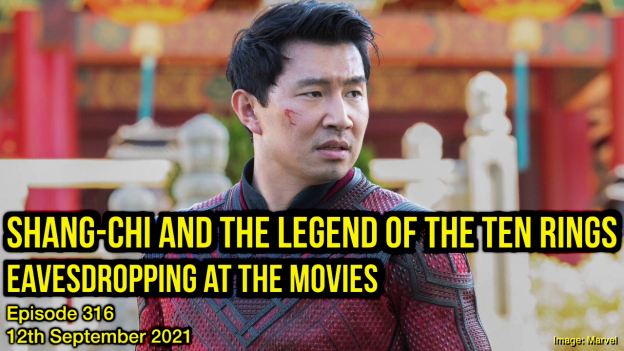
A new day, a new entry in the MCU, and on this occasion we’re introduced to an entirely new set of characters and mythos: Shang-Chi and the Legend of the Ten Rings fills us in on the history of a young Chinese-American man and his dad’s magical jewellery. Like Doctor Strange and Black Panther, it’s a film whose connection to the wider MCU is light, establishing characters, a setting, and story elements that are certain to tie in to subsequent films, but free of the obligation to prioritise them at the expense of itself. And like Doctor Strange and Black Panther, that freedom works in its favour – it’s of a piece, interesting, pretty, and entertaining.
We discuss the film’s setting in a Chinese-American immigrant context, comparing it in particular to The Farewell and Crazy Rich Asians: all three films dramatise the cultural differences between the new and old country, and the ways in which the younger generation might face challenges in visiting or returning to their ancestral home. Indeed, Awkwafina appears in all three films, and, even in supporting roles, expresses this subject all by herself. We also think about the MCU’s use of the film to address its own past, a character from Iron Man 3 returning: Shang-Chi not only rejects the way the earlier film totally reconfigured him from the comics, but also addresses the Orientalism with which he has historically been associated.
And there’s more besides – Tony Leung’s beautiful, evocative performance of a character that nonetheless doesn’t quite work; the quality of the action, much of it a cut above what we typically expect from Marvel; and that classic Disney trick – if in doubt, animate a cute animal. Shang-Chi and the Legend of the Ten Rings is a promising start to the MCU’s next phase, and we look forward to finding out how its world will integrate down the line, but it’s worth seeing on its own terms.
Ryan Reynolds’ schtick, so irritating for so long, is winning us back, and Free Guy is built around his entire star persona, the self-effacing originality of which José remarks upon. Reynolds plays Guy, a videogame non-player character – an extra, essentially, following a programmed routine within a virtual world – with a lightness and sweetness that defines the tone of the entire film.
We discuss what the film represents about videogame culture and what it discards, the desire for romance that drives the story, what Mike questions about its ending, and more. Free Guy is a charming and entertaining action comedy, whether you know games or not.
Disney has already turned one of its theme park rides into a box office colossus – is it time for another? They seem to think so, bringing us Jungle Cruise, an adaptation of one of the attractions from Disneyland’s grand opening in 1955, the Jungle River Cruise, starring The Rock, who we still refuse to call Dwayne Johnson, Emily Blunt, and Jack Whitehall, as explorers searching for the Tree of Life.
The film gives the ride more than a nod and a wink, The Rock’s character operating a cruise along the Brazilian Amazon, complete with the real ride’s cheesy dad jokes – and there’s effort made to reckon with the attraction’s history of racist representation of indigenous peoples. How successfully it does so is up for debate, the film indulging in its own cultural imperialism – despite being set in Brazil, there isn’t a word of Portuguese spoken; and no matter the purity of their intention, the characters are still in Brazil to take something that doesn’t belong to them.
We also discuss the film’s feminism and sexual politics, as embodied by Blunt’s and Whitehall’s characters, the setting in 1916 and the use of England rather than the USA as a point of origin for its story, and consider who the film is for – Mike sees its relationship with the likes of Jumanji, Indiana Jones, Hook and The Mummy, and is sure that he’d have loved this as a kid as much as he did those. It fails to really explore the poetic potential of some of its ideas, and one too many action scenes feel like they need explosions to keep things exciting, but on the whole, Jungle Cruise is a likeable bit of popcorn fodder with three terrific performances, and chemistry to match.
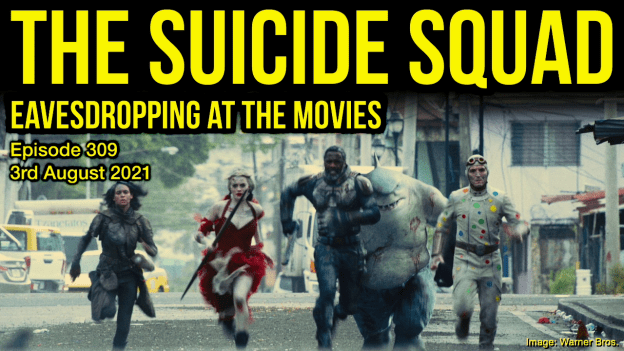
Apparently dissatisfied with the dismal reception of 2016’s Suicide Squad, DC has bravely decided to vaguely reboot the property with a spot-the-difference name change to The Suicide Squad, probably hoping that this new film will effortlessly send its predecessor down the memory hole. We ask whether it hits that whimsical tone it clearly wants to and discuss imperialism, satire, racism, gazing at males, rats, story structure, excessive volume and more.