Tag Archives: action

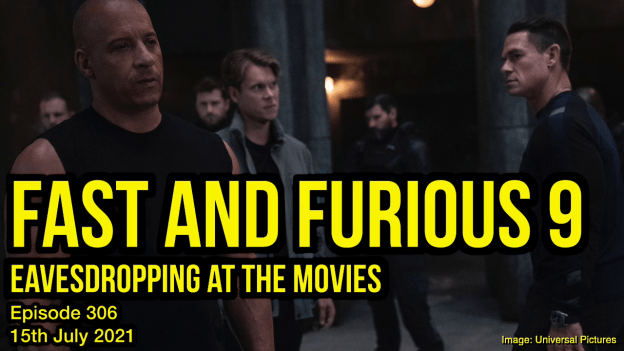
306 – Fast and Furious 9

Listen on the players above, Apple Podcasts, Audible, Google Podcasts, or Spotify.

What began twenty years ago as a series of car chases and races has since spiralled out of control into an action behemoth encompassing ten films, a TV series, videogames, and theme park attractions. But for the spinoff film Hobbs & Shaw, Fast and Furious 9 is Mike’s introduction to the Fast & Furious series, with José having seen some of the previous instalments, but not all.

We discuss the soap opera storytelling, the way it expresses humour – what it thinks are jokes are really just aggressive, macho posturing – and what it thinks of intelligence, José contending that it represents the worst of American culture in privileging stupidity and making it victorious, with Mike offering a complementary drop of nuance, arguing that it does at least believe that its heroes are smart… but it’s a stupid person’s idea of what being smart is. Core to the film’s failings is its almost complete lack of irony, only the car-turned-space shuttle indicating that the film has any understanding of comedy and how absurd it all is.

There’s no recommending Fast and Furious 9, its shortcomings exposed by the competence of almost every other action blockbuster (even Hobbs & Shaw, which had its own problems, but was a pleasant surprise). On the basis of this, Mike’s curiosity has been sated, and he’s happy to continue avoiding this godforsaken series for the rest of his life.

With José Arroyo of First Impressions and Michael Glass of Writing About Film.

305 – Black Widow

Listen on the players above, Apple Podcasts, Audible, Google Podcasts, or Spotify.

Marvel’s triumphant return to our cinemas is… a film that fills in a plot hole nobody cared about for a character who not only should have had a standalone film long before now but who has since been killed off. To say that Black Widow feels like a kick in the teeth is an understatement, but still, the MCU is back with us and we see what it has to offer.

And what it presents us with is something much more earthbound than the spacefaring antics in which Marvel has increasingly indulged: a good old-fashioned Russian spy story, and a family reunion of sorts, Natasha Romanoff driven to reconnect with the other undercover Russian agents who formed her surrogate family as a child. We ask whether the theme of family is done justice here, especially the father’s part in its expression. And, among others, we ask questions of the action filmmaking, the lack of humour in heroes, Romanoff’s conceptualisation, how the women are filmed, and whether it’s necessary to eschew edginess in order to pursue a progressive politics.

Black Widow is a film we enjoyed, though on reflection, picking out the reasons why is harder than picking at its flaws – but it certainly hasn’t dampened our willingness to continue following Marvel’s movies.

With José Arroyo of First Impressions and Michael Glass of Writing About Film.

303 – The Hitman’s Wife’s Bodyguard

Listen on the players above, Apple Podcasts, Google Podcasts, or Spotify.

The sequel to one of the first films we discussed on Eavesdropping at the Movies, The Hitman’s Wife’s Bodyguard reunites Samuel L. Jackson’s hitman, Ryan Reynolds’ bodyguard, and Salma Hayek’s hitman’s wife – whose role is significantly expanded from the first film’s bit part. The vaguely sketched plot – Antonio Banderas wants to blow up Europe or something, and that’s enough detail – is the wire hanger upon which jokes and comic character interplay are draped, but, crucially, is the comedy successful?

Whether it is or isn’t, and what we read into the audience response, is up for discussion, as is the deployment of the stars’ personas and cinematic histories, what renders Ryan Reynolds’ schtick endearing here where it’s normally irritating, and whether the film’s sexual dimension is overly vulgar or too one-sided.

José has seen The Hitman’s Wife’s Bodyguard twice now, and is no less in thrall to Hayek’s aggressive, wild performance the second time, loudly and enthusiastically responding to it. Mike is much less impressed with the film, but does admit to warming up to it in the second half, after a particularly mad joke that we won’t spoil here (but do in the podcast). If there are more Hitman’s Bodyguard films to come, hopefully with increasingly deliberately clunky titles, we’re up for them.

With José Arroyo of First Impressions and Michael Glass of Writing About Film.
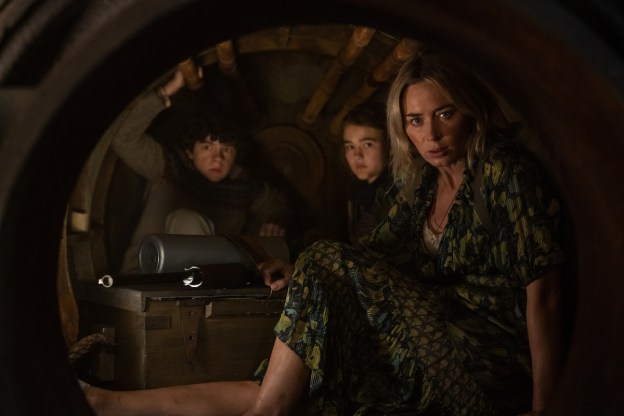
300 – A Quiet Place Part II

Listen on the players above, Apple Podcasts, Google Podcasts, or Spotify.

A Quiet Place Part II picks up moments after its 2018 predecessor ends, its characters desperate for refuge from the terrifying predators hunting them. Seeking survivors, they encounter a family friend, now a recluse, having lost his wife and children. Emboldened by her discovery of a way to combat the aliens, the family’s deaf daughter makes a beeline for a radio station she believes can help, and what was a home invasion horror becomes an action adventure.

While accommodating this alteration in tone, A Quiet Place Part II offers, as sequels tend to do, more of what made the first film so successful, and it’s terrifically entertaining cinema – but a diminished experience, compared to its predecessor, in almost every way. We consider the film’s view of society, the uncritical whiteness in its casting and its inability to imagine ways of living that don’t involve the nuclear family unit; and the lack of threat we feel, despite its functional and well-orchestrated set-pieces – we simply never feel like these characters are at any real risk of being allowed to die.

We have problems with A Quiet Place Part II, but don’t let them dissuade you from seeing it. It’s exciting and made José jump time and time again – we just wish, both in cinematic and social terms, it could see beyond its rather narrow boundaries.

With José Arroyo of First Impressions and Michael Glass of Writing About Film.

290 – Godzilla vs. Kong

Listen on the players above, Apple Podcasts, Google Podcasts, or Spotify.

The fourth entry in Legendary’s MonsterVerse, the first crossover in the series, sees a journey to the center of the Earth and Hong Kong made the playground of its titular colossi. In this cinematic universe seeking to challenge Marvel et al., Mike finds visual splendour and an ambition to reach for something a little more meaningful than your usual blockbusters. Indeed, the character of Godzilla, in particular, is well-known to derive from Japan’s horrific experience as history’s first and only target of nuclear warfare, and Mike argues that the MonsterVerse seeks to continue to use its creatures as giant metaphors that punch and breathe fire, unleashed by humanity’s insatiable consumption and arrogant claim on the natural world. José isn’t that impressed with this reading, but finds things to enjoy, particularly the beautiful imagery – though, he argues, while it demonstrates incredible skill and craft on the part of the artists who created it, art is precisely what it lacks. But luckily, although we butt heads over Godzilla vs. Kong, Birmingham remains intact.

Our podcast on Godzilla: King of the Monsters

Mike’s review of 2014’s Godzilla

José’s review of 2014’s Godzilla

With José Arroyo of First Impressions and Michael Glass of Writing About Film.

286 – Zack Snyder’s Justice League

Listen on the players above, Apple Podcasts, Google Podcasts, or Spotify.

In 2017, Justice League, DC’s answer to Marvel’s continuing Avengers crossovers, flopped. Director Zack Snyder had left the film several months before release, his role taken over by MCU regular Joss Whedon, and significant changes were made in an attempt to lighten the tone of what had so far been a rather bleak series. Immediately, talk erupted of a director’s cut – the so-called Snyder Cut – that would represent Snyder’s true vision, uncompromised by studio executives’ fears and directives. Initially no more than a meme responding to that film’s quality, it was given oxygen by Zack Snyder’s insistence that it did actually exist, and it now reaches us via online streaming in the age of Covid-19. There’s perhaps no other set of circumstances in which it would have been made real – on top of the original budget, the creation of this director’s cut cost some additional $70m – but what an opportunity to compare and contrast two versions of the same film.

At four hours in length, this is a version of Justice League that would never have seen a theatrical release, but the time it affords its characters to develop is welcome, and a huge improvement over the sketchy treatment some of them received in the original film – particularly Cyborg, played by Ray Fisher, who arguably becomes the central character in the Snyder Cut. We discuss and disagree on the decision to change the original aspect ratio of 1.78:1 to 1.33:1, which José loves but Mike considers a mistake, and look over a few key scenes and shots to explore the differences between Snyder’s and Whedon’s aesthetics.

And we discuss that new ending, additional scenes which help the Snyder Cut conceive of the overall story as epic, mythological fantasy, and more.

It’s a surprise to us both that we enjoyed Zack Snyder’s Justice League as much as we did, but there you have it. The four hours flew by and if this leads to the studio’s renewed interest in completing Snyder’s planned series, we’re up for it.

With José Arroyo of First Impressions and Michael Glass of Writing About Film.

252 – Tenet – Second Screening

Listen on the players above, on Apple Podcasts, or on Spotify.

Birmingham’s full-size IMAX cinema closed in 2011, having proved unprofitable (the independent venue it became, the Giant Screen, closed four years later for the same reason), so it’s off to the Manchester Printworks, home of the second-largest screen in the UK, for our second viewing of Tenet. We ask whether the full IMAX experience is worth it, Mike comparing the feeling of the images offered to those he saw in Dunkirk and The Dark Knight; José argues that it’s detrimental to the film to be exhibited in different cinema formats, as shooting in IMAX’s 1.43:1 aspect ratio, where the film is supposedly best seen, with the knowledge that it’ll be cropped for conventional cinema screens for its wide release and home media, means that artistic, interesting composition is impossible – you can’t compose well for two frames at once.

Mike suggests that an easily overlooked pleasure of Christopher Nolan’s cinema is turning his films over in your own head, playing with the logic, asking questions of it and trying to unlock the puzzle box – something he’s been doing since his first screening, and which we both spend some time on after this one. Laying out the timeline, speculating on what might happen that we’re not shown – this isn’t the first of Nolan’s films to invite that type of reflection. And Mike describes the pleasure of understanding things that aren’t hidden but simply too many to grasp all at once the first time – now that he broadly knows the film, things that left him confused at first now smoothly fall into place.

We reflect again on the film’s score, performances, and action scenes, finding that rather than changing our initial impressions, this second viewing helps us to perceive and explain better what made us feel the way we did at first. We find more to discuss – the use of Elizabeth Debicki’s height, the cost of Nolan’s adherence to achieving visual effects without the use of CGI, the pleasure of the way in which Aaron Taylor-Johnson’s character interacts with the heroes, whether Mike is just shit at watching spy movies – but our overall experience hasn’t changed. What we liked, we still like; what we didn’t, we still don’t.

(Mike’s short film, which he claims was harder to make than Tenet, can be seen below. It’s probably worth mentioning that if you still don’t know what Tenet is about, watching this could constitute a spoiler of sorts – after all, Mike brought it up because of its vague similarities.)

With José Arroyo of First Impressions and Michael Glass of Writing About Film.

251 – Tenet

Listen on the players above, on Apple Podcasts, or on Spotify. Click here for our second podcast on Tenet.

After a long wait and three delays, Christopher Nolan’s latest high-concept blockbuster, Tenet, has finally arrived in British cinemas. This description is a spoiler-free zone, but the podcast is decidedly not, so tread carefully before you listen: We spill every secret the film has to hold. The ones we could figure out, anyway.

Following our revisitation of five of Nolan’s massive flicks – the Dark Knight trilogy, Interstellar, and Inception – we’re keen to see how Tenet fits amongst its brethren. We consider, as we have done repeatedly, Nolan’s action direction, the aesthetic design, the tone, the concept that drives everything, how it’s explained, what we love, what let us down, and, well… to detail anything further would be indecent.

Mike is gobsmacked by it, finding brilliance in some of the film’s execution, though is keen to make more than a few criticisms. José is much colder towards it, dismissing it as no more interesting than comic books for children – can Mike’s enthusiasm rub off on him? Tenet has its flaws, but it’s ambitious, intriguing, large-scale, wonderfully cast and acted – it’s worth your time.

With José Arroyo of First Impressions and Michael Glass of Writing About Film.

249 – The Old Guard

Listen on the players above, on Apple Podcasts, or on Spotify.

An ambitious, large-scale Netflix production, The Old Guard throws special ops, behind-enemy-lines-style action together with intriguing superhero-style mythology. Charlize Theron leads a team of immortal warriors, ranging from hundreds to thousands of years old, who find themselves on the run from corporate and military-industrial pursuers.

José is captured by the film from the beginning, his love for Theron’s action stardom and the film’s mysterious setup pulling him in; Mike takes an age to warm up to it, his inherent suspicion of all things Netflix keeping him wary. But when the story develops its romantic side, he softens, and both agree on what the film does best: the defiant declaration of love from one man to another, surrounded by armour-plated, heavily armed police. The Old Guard approaches representation of different sexualities and ethnicities in heartfelt, open ways, and the prospect of sequels that develop that further – perhaps even a universe – is promising.

Ultimately, José loves The Old Guard much, much more than Mike, but it wins us both over.

With José Arroyo of First Impressions and Michael Glass of Writing About Film.

248 – Inception

Listen on the players above, on Apple Podcasts, or on Spotify.

Could we have found a Christopher Nolan film that José actually enjoys? We explore the brilliantly imagined and executed Inception, a heist movie set inside the human mind, talking up the intelligence and creativity with which the central concept is used, the elegant and effective intercutting and structure, and the noirish, expressive romance that underpins the entire affair.

We’ve had some disappointments with Interstellar and the Dark Knight trilogy, but Inception was just the antidote. Boy, are we fired up for Tenet now.

Making spoof Inception trailers was all the rage around the time of its release, and here are the two Mike made.

With José Arroyo of First Impressions and Michael Glass of Writing About Film.