263 – Small Axe: Mangrove

Listen on the players above, Apple Podcasts, Google Podcasts, or Spotify.

Small Axe, Steve McQueen’s remarkable anthology of five films made for the BBC, begins with Mangrove, a dramatisation of the 1971 trial of the Mangrove Nine, a key event in British history in which the institutional racism of the Metropolitan Police was successfully litigated by members of the black community in Notting Hill. While it is undoubtedly key, it’s an event with which neither Mike nor José is familiar, and the film embodies the BBC’s iconic mission statement of “inform, educate, entertain”, doing all three wonderfully.

We discuss the way in which Mangrove both fits into and demonstrates an evolution of McQueen’s filmmaking – it’s as powerful and subtly impassioned as any of his previous work, but, perhaps owing to the medium for which it is made, unusually accessible, less keen to make the audience seek its depths for itself. The long-term implications of the trial in raising the nation’s consciousness about institutional racism are clear to the characters, and they’re not shy about discussing them, indulging in justified and welcome exposition. Mike discusses the differences between the characters, particularly Frank Crichlow, the owner of the titular restaurant, and Darcus Howe, an intellectual who is introduced to us as such, how they play off each other, and particularly the way in which Howe persuades Crichlow of his central place in the West Indian immigrant community and their fight to address the racism they face from the police. And José picks up on McQueen’s style and visual expressiveness, confidently holding some shots for a long time, and carefully composing others with considerations of framing and colour to create striking imagery.

Mangrove is the first of an extraordinary series of films about black British history and the experience of West Indian immigrants and their children in the 1970s and 80s, and our podcasts on the others will follow. They’re on iPlayer and unmissable.

With José Arroyo of First Impressions and Michael Glass of Writing About Film.
262 – A Pigeon Sat on a Branch Reflecting on Existence

Listen on the players above, Apple Podcasts, Google Podcasts, or Spotify.

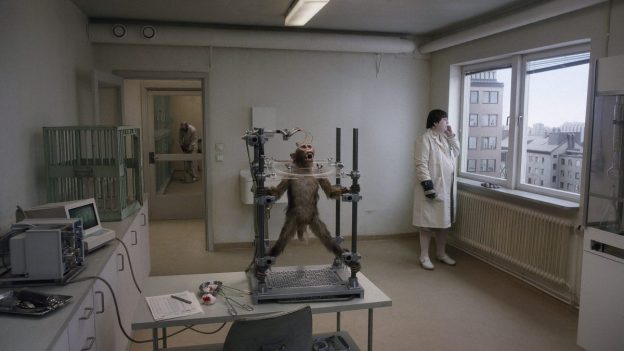
You find us in reflective mood, as we reflect upon a reflective Swedish comedy, Roy Andersson’s A Pigeon Sat on a Branch Reflecting on Existence. Hopping between vignettes, Andersson’s dispassionate camera sits in corners of rooms, its wide angle lens taking in everything on display from wall to wall, as often absurd and sometimes unsettling action slowly unfolds. The final film in Andersson’s “Living” trilogy (2000-2014), it asks, “what are we doing?”; and, as José points out, in one especially disturbing scene, “what have we done?”

José delights in its sense of humour, the film offering deadpan responses to surreal events; while it’s also up Mike’s street, the film’s studied slowness begins to grate on him, and when it loses him after an initial flourish of spontaneous and unpredictable oddness, it fails to win him back. We discuss its origins, its title inspired by Pieter Bruegel the Elder’s The Hunters in the Snow; its focus on life’s less fortunate, and how we interpret their behaviour; moments of stillness that eschew the opportunity for jokes; and its historical references, to World War II, to the brutality of white, and particularly British, imperial history, and to elements of Swedish history that our primitive knowledge of the country keeps us from properly accessing.

Our instinctive responses disagree, but perhaps mostly because of the difference in how comfortably we matched the film’s mood. A Pigeon Sat on a Branch Reflecting on Existence is an undeniably well-made, carefully considered and original work of individual expression and curiosity, and one that inspires boundless questions and interpretations of its own.

With José Arroyo of First Impressions and Michael Glass of Writing About Film.

261 – The City Without Jews

Listen on the players above, Apple Podcasts, Google Podcasts, or Spotify.

1924’s The City Without Jews, an Austrian silent film adapted from Hugo Bettauer’s enormously successful novel of the same name, published two years earlier, imagines a European city undergoing hyperinflation and mass unemployment, blaming the Jews for its problems, and expelling them. Unthinkable! Needless to say, it both drew on and prefigured actual events, but some of the imagery is chillingly evocative of what was yet to occur, including the Chancellor’s proud address from a balcony to the ecstatic crowds below, and the entire depiction of the Jews’ eviction, from being kicked out of their homes to the trains that remove them from the city.

Despite its historical interest, the stories that surround it, including the murder of Bettauer by a Nazi less than a year after its release, and its obvious and depressing relevance 100 years on, The City Without Jews is not a great film, its story and world feeling somewhat poorly thought-out, and its ending rather pat, perhaps the result of the significant changes made in adaptation that led to Bettauer falling out with the director, Hans Karl Breslauer. Nonetheless, it’s a fascinating and thought-provoking film, and worth watching.

With José Arroyo of First Impressions and Michael Glass of Writing About Film.
260 – The Garden of the Finzi-Continis

Listen on the players above, Apple Podcasts, Google Podcasts, or Spotify.

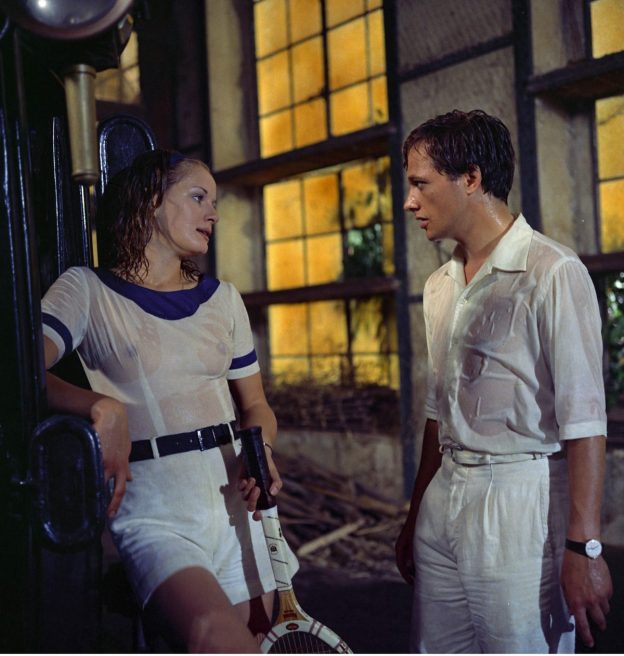
The winner of the 1971 Oscar for Best Foreign Language Film, Vittorio De Sica’s The Garden of the Finzi-Continis tells an aching story of doomed love within a wealthy Jewish community in Fascist Italy. The 1938 racial laws, enforcing the segregation of Italian Jews, have just been introduced, but the titular family’s titular garden offers insulation from the rising tide of fascism – for a while.

Mike finds the film’s love triangle somewhat banal, but is impressed with the subtly observed way in which the central characters allow themselves to remain comfortably ignorant of the increasingly hostile and dangerous Italy beyond their walls; comparisons to frogs in saucepans abound, not to mention the present-day normalisation of absurd corruption and violence in the Greatest Country in the World™. José is more keen on the romance, but still, the film’s sociopolitical side remains our focus. We consider the film’s use of physical space, the ways in which the Jewish characters can navigate it without being suspected by the racist public, but find themselves eager to retreat to safety as the film develops. We note that The Garden of the Finzi-Continis was made 25 years after the end of the Second World War, but 50 years prior to today: it’s now conspicuously an historical artefact that speaks to the time in which it was made, and whose proximity to the horrors it dramatises is necessary to keep in mind. And Mike reflects on his relationship with his Jewishness in this day and age, and how the film demonstrates that whatever divisions we may find among ourselves, to those who hate us, there’s no distinction.

It’s also Bonfire Night – well, the day after, but it’s a Friday evening so the festivities continue – and we celebrate by closing the window and trying to ignore the fireworks going off outside.

With José Arroyo of First Impressions and Michael Glass of Writing About Film.

259 – Love Me Tonight

Listen on the players above, Apple Podcasts, Google Podcasts, or Spotify.

We’re enraptured by a musical neither of has seen before, 1932’s Love Me Tonight, starring Maurice Chevalier as a charming and roguish Parisian tailor, and Jeanette MacDonald as a princess he falls for. Its soundtrack is peppered with Rodgers and Hart classics, and its stunning audiovisual design is endlessly experimental, expressive and exciting. In amongst our swooning over the film’s many pleasures, we find time to discuss the careers of Chevalier and director Rouben Mamoulian, discuss what makes it a uniquely American form of fairytale, and examine the fascinating censorship and production records made available on Kino Lorber’s special edition Blu-Ray.

With José Arroyo of First Impressions and Michael Glass of Writing About Film.
258 – Borat Subsequent Moviefilm

Listen on the players above, Apple Podcasts, Google Podcasts, or Spotify.

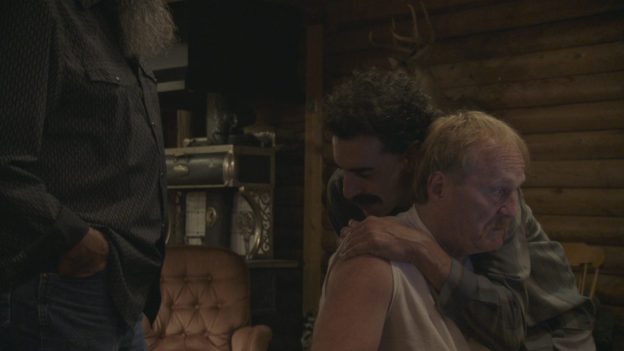
Fourteen years have passed since Sacha Baron Cohen’s first tour of the USA as Borat, his friendly, clueless, and decidedly un-PC Kazakh journalist. Borat gave his unwitting participants, real people who didn’t know that he was a character, space and encouragement to display their bigotry, sexism, racism, and stupidity – now he’s back to do it again, in a world in which bigotry, sexism, racism and stupidity are no longer deemed necessary to hide.

Sexism in particular is this film’s bedrock, the film introducing a daughter, Tutar, who Borat didn’t know about, and when she stows away on her father’s trip, he decides to offer her to Mike Pence as a token of Kazakhstan’s friendship. Women are chattel, and the only objection raised when Borat decides to give the fifteen-year-old Tutar breast implants is that he can’t afford them. Women’s role as playthings for men, and the society that refuses to allow them control over their bodies, shape almost every scene, including a debutante ball, a conversation with a Christian doctor, and of course, THAT scene with Rudy Giuliani.

We also discuss the question of the reality of what we’re seeing and how the film’s camerawork and editing fails to convince us of it, how comedy has changed in the last decade and a half, and how the film unexpectedly gives its unwitting participants the opportunity to be tolerant and welcoming. And we each share memories of our grandmothers.

With José Arroyo of First Impressions and Michael Glass of Writing About Film.
257 – Antz

Listen on the players above, Apple Podcasts, Google Podcasts, or Spotify.

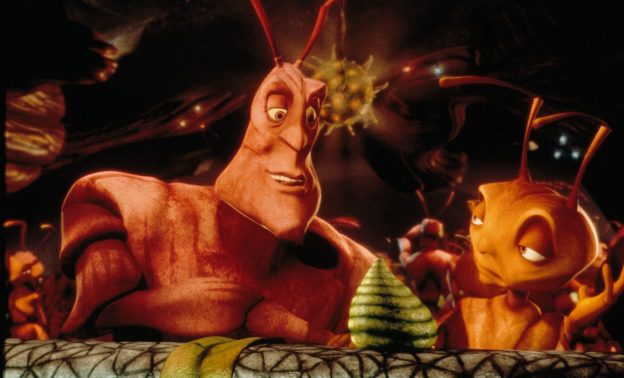
The second feature-length computer-animated film ever made, after Pixar’s groundbreaking Toy Story, Antz is an oddball. A public feud between Jeffrey Katzenberg and then-CEO of Disney, Michael Eisner, led to Katzenberg founding Dreamworks SKG and subsequently feuding with Pixar’s John Lasseter, who was making the suspiciously similar – and ultimately more successful – A Bug’s Life. Pixar is the historically more successful and well-regarded studio, and the direct comparison between these two films usually sees Antz considered inferior, but Mike’s long been fond of it, and in revisiting it we discuss both how far it shows us animation has come in the last twenty years, and its many qualities, including its rather grown-up tone and references, imaginative and expressive visual design and cinematography, and witty dialogue.

Oh, and we try to work out how children think.

With José Arroyo of First Impressions and Michael Glass of Writing About Film.

256 – Playtime

Listen on the players above, Apple Podcasts, Google Podcasts, or Spotify.

Jacques Tati’s masterpiece, 1967’s Playtime, is an extraordinarily ambitious work of visual comedy and social satire. Mike’s been keen to see this for fifteen years or more, knowing of its reputation for detailed visual design and the 70mm cinematography that shows it off, waiting for the right moment. José, when Mike suggests we watch it, thinks he’s seen it many years ago, but soon realises he was probably thinking of Monsieur Hulot’s Holiday, Tati’s rather more charming comedy of fourteen years prior, so it takes him a while to get into Playtime‘s rather more offbeat gear.

And he is ultimately a little cold to the film, though not immune to its appeal and pleasures, while Mike loves it unconditionally. In a somewhat alternate, near-future Paris, the plot, such as it is, follows two characters: Monsieur Hulot, the character Tati played in several films, as he stumbles through a France he finds unfamiliar and devoid of humanity; and Barbara, an American tourist visiting the city. In approximately six fairly distinct vignettes, Tati explores a vision of a consumerist, modern, and alienating Paris, the Eiffel Tower, symbolising the warm, cosy Paris of old, a long way away, merely a distant feature on the horizon or a reflection in a window. It’s an attitude for which José has little sympathy, though Mike suggests that the development of the final scene, a kind of funfair around a traffic jam, can be seen as a synergy of the traditional and modern, and finds it moving.

There’s a huge amount to discuss, including the design and execution of the jokes; the impossible scale of the set, nicknamed ‘Tativille’ and whose astronomical cost would ruin Tati, who was forced to file for bankruptcy; to what other films, if any, it can be compared; the visual design, cinematography, choreography, and colour; the use of nationality, particularly American; and how the film might play differently today compared to upon its initial release – Mike arguing that it may have anticipated changes to the real world that would later materialise, such as the cubicle office, whose familiarity to us diminishes the otherworldliness we might otherwise feel.

Playtime is a significant work of satire and well worth seeing, particularly given its beautiful restoration in 2014. Don’t miss it for fifteen years. Don’t be Mike.

With José Arroyo of First Impressions and Michael Glass of Writing About Film.

255 – The Shop Around the Corner and You’ve Got Mail

Listen on the players above, Apple Podcasts, Google Podcasts, or Spotify.

One a great masterpiece of cinema, the other a cultural icon of its day, we compare and contrast Ernst Lubitsch’s The Shop Around the Corner with Nora Ephron’s technologically updated remake, You’ve Got Mail. We discuss how each film treats its conceit of two people who dislike each other unwittingly falling in love over anonymous correspondence, the former film’s couple hating each other less vitriolically, the latter giving us more insight into the details of their messages; the latter making their story the entire focus, the former handling it as the main part of a range of stories that take place amongst its characters.

We consider whether James Stewart’s Alfred and Tom Hanks’s Joe are nice people, and what the films’ endings have to say about them and the women they fall for. José focuses on the films’ approach to class and power, praising The Shop Around the Corner‘s portrayal of working people and decrying You’ve Got Mail for barely even seeming to notice its uncritical acceptance of corporate power. And we consider more besides, including how Lubitsch’s camera makes a static setting evocative and expressive, that Godfather bit, and the similarities and differences in Hanks and Stewart’s often-compared personas.

With José Arroyo of First Impressions and Michael Glass of Writing About Film.
254 – L.A. Confidential

Listen on the players above, Apple Podcasts, Google Podcasts, or Spotify.

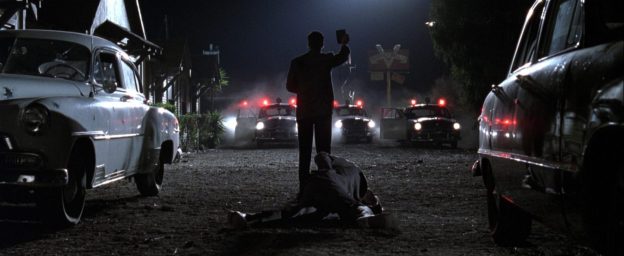
A corrupt police force intersects with the glamour of Hollywood in L.A. Confidential, the tightly-plotted neo-noir that won the Oscars for Best Adapted Screenplay and Best Supporting Actress in a year dominated by Titanic, and established the status and careers of Russell Crowe, Guy Pearce and Kevin Spacey. Over twenty years since its enormously successful release, does it hold up? We discuss its basis in the real history of L.A. and its sense of place, whether the screenplay deserves its plaudits, how it functions as a noir and more.

With José Arroyo of First Impressions and Michael Glass of Writing About Film.