Paolo Sorrentino reaches into his childhood to tell a story that’s in equal parts comic and tragic, with access to the off-kilter and fabulistic, in The Hand of God – whose title references that infamous goal scored by Diego Maradona, who Sorrentino semi-seriously credits with saving his life – as he dramatises here. We discuss the imagery, the familial banter, the curious opening scene, choosing Naples over Rome, and an oddball friendship with a happy-go-lucky smuggler.
After eighteen years away and vast changes in the blockbuster landscape in which it once broke incredible new ground, the Matrix series is back with a fourth film, The Matrix Resurrections. Keanu Reeves’ Neo is once again plugged into the Matrix as Thomas Anderson, but having trouble separating reality from dreams of events that happened twenty years ago… if dreams are what they are.
We discuss Resurrections‘ endless self-reflexivity, how it uses motifs and themes of the previous films, updating them where necessary and bringing more out of them (Mike is glad of the much improved use of mirrors). We also consider the film’s inclusivity, which is key to the Wachowskis’ work, and an uncomplicated joy here – it’s not difficult for people from a range of ethnic backgrounds and situated in different places along sexual and gender spectra to coexist in a blockbuster with no particular importance placed upon their identities, as Resurrections proves. You just have to want to do it, and the world that results is beautiful. And, at heart, it’s a middle-aged romance – for which José swoons!
Resurrections isn’t without its issues, and we consider those too – Mike asks whether the sense of wonder associated with the special effects of the original films is simply gone forever in a world in which literally anything can be done, and is, with all-powerful CGI, and we agree that the action is a Bourne-inflected disappointment, especially so in a series that itself spawned so many imitators of its own action scenes two decades ago.
But seen in its entirety, The Matrix Resurrections is an imaginative and interesting continuation of the story begun twenty years ago, and a holistic triumph of well-intentioned, positive and effortless representation. Whoever thought we’d get a fourth Matrix? And that it would be this different, and this good?
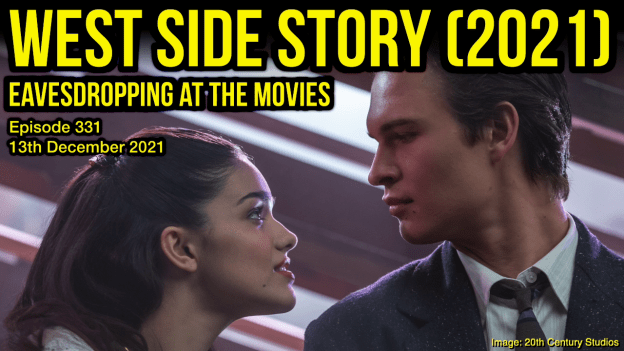
Steven Spielberg’s remake of West Side Story is here at last. The obvious question it raises is just why such a well-regarded film needs a remake – and the answer quickly becomes clear. Robert Wise’s 1961 adaptation of the 1957 stage musical is indeed a classic, but this new version comes from and enters a different America, one in which its message, José argues, is more urgently needed but faces a more difficult challenge to be heard. And on top of that, it’s just a really good film.
We discuss the film’s use of colour and lighting, the brutality of the violence and believability of the gangs and particularly Riff, the Jets’ leader, the purpose and effects of having a lot of dialogue spoken in entirely unsubtitled Spanish, and much more. The songs are timeless, the romance heartfelt, the imagery beautiful. West Side Story is a great success.
Corrections and clarifications: José would like to apologise for attributing West Side Story‘s original choreography to George Balanchine, when it was in fact created by Jerome Robbins. José has been disciplined and promises that it will not happen again.
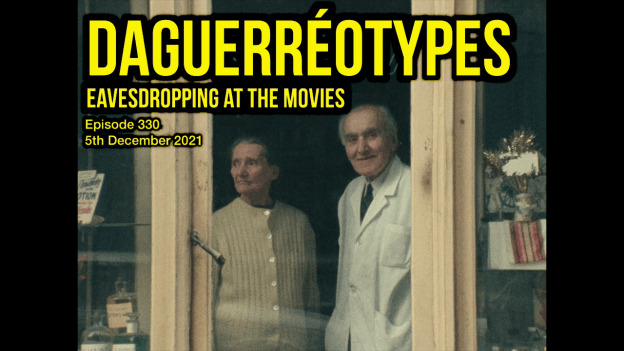
In 1975, caring for her infant son and unable to spend much time away from home, Agnès Varda turned her camera on her neighbours on her street, Rue Daguerre in Paris. In Daguerréotypes – the title a pun on the photographic process for whose inventor the road is named – she both observes them at work, running their shops and providing their services, and asks them questions about their lives, discovering where they’re originally from (most are not Paris natives) and how they met their husbands and wives. It’s a gentle, relaxed form of portraiture, one that combines imagery of the practicalities of daily work with the subjects’ descriptions of dreams and histories – although the use of a travelling magician’s show is arguably a little too precious. We discuss the different ways in which we respond to their stories, José commenting on Varda’s clear affection for the subjects, Mike arguing that there’s a tragic dimension that overhangs the film, with talk of dreams and escape.
Daguerréotypes is a sensitive portrait of a local community and a time capsule of an era that is now half a century old, and worth watching.
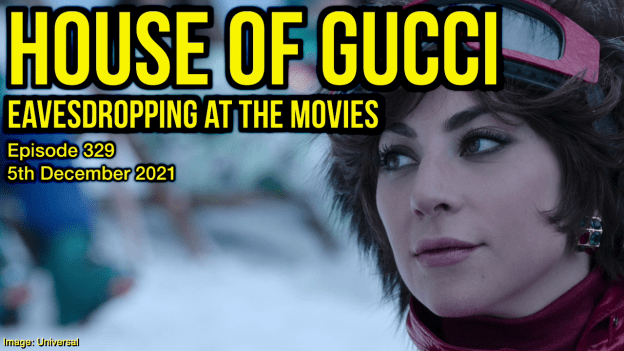
A true story of love, ambition, passion, betrayal, and retribution, House of Gucci is entertaining, interesting, and beautifully played… so why isn’t it good enough? We discuss its lack of seriousness of purpose, its failure to express itself with visual flair and use the camera to show us things we really need to see, and how it would have benefitted from giving Lady Gaga’s Patrizia the unambiguous spotlight, rather than making her part of an ensemble. House of Gucci is a film that we have no problem recommending, but given everything it could have been, to come away feeling like it’s a trifle is disappointing.
As he did with 2016’s Jackie, director Pablo Larraín explores the life, image, and legacy of a woman publicly struck by tragedy in Spencer, a fabulistic biopic that imagines a Christmas holiday spent with the royal family at Sandringham, during which Princess Diana struggles with the knowledge of her husband’s affair and the watchful eyes of both the royals and the paparazzi.
We discuss our own relationships to both Larraín and Diana, and consider how the film draws on various aspects of the princess’s public image in painting a portrait of a woman losing her mind. The film is set squarely within that mind, and Mike argues that it uses several tropes and techniques common to horror in order to dramatise Diana’s fracturing mental state. José expresses his love for Kristen Stewart’s outstanding lead performance, one that doesn’t impersonate but evokes, and conveys differing stages of psychosis with subtlety.
We don’t agree on everything, and the film isn’t perfect, but Spencer is a really remarkable, expressive exploration of an iconic figure.
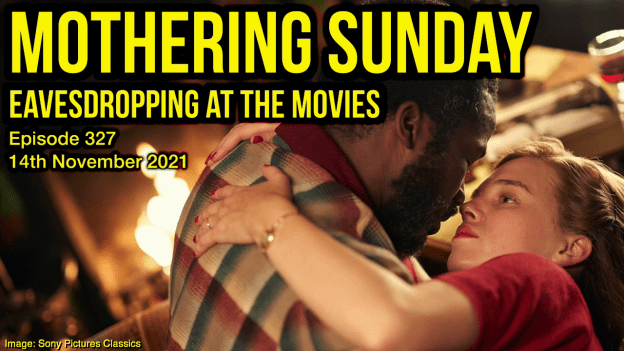
A film of surprising delights – certainly for Mike, who hates anything that looks like it could appear on ITV – Mothering Sunday tells the story of one key 1924 day in the life of a young maid. It’s a film filled with grief and lust, beautifully shot and featuring the best of British acting, Colin Firth and Olivia Colman’s performances subtly modulated and multifaceted. It’s imperfect, failing to engage with race as it perhaps should, and a framing device feels rather unnecessary – but it’s a moving and sensitive film.
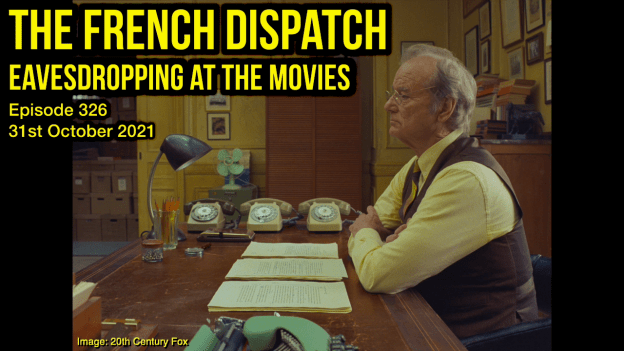
The French Dispatch, Wes Anderson’s love letter to The New Yorker, is, as you might expect, a charming way to pass a couple of hours – but not as funny or as tight as we might like, and certainly a disappointment in the light of his last two films, The Grand Budapest Hotel and Isle of Dogs (although, in fairness, reaching those heights even twice, let alone a third time consecutively, would be a big ask for anybody). Still, despite The French Dispatch‘s pleasures, some gorgeous imagery and a terrific, star-packed cast, we’re left asking what it’s all about, really – is it more than a vaguely diverting trifle based on Anderson’s favourite publication? And why can’t an ode to an icon of American sophistication be set in America?
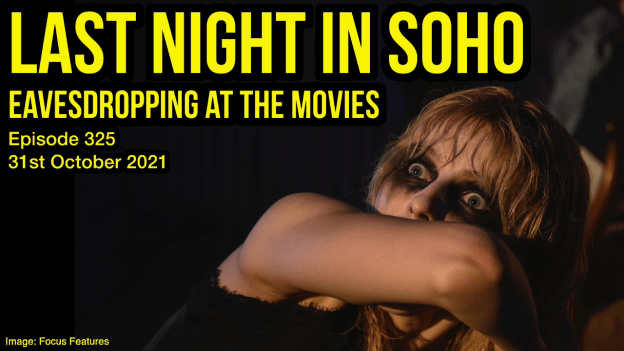
Edgar Wright’s highly anticipated psychological horror, Last Night in Soho, reaches cinemas, and we dive into its themes, its visual magnificence, its relationship to the era and environment it portrays… and its problems. It’s impossible not to admire this film for its lush cinematography, impressive special effects, and the best of its performances, but its screenplay leaves a huge amount to be desired, not just in how it conceptualises the world and people it portrays, but also, more simply, how clumsy it is in telling its story, bafflingly dropping entire character threads that seem like they obviously have places to go, and handling at least one secondary character’s entire subplot very poorly. We discuss the film’s dream logic, or lack thereof; its fear of the very lure of the grimy world it needs to show us, and the moralism that accompanies it; how it trades in nostalgia of Sixties Soho, despite being keen to exhibit is dark side; and the thematic simplicity of almost everything – things are good or bad, to be loved or feared, and room for complexity, there is none.
With all that said, it’s still a very enjoyable couple of hours, a discussion piece, and thanks to its fabulous imagery and in particular the performances of Anya Taylor-Joy and Matt Smith, easy to recommend.
P.S. Mike would like to acknowledge that he is aware that in the course of speaking too quickly for his brain to issue timely corrections, he wildly overstated how much the ghostly figures in Last Night in Soho are referred to as “blank” or “blanks”. It happens maybe once or twice, if he remembers rightly, and in passing. But he asserts that nonetheless, their faceless, amorphous, anonymous design and relentless, zombie-like behaviour does make them a fair point of comparison with the Blanks in The World’s End. So nyah.
In a chilly outdoor screening at the Coffin Works in Birmingham, we indulge in Nosferatu, F. W. Murnau’s 1922 German Expressionist classic. José’s seen it many times, Mike never in its entirety. We discuss how this 100-year-old film holds up today and still entertains a general audience, its differences from and similarities to Dracula, its source material, and more. Including how cold it was. Mike only wore a t-shirt.




 Eavesdropping at the Movies