We’re enraptured by a musical neither of has seen before, 1932’s Love Me Tonight, starring Maurice Chevalier as a charming and roguish Parisian tailor, and Jeanette MacDonald as a princess he falls for. Its soundtrack is peppered with Rodgers and Hart classics, and its stunning audiovisual design is endlessly experimental, expressive and exciting. In amongst our swooning over the film’s many pleasures, we find time to discuss the careers of Chevalier and director Rouben Mamoulian, discuss what makes it a uniquely American form of fairytale, and examine the fascinating censorship and production records made available on Kino Lorber’s special edition Blu-Ray.
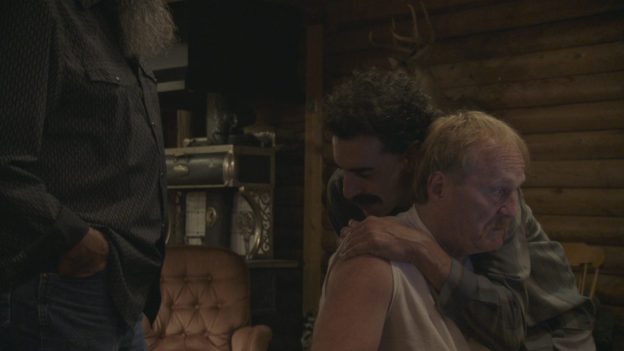
Fourteen years have passed since Sacha Baron Cohen’s first tour of the USA as Borat, his friendly, clueless, and decidedly un-PC Kazakh journalist. Borat gave his unwitting participants, real people who didn’t know that he was a character, space and encouragement to display their bigotry, sexism, racism, and stupidity – now he’s back to do it again, in a world in which bigotry, sexism, racism and stupidity are no longer deemed necessary to hide.
Sexism in particular is this film’s bedrock, the film introducing a daughter, Tutar, who Borat didn’t know about, and when she stows away on her father’s trip, he decides to offer her to Mike Pence as a token of Kazakhstan’s friendship. Women are chattel, and the only objection raised when Borat decides to give the fifteen-year-old Tutar breast implants is that he can’t afford them. Women’s role as playthings for men, and the society that refuses to allow them control over their bodies, shape almost every scene, including a debutante ball, a conversation with a Christian doctor, and of course, THAT scene with Rudy Giuliani.
We also discuss the question of the reality of what we’re seeing and how the film’s camerawork and editing fails to convince us of it, how comedy has changed in the last decade and a half, and how the film unexpectedly gives its unwitting participants the opportunity to be tolerant and welcoming. And we each share memories of our grandmothers.
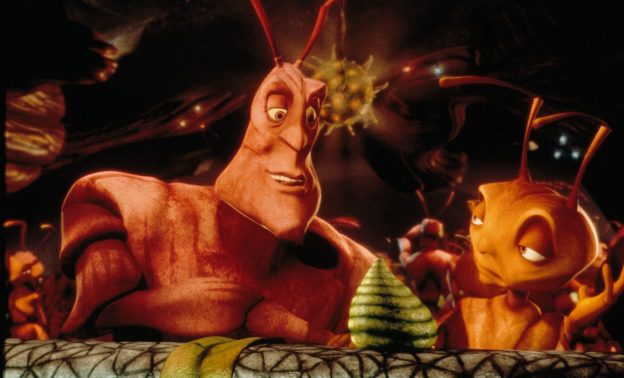
The second feature-length computer-animated film ever made, after Pixar’s groundbreaking Toy Story, Antz is an oddball. A public feud between Jeffrey Katzenberg and then-CEO of Disney, Michael Eisner, led to Katzenberg founding Dreamworks SKG and subsequently feuding with Pixar’s John Lasseter, who was making the suspiciously similar – and ultimately more successful – A Bug’s Life. Pixar is the historically more successful and well-regarded studio, and the direct comparison between these two films usually sees Antz considered inferior, but Mike’s long been fond of it, and in revisiting it we discuss both how far it shows us animation has come in the last twenty years, and its many qualities, including its rather grown-up tone and references, imaginative and expressive visual design and cinematography, and witty dialogue.
Jacques Tati’s masterpiece, 1967’s Playtime, is an extraordinarily ambitious work of visual comedy and social satire. Mike’s been keen to see this for fifteen years or more, knowing of its reputation for detailed visual design and the 70mm cinematography that shows it off, waiting for the right moment. José, when Mike suggests we watch it, thinks he’s seen it many years ago, but soon realises he was probably thinking of Monsieur Hulot’s Holiday, Tati’s rather more charming comedy of fourteen years prior, so it takes him a while to get into Playtime‘s rather more offbeat gear.
And he is ultimately a little cold to the film, though not immune to its appeal and pleasures, while Mike loves it unconditionally. In a somewhat alternate, near-future Paris, the plot, such as it is, follows two characters: Monsieur Hulot, the character Tati played in several films, as he stumbles through a France he finds unfamiliar and devoid of humanity; and Barbara, an American tourist visiting the city. In approximately six fairly distinct vignettes, Tati explores a vision of a consumerist, modern, and alienating Paris, the Eiffel Tower, symbolising the warm, cosy Paris of old, a long way away, merely a distant feature on the horizon or a reflection in a window. It’s an attitude for which José has little sympathy, though Mike suggests that the development of the final scene, a kind of funfair around a traffic jam, can be seen as a synergy of the traditional and modern, and finds it moving.
There’s a huge amount to discuss, including the design and execution of the jokes; the impossible scale of the set, nicknamed ‘Tativille’ and whose astronomical cost would ruin Tati, who was forced to file for bankruptcy; to what other films, if any, it can be compared; the visual design, cinematography, choreography, and colour; the use of nationality, particularly American; and how the film might play differently today compared to upon its initial release – Mike arguing that it may have anticipated changes to the real world that would later materialise, such as the cubicle office, whose familiarity to us diminishes the otherworldliness we might otherwise feel.
Playtime is a significant work of satire and well worth seeing, particularly given its beautiful restoration in 2014. Don’t miss it for fifteen years. Don’t be Mike.
One a great masterpiece of cinema, the other a cultural icon of its day, we compare and contrast Ernst Lubitsch’s The Shop Around the Corner with Nora Ephron’s technologically updated remake, You’ve Got Mail. We discuss how each film treats its conceit of two people who dislike each other unwittingly falling in love over anonymous correspondence, the former film’s couple hating each other less vitriolically, the latter giving us more insight into the details of their messages; the latter making their story the entire focus, the former handling it as the main part of a range of stories that take place amongst its characters.
We consider whether James Stewart’s Alfred and Tom Hanks’s Joe are nice people, and what the films’ endings have to say about them and the women they fall for. José focuses on the films’ approach to class and power, praising The Shop Around the Corner‘s portrayal of working people and decrying You’ve Got Mail for barely even seeming to notice its uncritical acceptance of corporate power. And we consider more besides, including how Lubitsch’s camera makes a static setting evocative and expressive, that Godfather bit, and the similarities and differences in Hanks and Stewart’s often-compared personas.
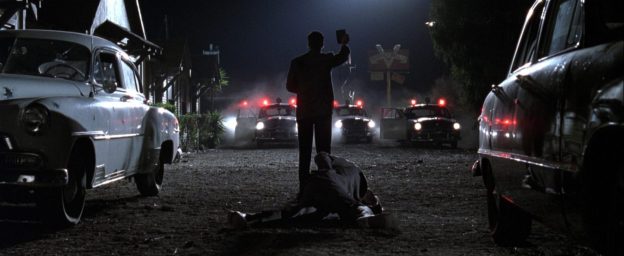
A corrupt police force intersects with the glamour of Hollywood in L.A. Confidential, the tightly-plotted neo-noir that won the Oscars for Best Adapted Screenplay and Best Supporting Actress in a year dominated by Titanic, and established the status and careers of Russell Crowe, Guy Pearce and Kevin Spacey. Over twenty years since its enormously successful release, does it hold up? We discuss its basis in the real history of L.A. and its sense of place, whether the screenplay deserves its plaudits, how it functions as a noir and more.
Horror tropes pervade I’m Thinking of Ending Things, Charlie Kaufman’s oddball drama about a girl doubting her relationship, but it can’t be considered a traditional horror. Instead, it turns these tropes inwards, likening a controlling, toxic relationship to an isolated, threatening, haunted house. It’s a fascinating and brilliant idea, but despite the film being well-observed and intriguing, it’s not engaging enough, and offers little opportunity for confident interpretation. Mike has little sympathy for its developing surreality; José wants more humour. Still, it’s an ambitious, interesting film, and worth delving into.
Birmingham’s full-size IMAX cinema closed in 2011, having proved unprofitable (the independent venue it became, the Giant Screen, closed four years later for the same reason), so it’s off to the Manchester Printworks, home of the second-largest screen in the UK, for our second viewing of Tenet. We ask whether the full IMAX experience is worth it, Mike comparing the feeling of the images offered to those he saw in Dunkirk and The Dark Knight; José argues that it’s detrimental to the film to be exhibited in different cinema formats, as shooting in IMAX’s 1.43:1 aspect ratio, where the film is supposedly best seen, with the knowledge that it’ll be cropped for conventional cinema screens for its wide release and home media, means that artistic, interesting composition is impossible – you can’t compose well for two frames at once.
Mike suggests that an easily overlooked pleasure of Christopher Nolan’s cinema is turning his films over in your own head, playing with the logic, asking questions of it and trying to unlock the puzzle box – something he’s been doing since his first screening, and which we both spend some time on after this one. Laying out the timeline, speculating on what might happen that we’re not shown – this isn’t the first of Nolan’s films to invite that type of reflection. And Mike describes the pleasure of understanding things that aren’t hidden but simply too many to grasp all at once the first time – now that he broadly knows the film, things that left him confused at first now smoothly fall into place.
We reflect again on the film’s score, performances, and action scenes, finding that rather than changing our initial impressions, this second viewing helps us to perceive and explain better what made us feel the way we did at first. We find more to discuss – the use of Elizabeth Debicki’s height, the cost of Nolan’s adherence to achieving visual effects without the use of CGI, the pleasure of the way in which Aaron Taylor-Johnson’s character interacts with the heroes, whether Mike is just shit at watching spy movies – but our overall experience hasn’t changed. What we liked, we still like; what we didn’t, we still don’t.
(Mike’s short film, which he claims was harder to make than Tenet, can be seen below. It’s probably worth mentioning that if you still don’t know what Tenet is about, watching this could constitute a spoiler of sorts – after all, Mike brought it up because of its vague similarities.)
After a long wait and three delays, Christopher Nolan’s latest high-concept blockbuster, Tenet, has finally arrived in British cinemas. This description is a spoiler-free zone, but the podcast is decidedly not, so tread carefully before you listen: We spill every secret the film has to hold. The ones we could figure out, anyway.
Following our revisitation of five of Nolan’s massive flicks – the DarkKnighttrilogy, Interstellar, and Inception – we’re keen to see how Tenet fits amongst its brethren. We consider, as we have done repeatedly, Nolan’s action direction, the aesthetic design, the tone, the concept that drives everything, how it’s explained, what we love, what let us down, and, well… to detail anything further would be indecent.
Mike is gobsmacked by it, finding brilliance in some of the film’s execution, though is keen to make more than a few criticisms. José is much colder towards it, dismissing it as no more interesting than comic books for children – can Mike’s enthusiasm rub off on him? Tenet has its flaws, but it’s ambitious, intriguing, large-scale, wonderfully cast and acted – it’s worth your time.
What She Said: The Art of Pauline Kael gives us the opportunity to reflect on a woman who, for José, stands above all other popular film critics, and whose work has always remained resonant. Pauline Kael effused about, excoriated, and defined an era of cinema and the culture that surrounded it, and changed the way films were written about. Through interviews with other critics, filmmakers and her daughter, Gina James, What She Said tells the story of Kael’s life, work, philosophies, and controversies.
And not very well. The documentary doesn’t ask interesting enough questions about Kael’s life, glossing over areas that just beg to be explored, such as the relationship that produced Kael’s daughter, which is handled only with a cursory line of superimposed text. José finds fault with the use of Sarah Jessica Parker to recite excerpts of Kael’s reviews, feeling it to be wasted time; Mike argues that we’re here because of her work, so it’s sensible to include examples of it, and the use of appropriate film clips to accompany the words works well. Wasted time or not, the film doesn’t show much interest in digging deep.
However, there’s pleasure to be had in spending time with What She Said‘s interviewees, and sinking into its vast assortment of archive footage and illustrative film clips. It’s a fan film, in the end, and enjoyable if approached with that in mind, and though Mike finds it hagiographic, José is glad of it as a corrective to Kael’s detractors, of whom there were many, who saw her as a harridan and whose sparring with her almost always had an obviously misogynist component. It’s an unsatisfying documentary, but well-meaning, and recommended to anyone with an interest in film culture and its history.






 Eavesdropping at the Movies