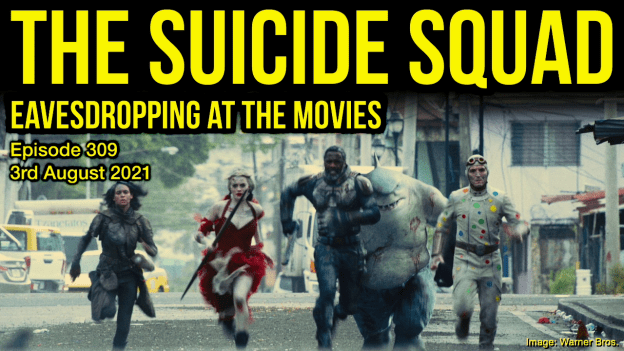
Apparently dissatisfied with the dismal reception of 2016’s Suicide Squad, DC has bravely decided to vaguely reboot the property with a spot-the-difference name change to The Suicide Squad, probably hoping that this new film will effortlessly send its predecessor down the memory hole. We ask whether it hits that whimsical tone it clearly wants to and discuss imperialism, satire, racism, gazing at males, rats, story structure, excessive volume and more.
Reminding José of 1970s auteur exploitation movies and Mike of The Twilight Zone, M. Night Shyamalan’s Old confines its characters, and most of its action, to an isolated beach at a high-class tropical resort. As you might expect with Shyamalan, it’s best seen with little advance knowledge, as the plot twists and turns, revelations throwing previous events into new light.
But we do, indeed, encourage you to see it – it’s perhaps the most entertaining film Shyamalan’s made in some time, and although his dialogue isn’t the finest you’ll ever hear, his camerawork is some of the most interesting. He’s a director who always seeks an interesting or expressive composition, who isn’t satisfied with shot-reverse shot, and his enthusiasm for the image is infectious. Some things could be better – some dramatic moments could be heightened, and it’s a fairly thin film that may not reward a second viewing, when there’s no hope of surprise. But the first viewing is an engrossing one, and we recommend it.
1996’s Space Jam is beloved of people Mike’s age throughout the Western hemisphere, despite basketball’s limited reach beyond North America – it was a Looney Tunes film, full of imagination and laughs, and is today a nostalgic linchpin for millennials. And because millennials now make films, it’s back, twenty years on, with Space Jam: A New Legacy, featuring LeBron James in Michael Jordan’s central role as the basketball star who joins forces with the Looney Tunes to defeat a team of superpowered villains.
But the wit and tone of the 1996 original is nowhere to be found here, beyond those unacceptably brief moments in which Bugs Bunny and co. get to shine. There’s a heavy focus on family, a theme that’s come up more than a few times on recent podcasts and never feels intelligently explored, with LeBron’s son held hostage in scenes that are supposed to heighten the sense of threat but in fact just grind any sense of entertainment to dust. But even that isn’t the film’s biggest problem – it’s the corporate project of it all.
Now, that a big-budget studio property has a corporate project to it is no surprise, but the extent of A New Legacy‘s is shocking. As LeBron and his son are sucked into Warner Bros.’ computers, the studio’s back catalogue becomes their universe, quite literally. The Looney Tunes have a planet. Harry Potter has a planet. Game of Thrones has a planet. Even Casablanca has a planet. And throughout, clips from old films are invaded by the Looney Tunes, references pop up constantly, and characters from countless properties pepper the crowd at the climactic basketball game. Any of these alone is nothing to screech about, and indeed, spotting characters and references is fun on its own merit – but the ethos behind it all, of making Warner Bros. the sole provider of culture in a universe pathetically dependent on the work it cannibalises from itself, is as revolting as it is revoltingly proud of itself. It really has to be seen to be believed. But in order to believe it you’d have to see it. What a dilemma.
So, no. We don’t recommend Space Jam: A New Legacy. Mike’s still going to try to get José to watch the first one though.
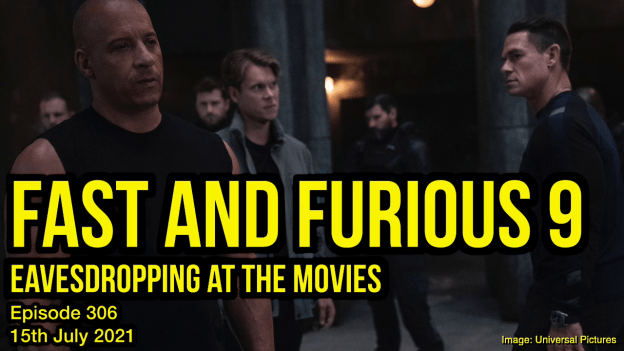
What began twenty years ago as a series of car chases and races has since spiralled out of control into an action behemoth encompassing ten films, a TV series, videogames, and theme park attractions. But for the spinoff film Hobbs & Shaw, Fast and Furious 9 is Mike’s introduction to the Fast & Furious series, with José having seen some of the previous instalments, but not all.
We discuss the soap opera storytelling, the way it expresses humour – what it thinks are jokes are really just aggressive, macho posturing – and what it thinks of intelligence, José contending that it represents the worst of American culture in privileging stupidity and making it victorious, with Mike offering a complementary drop of nuance, arguing that it does at least believe that its heroes are smart… but it’s a stupid person’s idea of what being smart is. Core to the film’s failings is its almost complete lack of irony, only the car-turned-space shuttle indicating that the film has any understanding of comedy and how absurd it all is.
There’s no recommending Fast and Furious 9, its shortcomings exposed by the competence of almost every other action blockbuster (even Hobbs & Shaw, which had its own problems, but was a pleasant surprise). On the basis of this, Mike’s curiosity has been sated, and he’s happy to continue avoiding this godforsaken series for the rest of his life.
Marvel’s triumphant return to our cinemas is… a film that fills in a plot hole nobody cared about for a character who not only should have had a standalone film long before now but who has since been killed off. To say that Black Widow feels like a kick in the teeth is an understatement, but still, the MCU is back with us and we see what it has to offer.
And what it presents us with is something much more earthbound than the spacefaring antics in which Marvel has increasingly indulged: a good old-fashioned Russian spy story, and a family reunion of sorts, Natasha Romanoff driven to reconnect with the other undercover Russian agents who formed her surrogate family as a child. We ask whether the theme of family is done justice here, especially the father’s part in its expression. And, among others, we ask questions of the action filmmaking, the lack of humour in heroes, Romanoff’s conceptualisation, how the women are filmed, and whether it’s necessary to eschew edginess in order to pursue a progressive politics.
Black Widow is a film we enjoyed, though on reflection, picking out the reasons why is harder than picking at its flaws – but it certainly hasn’t dampened our willingness to continue following Marvel’s movies.
An offbeat, gentle, surreal, intriguing and slightly camp comic drama, French Exit is a pleasant surprise for us both. Michelle Pfeiffer’s widowed heiress, reduced to selling her late husband’s property, takes what’s left of her life – her cat, adult son, and attitude – to an apartment in Paris, where she resolves to spend her remaining money before ending her life. Sounds hilarious.
And indeed it is, its director, Azazel Jabocs, demonstrating a mastery of tone. We discuss what makes the film work, its visual design, its relationship with and attitude towards money, how that campness José perceives is kept subdued, and more. French Exit isn’t a perfect film by any means, but it is a good one, and a charming way to spend a couple of hours.
The sequel to one of the first films we discussed on Eavesdropping at the Movies, The Hitman’s Wife’s Bodyguard reunites Samuel L. Jackson’s hitman, Ryan Reynolds’ bodyguard, and Salma Hayek’s hitman’s wife – whose role is significantly expanded from the first film’s bit part. The vaguely sketched plot – Antonio Banderas wants to blow up Europe or something, and that’s enough detail – is the wire hanger upon which jokes and comic character interplay are draped, but, crucially, is the comedy successful?
Whether it is or isn’t, and what we read into the audience response, is up for discussion, as is the deployment of the stars’ personas and cinematic histories, what renders Ryan Reynolds’ schtick endearing here where it’s normally irritating, and whether the film’s sexual dimension is overly vulgar or too one-sided.
José has seen The Hitman’s Wife’s Bodyguard twice now, and is no less in thrall to Hayek’s aggressive, wild performance the second time, loudly and enthusiastically responding to it. Mike is much less impressed with the film, but does admit to warming up to it in the second half, after a particularly mad joke that we won’t spoil here (but do in the podcast). If there are more Hitman’s Bodyguard films to come, hopefully with increasingly deliberately clunky titles, we’re up for them.
Before Lin-Manuel Miranda shot to fame in the mid-2010s with Hamilton, he had already enjoyed success with his 2005 musical, In the Heights, with a book by Quiara Alegría Hudes, winning four Tonys for its Broadway production in 2008. Set in Washington Heights, a largely Dominican neighbourhood in Upper Manhattan, it now comes to cinemas, following the lives, struggles and dreams of its inhabitants, who simply cannot stop singing.
Well, singing and rapping – and it’s the rapping that shines, Miranda’s lyrics as witty and intricate as those in Hamilton, while the singing is less impressive, and the domain of the film’s women, who Mike wishes had been given the opportunity to rap. We discuss our disappointment in the direction – the film is full of visual ideas that aren’t executed to their fullest potential – and its relationship to the cultures and peoples it portrays.
In the Heights has its flaws, but despite them, it’s an immensely likeable portrait of life in its locale, José in particular, an immigrant to North America himself, recognising a lot of what it depicts and loving the way it shows off the cultures around which it’s based. We pick fault with it, because that’s what we do, but don’t let that stop you from seeing and enjoying it.
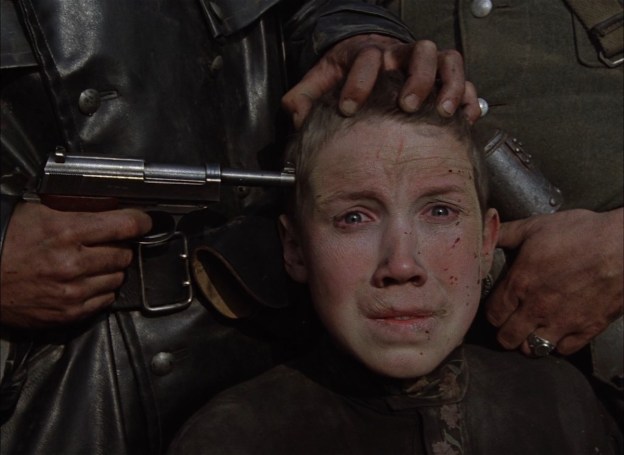
We explore Come and See, a 1985 Soviet film whose reputation precedes it – it’s regarded as one of the greatest war films of all time. In 1943 Belarus, a young teenager, Flyora, joins the resistance, but as he travels from village to village across Nazi-occupied Belarus, experiencing worsening horrors and atrocities brought upon the locals, the extent to which he is out of his depth gradually becomes clearer and clearer.
Part of Come and See‘s reputation is of being hard to watch, something we both take issue with – it goes to some deeply unpleasant places, but it’s a gradual descent rather than an onslaught. That the film is regarded as such a trial has likely caused some filmgoers to unnecessarily avoid an experience that they would value. While it depicts shocking imagery and events, it’s shot with an ethical eye – everything that’s shown has a purpose, and that which would be excessively prurient is often avoided.
We also consider the use of supernatural and fairytale aesthetics to place us in the mind of an innocent teenager, and the repeated portrait photography that shows the deepening scars the film’s events leave upon him. We also discuss the film’s view of Hitler and how it espouses a kind of great man theory in placing him as an icon at the centre of the Nazis’ crimes, and the explosion of audiovisual imagination that is the final scene.
Come and See is a beautifully made expression of the hideous costs of war on the innocent, and on our humanity. It’s imaginative, intelligent, moving and shocking, and, we might add, beautifully restored. If you’ve avoided it on the basis of its notoriety, we urge you to reconsider. It’s truly great.
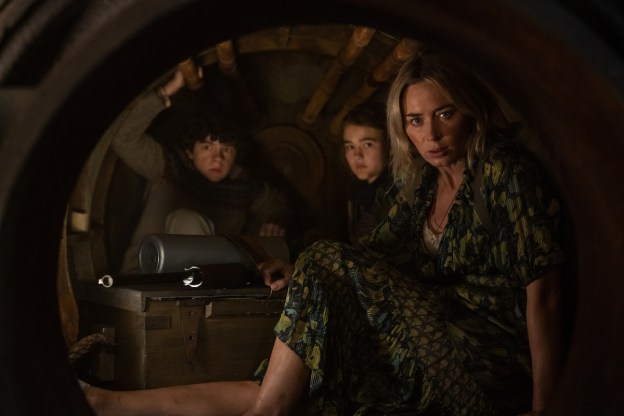
A Quiet Place Part II picks up moments after its 2018 predecessor ends, its characters desperate for refuge from the terrifying predators hunting them. Seeking survivors, they encounter a family friend, now a recluse, having lost his wife and children. Emboldened by her discovery of a way to combat the aliens, the family’s deaf daughter makes a beeline for a radio station she believes can help, and what was a home invasion horror becomes an action adventure.
While accommodating this alteration in tone, A Quiet Place Part II offers, as sequels tend to do, more of what made the first film so successful, and it’s terrifically entertaining cinema – but a diminished experience, compared to its predecessor, in almost every way. We consider the film’s view of society, the uncritical whiteness in its casting and its inability to imagine ways of living that don’t involve the nuclear family unit; and the lack of threat we feel, despite its functional and well-orchestrated set-pieces – we simply never feel like these characters are at any real risk of being allowed to die.
We have problems with A Quiet Place Part II, but don’t let them dissuade you from seeing it. It’s exciting and made José jump time and time again – we just wish, both in cinematic and social terms, it could see beyond its rather narrow boundaries.




 Eavesdropping at the Movies