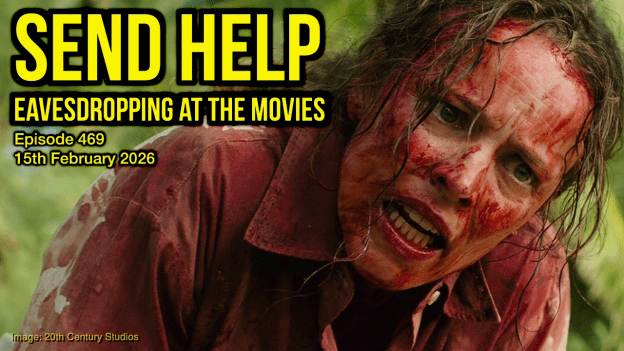
Send Help sees Rachel McAdams marooned on a desert island with her asshole boss in a cartoonishly gory comic adventure the likes of which made director Sam Raimi’s name. We discuss how feminist it really is – at the very least, it’s a bloke’s idea of female empowerment – and praise McAdams’ and Dylan O’Brien’s performances, upon which the entire film relies.
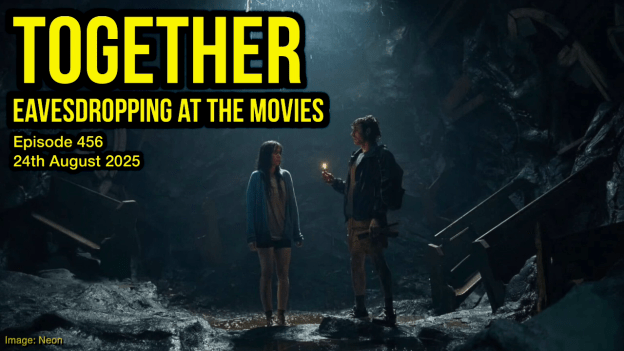
Commitment is scary. It’s especially scary when you drink water from a cursed puddle that wants to make a hybrid of you and your partner. Together tells the story of a couple moving to a new home during a questionable period in their relationship: she has a new job and is responsible for the move away; he’s emotionally distant since the death of his parents and relies on her for transportation and financial security. They love each other, but will they last?
First-time director Michael Shanks demonstrates a good instinct for tone, effectively combining comedy and horror – that Alison Brie and Dave Franco (married in real life) are both experienced comic actors helps the film draw out the absurdity of the events it depicts. What quibbles we might have with details of its supernatural basis are easily ignored because its focus always remains on the central couple. It doesn’t matter that some specific detail might not be explained to our satisfaction: the question is always, how do the couple respond to their predicament? Together never loses sight of what’s most important, and that makes it one of the best horrors – maybe one of the best films full stop – that we’ve seen in a while.
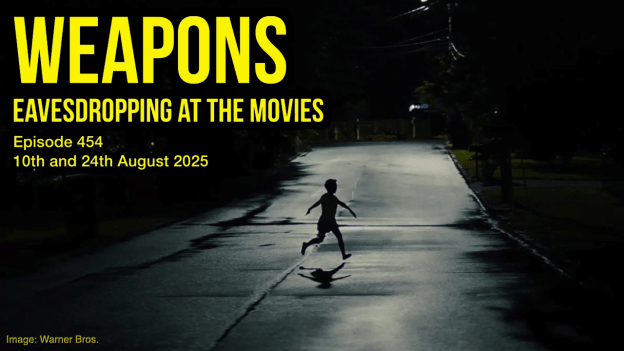
One of the most hotly-anticipated horror films in recent memory, Weapons begins with seventeen third-grade children in a Pennsylvania town mysteriously waking up at 2:17am one Wednesday and running from their homes into the darkness. The shocking, unexplained disappearance and imagery of an empty classroom alone suggest an allegory of school shootings, and we ask what else can be read into the film, and discuss the depth with which it handles its themes. We have our issues with Weapons but enjoy it very much all the same, and find a lot to like. It’s probably just a little overpraised.
Two weeks later, with the film still on his mind, Mike opens up further discussion and proposes that maybe there’s more to it than he gave it credit for – or that you have to be American to properly get it.
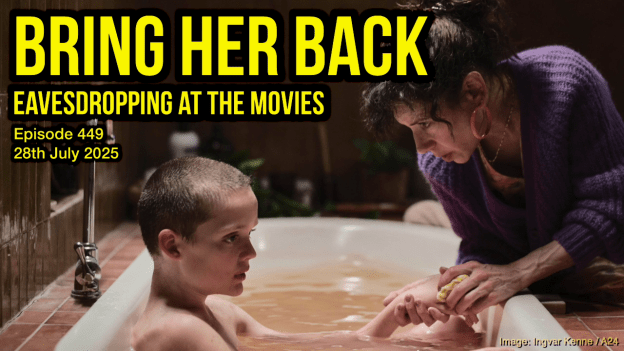
YouTubers-turned-directors Danny and Michael Philippou demonstrate a real eye for visual design and an ability to create imagery to truly disgusting effect in Bring Her Back, in which Sally Hawkins plays a foster parent whose daughter’s death leads her to search for answers in the occult. The filmmaker twins are 32 years old, which, perhaps unfairly, leads us to ascribe the film’s lack of depth and prioritisation of visual shock to their youth. Bring Her Back shows a certain immaturity, but great potential, and we’re interested to see if the pair’s storytelling and sensitivity to theme improves.
We also discuss child actors in horror, as the film drives Mike to question the ethics of using children as Jonah Wren Phillips is here, both in terms of the desired effect on the audience and the potential unintended effect on the child. Not all unease is good unease, and Bring Her Back makes us ask: what cost is too high for such entertainment?
The seventh instalment in the Jurassic Park (now Jurassic World) series, Jurassic World Rebirth might be the first of the sequels to really come close to capturing the kind of wonder, excitement and horror that the 1993 original offered. That might be in part because it cribs liberally from it, with both moments and entire sequences closely evocative of their 32-year-old counterparts. But there’s plenty else that’s new here, and Rebirth is a characterful expansion to the Jurassic Park story.
Thoughts of containment have finally been totally discarded – dinosaurs have now been roaming the Earth for some time, to the point that they’re dying out everywhere other than a narrow band around the equator, which is illegal for human travel. So that’s where we’re headed, of course, as a pharmecutical exec seeking to make a fortune from dino-sourced drugs hires a team of mercenaries to extract blood from three creatures: one that swims, one that walks, and one that flies. It’s a decent structure that tells you what to expect and allows for a variety of settings and action, into which are placed such charismatic stars as Scarlett Johansson, Mahershala Ali, Jonathan Bailey and Rupert Friend. Director Gareth Edwards builds the world beautifully, exploiting it for that sense of scale that so defines his aesthetic, and reminding Mike in particular of his feature debut Monsters; and although in simple terms – this is, ultimately, a blockbuster sequel – the film has a moral message worth expressing.
Jurassic World Rebirth is easily the best of the Jurassic sequels and equally easy to recommend. Just try not to focus too much on how it reminds you of a better film from 1993.
The slasher series without a slasher returns for its sixth instalment, fourteen years after we last saw it. Where Halloween gave us Michael Myers, Friday the 13th, Jason Voorhees, and A Nightmare on Elm Street, Freddy Krueger, Final Destination made death the villain – perhaps more accurately, Death, but we never see a cloaked man wielding a scythe. Where the figure of the slasher killer could, in principle, be evaded and even beaten, Final Destination‘s Death, non-corporeal and omnipresent, carries a key threat of inevitability. Nobody escapes Death.
In each Final Destination film, one character’s premonition of catastrophe gives them the chance to save themselves and others from death, but Death won’t take being cheated lying down, and sets its sights on pursuing its near-victims to the graves they’re currently avoiding. How? Through elaborate, Rube Goldberg-esque accidents, of course. We discuss the ways in which Final Destination Bloodlines‘ set pieces work, how they focus on small moments and individual stories, and how they’re a nightmare for the naturally anxious. José isn’t shy of expressing his dislike of the film; Mike, the opposite, and he does his best to explain the appeal of watching so many people perish in such gruesome ways. We even ask whether a slasher series could be made with which José would see eye to eye, and imagine what it might look like.
Sinners, written and directed by Ryan Coogler, is a horror musical set in 1930s Mississippi, shot in part on IMAX 70mm film, starring Michael B. Jordan as a pair of identical twins who return to their hometown for a new start, only to encounter vampires. It’s as ambitious as that sounds and full of ideas and culturally specific nuance, and José loves it. Mike doesn’t.
We discuss how the music draws on several influences, not just from the blues of the era but also from Irish folk and hip-hop; the getting-the-band-back-together feel of the opening, in which the twins bring their influence and riches to bear on the creation of the juke joint; the visual design, simultaneously confident and careless; the crowd-pleasing fantasy of an anti-racist Rambo; and the theme of vampirism – what it means and how it’s used.
Writer-director Robert Eggers, whose reputation for aesthetically rich, deeply-researched and idiosyncratic horror precedes him, has long been working on a remake of F. W. Murnau’s Nosferatu, the 1922 German Expressionist classic whose influence has been felt in the horror genre for a century. It’s a big fish to try to take down, but it’s source material that feels like it exists especially for him – how does he do?
Very well, as it turns out… although, in classic fashion, we manage to talk around what a fantastic time we had by concentrating on our criticisms. Ignore them until you’ve taken yourself to the biggest cinema you can to see it – it’s an experience you should have. Then come back and listen to us discuss the debt Eggers’ Nosferatu owes to the colour tinting processes of the silent era, how the second half gets bogged down in tropes and plot, the delineation between sex and love, the pressure to be accessible, whether horror needs to be scary, and the important lesson we learned from Shrek Forever After.
Hugh Grant brings his idiosyncratic brand of English charm to the world of horror in Heretic, in which he isolates and tests the faith of two young Mormon missionaries. It’s a film that leaves you asking all sorts of questions, such as, “did anything he was up to actually make any sense?”, but for a horror film so heavy on the dialogue and relatively light on the scares, it’s fabulously enertaining throughout – a real achievement of direction and writing. See it!
A welcome new instalment in the Alien franchise, which has moved between genres and directors, remained popular for over four decades, and offered fascinating expansions of its internal mythos, Alien: Romulus moves with the times to give Generation Z the opportunity to die in space. It goes like the clappers, orchestrates loads of entertaining, tactile action, and is unbelievably good-looking. It’s also underwritten, arguably overstuffed with reference to previous films in the series, and features one of those entirely uncontroversial and ethically pure reanimations of a deceased actor through CGI and other technologies. Perhaps after seeing the muted responses to the ideas on offer in Prometheus and Alien: Covenant, the series has decided to seek refuge in the cloying bosom of nostalgia – but we differ on how excessive it is, while enthusiastically agreeing that Romulus is great fun, and easy to recommend.



 Eavesdropping at the Movies