Hugh Grant brings his idiosyncratic brand of English charm to the world of horror in Heretic, in which he isolates and tests the faith of two young Mormon missionaries. It’s a film that leaves you asking all sorts of questions, such as, “did anything he was up to actually make any sense?”, but for a horror film so heavy on the dialogue and relatively light on the scares, it’s fabulously enertaining throughout – a real achievement of direction and writing. See it!
A welcome new instalment in the Alien franchise, which has moved between genres and directors, remained popular for over four decades, and offered fascinating expansions of its internal mythos, Alien: Romulus moves with the times to give Generation Z the opportunity to die in space. It goes like the clappers, orchestrates loads of entertaining, tactile action, and is unbelievably good-looking. It’s also underwritten, arguably overstuffed with reference to previous films in the series, and features one of those entirely uncontroversial and ethically pure reanimations of a deceased actor through CGI and other technologies. Perhaps after seeing the muted responses to the ideas on offer in Prometheus and Alien: Covenant, the series has decided to seek refuge in the cloying bosom of nostalgia – but we differ on how excessive it is, while enthusiastically agreeing that Romulus is great fun, and easy to recommend.
Listen to our podcasts on the previous two films in the series, Jigsaw and Spiral.
Mike’s favourite horror series, which fizzled out in 2010 after seven annual instalments, has been resurrected in fits and starts over the past few years, and if future sequels can maintain the quality of storytelling of Saw X, we want to see more of them. José still doesn’t understand the appeal of the gore and torture, but accepts that it’s part of the landscape here; what neither of us expects is such an involving and interesting first act.
The serialised story that became so hard to follow during the 2000s is here eschewed in favour of a relatively self-contained episode of Jigsaw’s life – the convolutions that followed his death way back in Saw III are nowhere to be seen here. We’re in pure prequel mode, following him on a trip to Mexico to receive an experimental miracle cure for his terminal cancer, during which the film confidently takes time to build surprising and effective hope for him – everybody likes Jigsaw, the adorable little sadist, after all. The savage redemption that he sets out to offer later on is given weight by this stage-setting, and in the light of how ugly these films can be, it’s a rather refreshing and bold bit of storytelling.
We discuss the racial composition of the group of victims and the varying viciousness of the games they’re forced to play, and just how hard they are to beat – disproportionate gruesomeness is this series’ stock-in-trade, but is only three minutes to sacrifice a body part really fair? Mike praises the lighting, which proves images need not be hard to see to be dark. And we discuss the series’ history, the differences between Saw X and its predecessors, and single out Tobin Bell, the man holding everything together. He got lucky in 2004 to find that his almost background role would quickly make him an iconic cinematic villain; the filmmakers got lucky that the bit-part player they’d hired to lie on the floor for two hours turned out to have the ability and presence to lead a billion-dollar franchise.
Mike’s always thrilled to see a new Saw film, and the fact that this one’s good is merely icing on the cake – but most remarkably, José has found one he needs no nudging or persuasion to recommend!
You can also hear our discussion of 2018’s The Nun, and our podcast on The Exorcist, part of our exploration of the oeuvre of William Friedkin.
For our 400th episode we indulge in a pair of horror sequels, both heavy on faith, possession, and Christianity. One is part of a modern universe of interconnected stories, characters, and demons, the other represents the reignition of a series whose sequels have been produced intermittently for fifty years without receiving anything like the acclaim of the film that spawned them. The Nun II is the eighth film in the ten-year-old Conjuring Universe; The Exorcist: Believer is only the sixth Exorcist film in half a century. Truly, they don’t make them like they used to.
Neither film in this double bill is very good in totality, but The Nun II contains imaginative and effective set pieces and visual ideas, while The Exorcist: Believer is content to discard a reasonably interesting first act in favour of useless and charmless reference to, and pathetic reenactment of, William Friedkin’s 1973 original. We discuss what we think the films are about, wittingly or otherwise – horror is commonly understood to often allegorise and express the ills and worries of the societies that produce them, and we consider the ways in which these films might be doing so. And there’s much to compare and contrast between them, including their characters’ attitudes to the supernatural; the ways in which religion, be it Catholicism specifically or Christianity more generally, plays into their stories and atmospheres; and the kinds of imagery through which they attempt to instil fear in their audiences. And we take time to criticise many, many examples of the weakness of the storytelling in Believer.
The Nun II, like its 2018 predecessor, is not very good, but it is fun. The Exorcist: Believer is neither good nor fun. Happy 400th episode!
José gave an introduction to the MAC’s screening of The Old Dark House, a 1932 comedy horror directed by James Whale, focusing on queerness. James Whale was openly gay – although what it meant to be openly gay in the 1930s is up for discussion – and knowledge of his sexuality has led to interpretations of his work in that light, including Frankenstein (1931) and The Invisible Man (1933). The Old Dark House arguably invites such readings more explicitly than those, with the demeanour of Ernest Thesiger as Horace Femm (not to mention his surname), the relationship between Morgan (Boris Karloff) and Saul (Brember Wills), and the casting of a woman in the role of patriarch, with actress Elspeth Dudgeon credited as John Dudgeon.
As well as its queerness, we discuss its preponderance of tropes and how well they cohere, its use of distorted imagery, its pacing and more.
Trauma as metaphor has become a trope of horror in recent years, and Smile features it more bluntly than you’ve ever seen. We discuss its messaging, storytelling, and camerawork, and remark upon the ways in which 2014’s It Follows may have inspired it. In the sense of Ali Baba and the Forty People Who Were Inspired.
Nope, Jordan Peele’s third film as writer-director, following his zeitgeist-capturing Get Out and complex, ambitious Us, invites its audience to speculate on audiences and spectacle. The kinds of things it wants us to think about are clear, and we discuss its themes of commercialised tragedy, fear of the audience, and photography as truth, among others – but what it has to say about them is at best muddled, and, more frankly, disappointingly uncritical. Like Peele’s previous films, Nope is a terrific conversation starter, but unlike them, its contribution to that conversation is weak.
We visit the MAC for a screening of the new 4k restoration of Psycho, one of the most analysed films of all time, and arguably director Alfred Hitchcock’s most famous. It’s a film we’ve both seen several times, but not for a few years, and in the cinema setting for which it’s meant, instead of the classroom, there’s a renewed and reinvigorated wonder to its imagery and editing.
We share our feelings about this screening, remark upon things we’d forgotten or had never noticed before, discuss how elements of the film have aged, and compare it to Brian de Palma’s Dressed to Kill, which was, shall we say, inspired by Psycho, and which we recently saw. We find plenty of room for criticism, but although we conclude that Psycho works for us more as a collection of a few iconic scenes than a thoroughly engrossing story from beginning to end, those scenes shine, and nowhere more vividly than on a cinema screen.
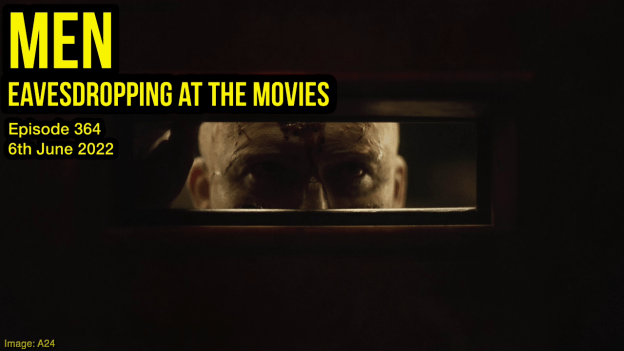
Alex Garland’s Men is as blunt as its title, with nothing of the profundity it would like to think it possesses. It’s slow and boring, too. Very pretty though. Well done to the cinematographer.
Referential and reverential of classic slashers from decades past, Ti West’s X is likely just the sort of thing the dedicated horror fan wants to see – but to Mike, it’s a pretty unsophisticated and tedious imitation of much better films, and to José, it’s unpleasant, racist, sexist, and ageist. But on the plus side, no film has made him – a man who is decidedly not delighted by being frightened – jump and yell with the kind of regularity and energy that X inspired, which really livened things up for Mike. Unfortunately for you, José won’t be watching it a second time, and if you can’t drag him along, it’s not worth it.