Tag Archives: drama

188 – Bait

Shot in black and white on a clockwork camera from the 1970s, the hand-development of its 16mm film resulting in scratches and unpredictable changes in exposure, and its soundtrack entirely post-synchronised, Mark Jenkin’s Bait is audiovisually suffused with atmosphere and texture, and not a little dreamlike and weird to boot. It tells the story of Martin, a Cornish fisherman struggling to cope with the upheaval of both his region and his life specifically that results from an influx of middle-class settlers. He’s sold his family’s cottage to a family of outsiders, his brother now uses his fishing boat to take tourists on drunken stag parties, and Martin snarls and growls his way through dealing with these changes.

It’s clear that we’re meant to see Martin as a hero, but he’s tilting at windmills – though perhaps that’s WHY he’s a hero – and José argues that the film is deeply conservative, asking, for instance, why it’s so bad that Martin’s brother adapts to his changing environment by taking tourists on trips. Mike argues that the family of newcomers is too caricatured, so keen is the film for us to see them as invaders who fuck everything up, and thinks about the film’s parochialism in the wider context of Brexit – the unfriendliness to outsiders displayed here speaks to anti-immigrant sentiment throughout the UK; is there a difference between the way the Cornish in Bait feel and the way Brexiters throughout the country feel? Perhaps there’s a tension between the relative power and privilege of the “invaders” and “invaded” that we don’t resolve, but in overly simplistic terms we don’t emerge from the film feeling entirely on its side.

Jenkin’s cinematography and editing beautifully conveys what there is to love about Martin’s way of life, concentrating on manual labour and his close-knit community. José suggests that the film looking the way it does makes it feel as though it’s already an object from the past, with the romance, nostalgia and loss that goes along with it – just as it depicts the decline of its way of life. It also puts us in mind of Italian Neorealism, José bringing up Visconti’s La terra trema, Mike thinking of De Sica’s Bicycle Thieves, and we’re indebted to Mark Fuller for offering a perspective on Bait‘s place within a tradition of similarly claustrophobic coastal dramas, such as Gremillon’s The Lighthouse Keepers, Epstein’s Finis Terrae, Flaherty’s Man of Aran, and Powell’s Edge of the World. Mike also considers the film’s visual and tonal similarity to Aronofsky’s Pi, thinking about how effectively that film places the audience in the main character’s headspace, and suggesting that the visual design here does the same.

Bait is a considerable film, one that speaks deeply to the loss of a certain way of life and the anger and resentment to which that leads. But the film doesn’t appear keen for this resentment to be questioned, and we feel it needs to be.

The podcast can be listened to in the players above or on iTunes.

With José Arroyo of First Impressions and Michael Glass of Writing About Film.

184 – Judy

José reminisces about Judy Garland as a feature of his childhood, a constant presence on his family’s television, and as a person who took on different significance to him as he grew up. Whether he admits it or not, he’s been keen to see Judy since the trailers first appeared. Mike, predictably, neither knows much about her nor cares, although he has seen The Wizard of Oz about a thousand times.

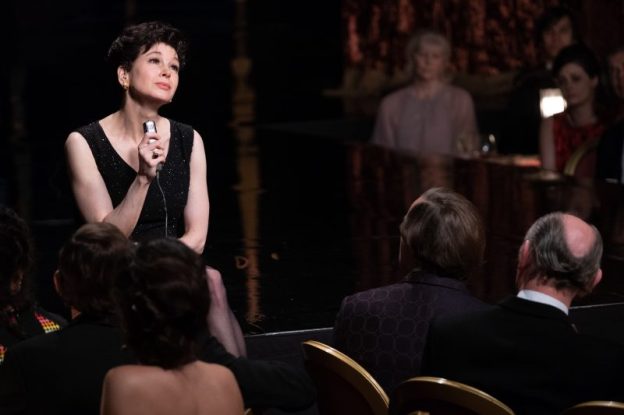
The film’s greatest pleasure is Renée Zellweger’s performance, a pleasant surprise to José as he’s never liked her very much. We agree that the stage numbers leave something to be desired – the production seems to create a disconnect between Zellweger’s performance and singing, sounding artificial – but swoon at moments when it all comes together, particularly in the climactic rendition of Over the Rainbow. José suggests that this is when Zellweger most deviates from any of Garland’s true performances, and perhaps that relative freedom from imitation is what gives her the space to connect to the song here.

In general terms, the film is none too exciting, shot effectively but inexpressively and ticking off the normal plot points of a star-on-the-decline biopic, with money and family worries, substance abuse problems, temper tantrums and assorted other clichés making appearances, and authentic as it may be, there’s only so many times Judy can be late for a gig before the drama wears thin. Her relationship with her children is an emotional wrench, though, and the film builds to an effective ending, powered by that fantastic final number.

There’s a subplot about Judy’s encounter with a gay couple that recognises her importance to the gay community and contrasts her glitz and stardom with the inhumane oppression to which gay people were and are treated – homosexuality was decriminalised in the UK only two years prior to when the film is set. It’s a plot strand that could fall on its face through cheesiness or clumsiness, particularly considering the couple’s role in the final scene, but it arguably succeeds through periphrastic, sparing dialogue, and by tying everything back to Judy’s songs. Everything comes back to those, ultimately, and despite some lacklustre direction here and there, it all comes together when it absolutely needs to.

The podcast can be listened to in the players above or on iTunes.

With José Arroyo of First Impressions and Michael Glass of Writing About Film.

183 – The Mustang

A captivating performance from Matthias Schoenaerts as a long-time inmate in a Nevada prison gives The Mustang its heart and emotional centre. The story of an isolated man finding the ability to open up through a relationship he develops with a wild horse isn’t going to win any awards for originality and is pretty one-note, but has its pleasures, and is an easy watch.

Writer-director Laure de Clermont-Tonnerre calmly avoids asking obvious and important questions of the American prison system in favour of depicting the benefits of the horse training initiative – based on a real-life scheme that operates in a number of US states – and José suggests that her nationality has a part to play in this apparent lack of knowledge about the deep institutional issues involved, or at least her lack of interest in challenging them. The film indulges in cliché after cliché, but, for all its flaws and lack of imagination, Mike liked it, because that’s what he’s like, and we really can’t emphasise enough how good Schoenaerts’ central performance is.

The podcast can be listened to in the players above or on iTunes.

With José Arroyo of First Impressions and Michael Glass of Writing About Film.
182 – Rojo

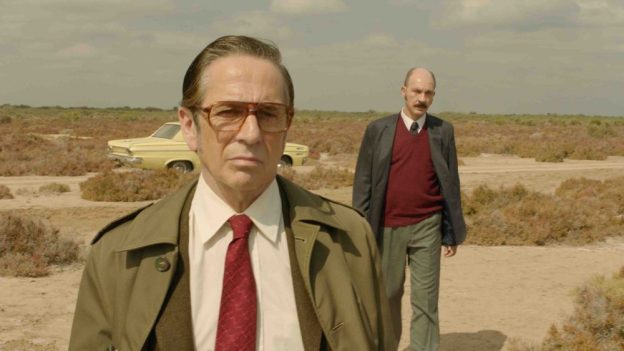
In the mid-Seventies, Argentina was terrorised by the Triple A (Argentine Anticommunist Alliance), a far-right death squad that disappeared countless people, and it is under this regime of fear and death that Rojo is set – with 1976’s military coup on the horizon. Disappearance is one of the film’s major themes and gives it its central structure: Dario Grandinetti’s Claudio, a lawyer, has an altercation with a rude young man in a restaurant and, though what follows is partially accidental, ends up leaving the man for dead in Argentina’s vast desert.

It’s the first act of disappearance in a film draped with them, disappearances that nobody speaks of, but everybody takes advantage of. Overt signals of the Triple A are absent here – the film shows us how daily life is affected, in a chilling atmosphere not of fear, but of acceptance. Friends are spoken of as having moved away. A house vacated by a family we never see is ransacked by otherwise well-to-do, middle-class neighbours, and presents a money-making opportunity. The culture isn’t fought, it is adjusted to.

Though we find great depth to Rojo‘s thematic complexity, we find less joy in its cinematic technique. José isn’t as critical as Mike, whose arse went to sleep through boredom, but despite an aesthetic that beautifully evokes the 1970s in every way, the film makes no real concessions to the audience, particularly lacking tension, which we feel there was ample opportunity for.

However, despite our criticisms, we recommend Rojo. It portrays a time and place rarely seen, and does so with intelligence and confidence. Its themes, of course, speak not just to mid-Seventies Argentina but keenly to today’s increasingly right-wing societies in Europe and America, and in that light its themes of complicity and adaptation to quotidian far-right terrorism constitute a warning.

The podcast can be listened to in the players above or on iTunes.

With José Arroyo of First Impressions and Michael Glass of Writing About Film.

174 – The Farewell

We love Lulu Wang’s comedy-drama The Farewell, about a Chinese family that knows their grandmother, Nai Nai, has cancer, but keeps it a secret from her. Awkwafina brings humour and sensitivity to the American-raised granddaughter who argues that her family is in the wrong, and although the film opens up questions of cultural differences, it’s remarkably even-handed, refusing to judge or criticise any opinion. Zhao Shuzhen, playing Nai Nai, is delightfully warm and snappy, and shares wonderful chemistry with Awkwafina.

The Farewell is a gentle film that tells an engrossing story, and it’s simply a pleasure to be in its world.

The podcast can be listened to in the players above or on iTunes.

With José Arroyo of First Impressions and Michael Glass of Writing About Film.
171 – The Souvenir

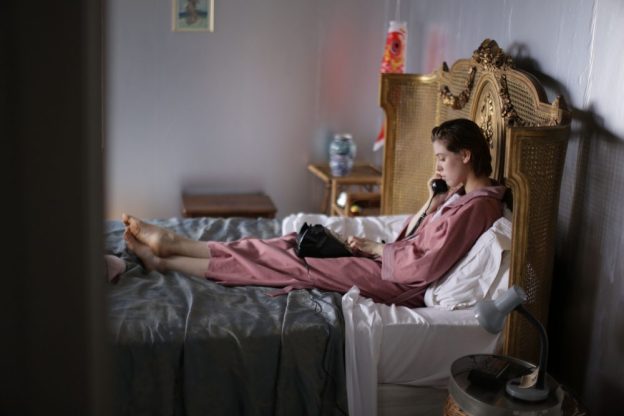
A gentle, somewhat meandering podcast to follow a gentle, somewhat meandering film. Joanna Hogg’s The Souvenir talks of artistic development, the vigour of youth, life without money worries, and the complications of love, all through a soft camera and subtle performances. It’s a film that refers to and respects art, that remembers the past fondly, and that leads José to explain the Portuguese concept of saudade, quoting Eugène Green here.

The podcast can be listened to in the players above or on iTunes.

With José Arroyo of First Impressions and Michael Glass of Writing About Film.

166 – Pain and Glory

It’s probably fair to say that Pedro Almodóvar’s films seem to be made specifically for José. It’s in every detail: the locations, eras, sexuality, ways of life, attitudes, class, love of cinema and countless other aspects of Almodóvar’s oeuvre speak to José on a deep, intimate level. He’s watched every one of his films time and time again, and he considers Pain and Glory, which he has already seen twice and plans to see again, a masterpiece. Mike doesn’t have anything like such a specific relationship to Almodóvar, and indeed has only seen one other of his films, 2016’s Julieta, which he liked very much – and indeed he likes Pain and Glory just as much… though not quite as much as José.

We discuss how Pain and Glory stands alone but might benefit from being seen in relation to Almodóvar’s oeuvre. Several of his regular collaborators appear, including Cecilia Roth, Antonio Banderas, Julieta Serrano and Penélope Cruz; this film, as with The Law of Desire, Broken Embraces and Bad Education, is about a filmmaker; it makes use of art as an unconscious but pointed visual layering and underlying theme; images of characters writing on typewriters or computers show up – this is a film about, amongst other things, writing. Mike brings up the way chance events are used to drive the plot forward and thinks about how they’re contextualised; José praises how fluid Almodóvar’s storytelling is here, effortlessly bringing together disparate timelines and plot strands.

Is this autofiction, as the mother in the film accuses her filmmaker son of so often indulging in? José considers the appearance of Almodóvar’s own mother in his previous films and how so many of his previous films are in fact about mothers (All About My Mother and Volver being the most obvious examples). We discuss the structure of the film, the movement from the relationship with an actor who’s an addict to a previous relationship with an addict, through the performance of a confessional monologue titled Addiction, then a sexual awakening seen from a young boy’s point of view. Representations of Spain in the 50s, memories of the past and a present setting fluidly intermingle. We also consider its themes of illness, ageing and loss, and how it’s a film about cinematic expression, the revelation that half of the diegetic world is in fact a film within a film recontextualising half the story, similar to Bad Education but to different effect here.

It’s a film on which as soon as we finished, José regretted not saying more: The references to Lucrecia Martel’s La niña santa, the clear allusion to Fellini’s , the use of Rosalía to sing the song by the river, the section on films that feature water such as Splendor in the Grass and Niagara. He’s only scratched the surface of a great film.

The podcast can be listened to in the players above or on iTunes.

With José Arroyo of First Impressions and Michael Glass of Writing About Film.
165 – Animals

There’s a remarkable female gaze in Animals, Sophie Hyde’s adaptation of Emma Jane Unsworth’s novel, and a wonderful sense of insightful observation in the world occupied by and behaviours of the two friends whose stories it tells.

Mike, who’d been anticipating it keenly since seeing the trailer, feels a little shortchanged by the triteness of the larger themes on which the film builds and the relative lack of excitement in comparison to what the trailer conveyed. José shares a little of that feeling but is keen to express his pleasure at seeing a film so confidently and originally expressive of a female perspective, particularly in its sex scenes. And we both adore the stars, Alia Shawkat for her fabulously performative comic theatrics, and especially Holliday Grainger for her extraordinary, sensitive, soulful expression of a girl falling in and out of love and friendship and upset with her own failings.

Animals is a film that explodes with creativity and expressiveness in the details, but whose big picture leaves us wanting.

The podcast can be listened to in the players above or on iTunes.

With José Arroyo of First Impressions and Michael Glass of Writing About Film.

163 – Once Upon a Time in Hollywood

Mike feared it might be the most tasteless film ever made. José doesn’t look forward to Quentin Tarantino films. But we both came away from this fantastical reimagining of a near-mythological era of Hollywood history having had a great time. Tellingly, for a film that exceeds two and a half hours, we both felt the time fly by.

Tarantino’s love for and expert knowledge of Hollywood and cinema informs all of his work, and arguably not that consequentially – he cribs shots, pastiches genres, and evokes styles and tones specific to cinema, but to debatable significant effect beyond the superficial. But in Once Upon a Time in Hollywood (OUATIH for brevity’s sake), the decision to bring this passion to the surface and tell a story directly about Hollywood results in Tarantino’s most meaningful and personal film. What he values is brazenly displayed here, and, Mike suggests, isn’t entirely pleasant to examine. He finds OUATIH initially troubling in this regard – with a day’s reflection on it, he comes to see it as deeply conservative and protective of privilege. In digging this up, we discuss its sexual politics, the way it uses race, and the clash it represents between the old and the new in a rapidly changing 1969 Hollywood. Mike argues that, as in 2009’s Inglourious Basterds, Tarantino’s revisionism revealingly reflects his fantasy of what an ideal world would look like and contain, and in this case it’s a little uneasy to stomach. He also takes issue with the way the Manson family are used, but not, as he feared, for reasons of taste – Charles Manson wasn’t in Hollywood by chance, he wanted stardom, and for a film in which the desire for and loss of stardom are interests, to show no interest in drawing a thematic link here, instead only wanting to use the Manson family to rag on hippies, is more evidence of Tarantino’s retrograde attitude.

The flip side to this coin is that the things Tarantino loves are wonderfully, warmly depicted. OUATIH is as much about television as it is cinema, if not more so, and Tarantino offers imagined and reimagined TV shows of many types in evoking in detail the time and place in which he grew up. To José, about the same age as Tarantino, there abound countless nostalgic pleasures; to Mike, disgustingly born 30 years too late, the film’s enthusiasm and obvious knowledge about its setting rubs off easily. The film easily convinces you to love what it loves, be it silly, overblown action movies; cheesy, overblown TV acting; or Brad Pitt’s Hawaiian shirt, which in one scene blows off.

Speaking of Pitt, José considers this his best performance, one in which he switches from evoking coolness and control to dumb and tripping balls. But for all the little touches and tone he brings to his character, Leonardo DiCaprio brings entirely different registers. His performance is a tour de force, his Rick, a declining Western star, constantly performing, even only to himself at times, and at every moment his emotions and thoughts are crystal clear, even under layer upon layer of performance. DiCaprio practically shapeshifts in sketches depicting Rick’s old movies and television appearances, and offers a sympathetic portrait of a star unable to adapt to his changing environment. It’s a rich, demanding role, and DiCaprio is spellbinding in meeting its challenge.

You’d be doing yourself a disservice missing Once Upon a Time in Hollywood at the cinema. It’s an excited, passionate trip through a Hollywood fantasy, hilarious, light, and thoroughly enjoyable – though, like so many fantasies, its underbelly is dark.

The podcast can be listened to in the players above or on iTunes.

With José Arroyo of First Impressions and Michael Glass of Writing About Film.

159 – O Fantasma

We’re still with MUBI and grateful for the opportunity to see O Fantasma, directed by João Pedro Rodrigues: a film José had heard of and been encouraged to see by various friends, but hadn’t quite come his way until now. He thought the film was only a few years old and could now kick himself for having waited twenty years to see it. José thinks it a masterpiece, Mike doesn’t; though the film being clearly aimed at a gay male audience might help account for it, and it speaks to José deeply.

Following Sergio (Ricardo Meneses), a very handsome young garbageman in Lisbon, perpetually horny and on the hunt for sex, O Fantasma is feverish sex dream of a film, a reverie, that evokes the feeling of horniness, of being up for sex but having no one with whom to find release. What starts as a hunt eventually turns the hunter into the hunted. We discuss how the character of Sergio seems to have no filter and no fear. He lives in a homophobic culture fraught with danger but is free. The sexual situations seem to take on the form of a dare and, even in the most potentially dangerous encounters, Sergio’s glance seems to say “I’m not afraid of you and it could get sexual if you want it to”. We discuss how the film’s story is structured differently to a conventional narrative: there is a conveyance of a certain kind of sexual dreamscape. The various episodes might not cohere in terms of plot but do come together in the film’s conveyance of atmosphere and feeling.

We note how for an earlier generation this would have been an X-rated film due not only to its subject matter but to its explicitness. We also remark upon the film’s real queer gaze that is also a gay male gaze; something worth distinguishing. We compare the film to the New French Extremity films of the era but also note that where they possessed had a harsh kind of crudeness, O Fantasma is very stylised. José finds the film unusual and beautiful, with extraordinary images that are really potent and poetic.

Sergio feels his desires in a culture in which he’s allowed none of them. Yet this is a film that celebrates a full spectrum of desires, the freedom to desire and to act on one’s desires. O Fantasma is a film that will confirm every homophobe’s worst views of gay men – and that partly its strength. It’s a film that is made in and asserts freedom. Sergio’s gaze is radiant, subversive, and defiant.

If you’re a gay man interested in film, this is unmissable.

The podcast can be listened to in the players above or on iTunes.

With José Arroyo of First Impressions and Michael Glass of Writing About Film.