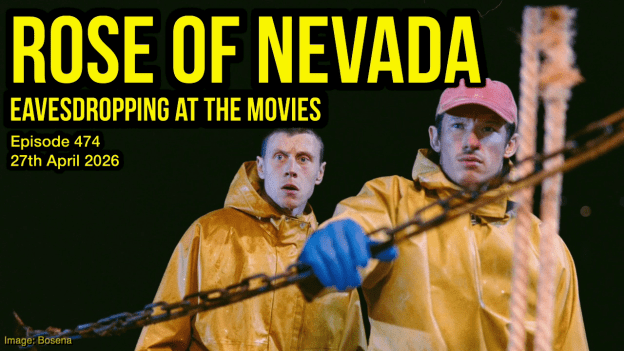
Seven years ago, we disagreed with the thrust of what Mark Jenkin’s Bait had to say about the world as it is and as it ought to be, but appreciated its expressive strength. It was a film with substance. You could grapple with it. Rose of Nevada broadly conveys the same messages, but, as they derive primarily from the film’s setting and less so its plot, is less forceful and argumentative about them, requiring us to accept them in shorthand and take them as read.
Fair enough, perhaps – why make the same film twice? – but the story to which Jenkin’s perspective is here allied is of little interest, and told with insufficient clarity, populated by dull, flat characters whose developments are poorly motivated – if at all. Jenkin is certainly a visual stylist, but he shows little instinct for effective storytelling or direction of actors here, and we question the response Rose of Nevada has received from other critics, which seems inexplicably universal in its positivity.
Shot in black and white on a clockwork camera from the 1970s, the hand-development of its 16mm film resulting in scratches and unpredictable changes in exposure, and its soundtrack entirely post-synchronised, Mark Jenkin’s Bait is audiovisually suffused with atmosphere and texture, and not a little dreamlike and weird to boot. It tells the story of Martin, a Cornish fisherman struggling to cope with the upheaval of both his region and his life specifically that results from an influx of middle-class settlers. He’s sold his family’s cottage to a family of outsiders, his brother now uses his fishing boat to take tourists on drunken stag parties, and Martin snarls and growls his way through dealing with these changes.
It’s clear that we’re meant to see Martin as a hero, but he’s tilting at windmills – though perhaps that’s WHY he’s a hero – and José argues that the film is deeply conservative, asking, for instance, why it’s so bad that Martin’s brother adapts to his changing environment by taking tourists on trips. Mike argues that the family of newcomers is too caricatured, so keen is the film for us to see them as invaders who fuck everything up, and thinks about the film’s parochialism in the wider context of Brexit – the unfriendliness to outsiders displayed here speaks to anti-immigrant sentiment throughout the UK; is there a difference between the way the Cornish in Bait feel and the way Brexiters throughout the country feel? Perhaps there’s a tension between the relative power and privilege of the “invaders” and “invaded” that we don’t resolve, but in overly simplistic terms we don’t emerge from the film feeling entirely on its side.
Jenkin’s cinematography and editing beautifully conveys what there is to love about Martin’s way of life, concentrating on manual labour and his close-knit community. José suggests that the film looking the way it does makes it feel as though it’s already an object from the past, with the romance, nostalgia and loss that goes along with it – just as it depicts the decline of its way of life. It also puts us in mind of Italian Neorealism, José bringing up Visconti’s La terra trema, Mike thinking of De Sica’s Bicycle Thieves, and we’re indebted to Mark Fuller for offering a perspective on Bait‘s place within a tradition of similarly claustrophobic coastal dramas, such as Gremillon’s The Lighthouse Keepers, Epstein’s Finis Terrae, Flaherty’s Man of Aran, and Powell’s Edge of the World. Mike also considers the film’s visual and tonal similarity to Aronofsky’s Pi, thinking about how effectively that film places the audience in the main character’s headspace, and suggesting that the visual design here does the same.
Bait is a considerable film, one that speaks deeply to the loss of a certain way of life and the anger and resentment to which that leads. But the film doesn’t appear keen for this resentment to be questioned, and we feel it needs to be.
The podcast can be listened to in the players above or on iTunes.