Tag Archives: drama

468 – Pillion

Listen on the players above, Apple Podcasts, Audible, Spotify, or YouTube Music.

Possibly the sweetest and lightest gay BDSM biker film ever made, Pillion opens up conversations on power dynamics, consent and boundaries, and made Mike cry. Everything about it is so assured, particularly Harry Melling’s understated protagonist, meek and new to BDSM; Alexander Skarsgård’s commanding, mysterious lover; and Harry Lighton’s direction, the control of tone he exhibits a remarkable achievement for a first feature. We explore the film’s themes, offer different interpretations of events, and ask what’s good and bad about the relationship depicted.

Pillion is a wonderful film, with, given the subject matter, a surprisingly funny and wholesome spirit. Highly recommended.

With José Arroyo of First Impressions and Michael Glass of Writing About Film.

466 – Nuremberg

Listen on the players above, Apple Podcasts, Audible, Spotify, or YouTube Music.

Russell Crowe shines in Nuremberg as Hermann Göring, who became the face of the Nazi Party following Hitler’s suicide and the end of the war, as he’s held in custody and probed by a psychiatrist as the titular trials approach. Indeed, while a mediocre film, its actors’ performances are a pleasure – with the exception of Rami Malek, whose psychiatrist is twitchy, busy, and a failure. A shame that he’s the protagonist, then.

We discuss the film’s structure and screenplay: José contends that Malek’s character is not just badly played but an irrelevance, and the drama would be much better served by focusing on Michael Shannon’s prosecutor; Mike criticises what he claims is a stupid person’s idea of clever writing.

And there’s more to think about: how Nuremberg compares to Bridge of Spies, which similarly depicted a novel trial that had obvious implications beyond the courtroom, and Judgment at Nuremberg, the other major dramatisation of the trials; the film’s tone, which is able to handle moments of humour but sometimes veers into the overly glib and kitsch; the present-day rise of fascism and the genocide in Gaza to which the film speaks; the use of real footage of Holocaust victims and the purpose to which it’s put; and whether we think that its critique of the Catholic Church for its support of the Nazis, and suggestion that dropping the atomic bomb on Japan was an unjustifiable atrocity, are surprising and bold things for a mainstream American film to do… or not particularly impressive, and shouldn’t people just know this stuff anyway?

With José Arroyo of First Impressions and Michael Glass of Writing About Film.

465 – Die My Love

Listen on the players above, Apple Podcasts, Audible, Spotify, or YouTube Music.

Jennifer Lawrence gives a career-best performance as a new mother struggling with depression and a rocky relationship in Die My Love, directed by Lynne Ramsay, whose remarkable instinct for tone and atmosphere shouldn’t be taken for granted. It’s a character study whose artistry is all in the filmmaking and performances, which bring out great richness of feeling in material that, on the page, might seem to lack complexity. One could suggest that those who’ve experienced similar struggles to the film’s characters hold the key to unlocking its depths, but that’s a temptation to avoid – one of the film’s achievements is the ease with which it gets you to feel what its characters are feeling. See it at the cinema, where you’ll be able to properly submit yourself to it.

With José Arroyo of First Impressions and Michael Glass of Writing About Film.
463 – Frankenstein (2025)

Listen on the players above, Apple Podcasts, Audible, Spotify, or YouTube Music.

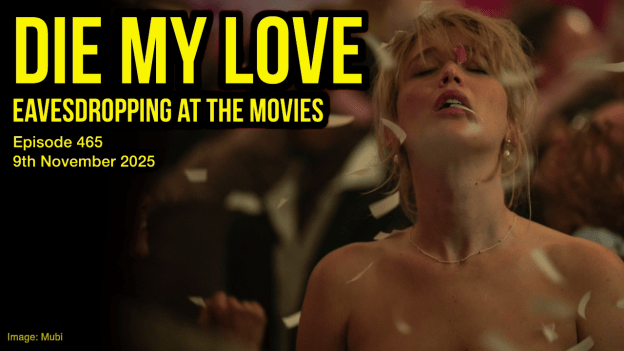
Another classic Gothic horror is remade for the modern age: first we saw Robert Eggers’ Nosferatu, and now Guillermo del Toro brings us his adaptation of Frankenstein. Like Nosferatu, Frankenstein is astonishing to look at, and, like Nosferatu, also written by its director, it probably would have benefitted from the attention of a professional screenwriter. Still, it’s a pleasure to spend time in the word del Toro envisions, and we talk wide angle lenses, the range of performances – Oscar Isaac’s busy, Jacob Elordi’s brooding, Mia Goth’s underwhelming – the difficulty of understanding dialogue in screen two at the Mockingbird, and what this Frankenstein thematically shares with One Battle After Another.

With José Arroyo of First Impressions and Michael Glass of Writing About Film.
439 – The Brutalist

Listen on the players above, Apple Podcasts, Audible, Spotify, or YouTube Music.

We visit BFI Southbank for a 70mm screening of The Brutalist, Brady Corbet’s epic period drama. It’s a super-sized film – 215 minutes, not including the intermission – and it deserves a super-sized podcast, for which we’re joined, as we occasionally are, by Mike’s brother, Stephen, who’s already seen the film once. It’s an extraordinarily complex, subtle and absorbing film that draws on countless themes and parts of history in telling its story of a Hungarian Holocaust survivor and architect who escapes to America and finds a wealthy client enamoured with him.

We dig in to the film’s themes with breathless enthusiasm, and talk sex, racism, the immigrant experience, long takes, rape, capitalism, doing things for effect, art, aspiration, jealousy, the value of 70mm, and much more. José describes The Brutalist as his film of the year; Mike ponders whether he likes it more than the Robbie Williams monkey movie.

With José Arroyo of First Impressions and Michael Glass of Writing About Film.

438 – Presence

Listen on the players above, Apple Podcasts, Audible, Spotify, or YouTube Music.

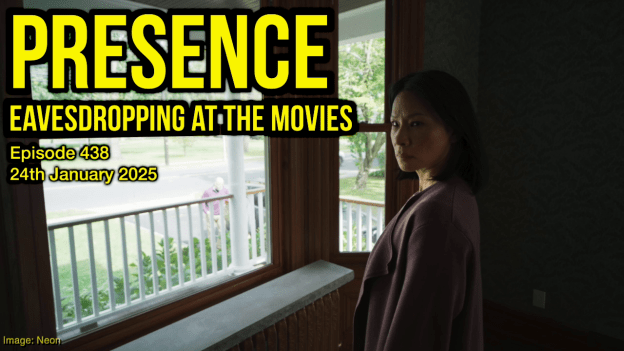
“Steven Soderbergh’s making a horror film from the perspective of the ghost” turns out to be a sentence specifically designed to appeal to Mike, who has been looking forward to Presence for ages. (José struggles to remember the film’s title, even moments after having seen it.) But part of that pitch is deeply misleading. Presence‘s trailers were loaded with quotes from overeager horror publications that praised the film’s fear factor, which leads to a little confusion when the final product is revealed to be a family drama that, despite the ghost whose eyes we see everything through, isn’t even trying to scare us. And that’s great! We just didn’t realise that’s what we were in for.

What Presence gives us is a compelling exercise in film form and storytelling that constantly maintains our interest and which we thoroughly enjoy, but which sadly disappoints us in a variety of ways – though only a few of which we agree on. What interests Mike about the film’s camerawork and handling of its invisible, point-of-view character leaves José unimpressed; Mike doesn’t get what José does out of the critique of modern masculinity.

But despite our disagreements and disappointments, we enthusiastically recommend Presence as an experiment worth experiencing. It’s intriguing, efficient, and original – and there’s very little like it.

With José Arroyo of First Impressions and Michael Glass of Writing About Film.
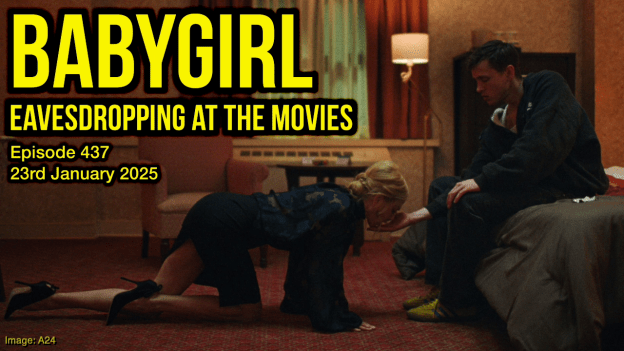
437 – Babygirl

Listen on the players above, Apple Podcasts, Audible, Spotify, or YouTube Music.

Nicole Kidman gives a compelling, vulnerable performance in Babygirl, as a woman for whom sexual satisfaction requires her to relinquish the power she otherwise projects throughout her life, and who begins an affair with a much younger man she finds herself unable to resist. Unfortunately, that’s the only significant thing to recommend about the film, which we find superficial, badly thought out, and most crucially of all for Mike, nowhere near steamy enough. It’s good fun to discuss, though, and gives us opportunity to reminisce about sneaking into films we weren’t allowed to see when we were kids. Stick around to learn José’s Looney Tunes technique for fooling the ticket guy.

With José Arroyo of First Impressions and Michael Glass of Writing About Film.
433 – Juror #2

Listen on the players above, Apple Podcasts, Audible, Spotify, or YouTube Music.

A film whose brilliant conceit is so simple and compelling we can’t believe we’ve never seen it before, Juror #2 tells the story of a juror whose responsibility it is to assess the guilt of a defendant who he knows is innocent of murder – because it was the juror who did it.

Summoned to serve on a jury and quickly recognising the details of the case, Nicholas Hoult’s Justin realises that the deer he hit with his car one dark, stormy night was in fact the defendant’s girlfriend, for whose supposed murder he is on trial. So begins a morality play of sorts, Justin wanting to do the right thing and keep an innocent person from prison, but unwilling to expose himself as the real, if accidental, killer.

It’s a film that sets two institutions, the family and the court, at war. Justin’s wife has a baby on the way, and is there any wrong that can’t be justified by the protection of the family? We discuss this in the particular light of director Clint Eastwood’s reputation as a lifelong conservative, Mike suggesting that the distrust the film shows towards the legal system, a government institution, has precedent in Eastwood’s other work, but its critique of the sanctity of the family is surprising and invigorating.

Juror #2 is a thoroughly engrossing exploration of a terrific idea, and you’ll take its questions home with you long after it ends. What would you do? Are you sure?
With José Arroyo of First Impressions and Michael Glass of Writing About Film.

430 – Gladiator II

Listen on the players above, Apple Podcasts, Audible, Spotify, or YouTube Music.

Ridley Scott returns to Gladiator after more than twenty years, telling a story that’s broadly the same, but neatly picks up from the original too. Gladiator II stars Paul Mescal in the central role, and we discuss whether he has the movie star charisma to match his indie film credentials; we also talk action, visual effects, Denzel Washington’s Iago figure, the trope of the gay villain, and more.

With José Arroyo of First Impressions and Michael Glass of Writing About Film.

429 – Joker: Folie à Deux

Listen on the players above, Apple Podcasts, Audible, Spotify, or YouTube Music.

2019’s Joker, which gave the iconic supervillain an all-purpose mental health disorder, a tragic origin story, and a name – Arthur Fleck – was never meant to have a sequel. But it made a billion dollars, so Joker: Folie à Deux is here. And, being a jukebox musical based primarily on show tunes from the mid-20th century canon, we ask who it’s for. The first film took risks in eschewing so many trappings of the comic book genre; did the filmmakers hope that their audience would respond similarly to further experimentation? Or is it a means of punishing an audience they attracted but loathe?

If the film hates its audience… well, so does Mike, which might explain why he got on with it. José, on the other hand, liked the first film, and is happy to see more of Joaquin Phoenix and hear those classic songs. Joker: Folie à Deux is far from a great film, not that close to a good film, and doesn’t have much of interest or intelligence to say about its themes – but it’s fascinating that it exists.

With José Arroyo of First Impressions and Michael Glass of Writing About Film.