Ridley Scott returns to Gladiator after more than twenty years, telling a story that’s broadly the same, but neatly picks up from the original too. Gladiator II stars Paul Mescal in the central role, and we discuss whether he has the movie star charisma to match his indie film credentials; we also talk action, visual effects, Denzel Washington’s Iago figure, the trope of the gay villain, and more.
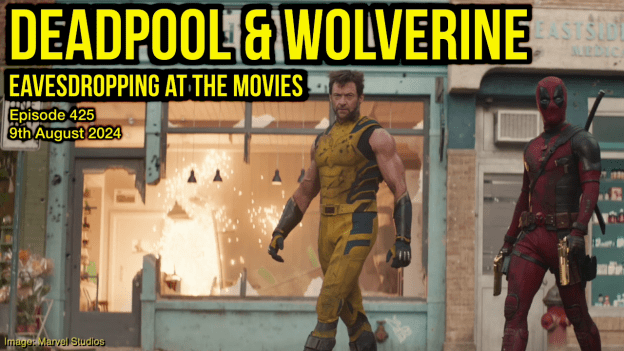
Deadpool 2 put us in such a foul mood when it came out in 2018 that we threw away our podcast on it. It was too toxic to publish. Fortunately, Deadpool & Wolverine, the third in the series, didn’t have such an effect on us – even José found some things to compliment about it.
Perhaps it’s the relative diminishment of Marvel since its peak in 2018, when it was reaching the climax of the story it had been building for a decade, that makes Deadpool & Wolverine work as it otherwise might not – its jokes about the X-Men joining the MCU at a low point really landed, for example. It’s far from perfect – Ryan Reynolds’ schtick remains smug, and the film tries to have it both ways, delivering snarky commentary on the sorts of things films like this do, then discarding the snark when it wants to do them itself. But it’s pacey, energetic, full of intense action with a delightfully cartoony attitude, filled with so many attempts to make you laugh that some of them are bound to work, and featuring a pair of enjoyable, charismatic villains: Matthew Macfadyen’s Mr. Paradox is a marvellously hammy presence, while Emma Corrin’s Cassandra Nova’s slight physique and genteel demeanour make her telepathic abilities all the more threatening.
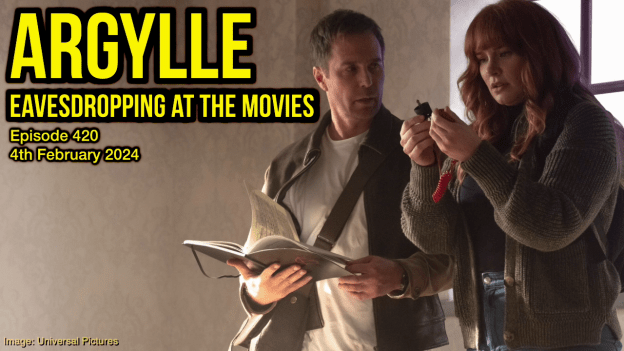
Is the world right, or is Mike? Argylle, Matthew Vaughn’s new spy comedy, has received terrible reviews and is bombing at the box office – but Mike thinks everyone else is wrong, taking it far too seriously, and missing the parody. José is more in tune with the vox populi, finding the film a slog, Henry Cavill’s hair ugly, and Bryce Dallas Howard ill-cast. But we find concord when it comes to the film’s action scenes, and we discuss the transitions between Cavill and Sam Rockwell, Howard’s look and movement, Mike’s continuing complaint about the peculiar look of British visual effects, and more.
As José describes, the Expendables films set Jason Statham up as the logical inheritor of the action hero crown formerly held by Stallone, Schwarzenegger, Van Damme and so on – and true to his status as such, Statham has many rubbish films under his belt. The Beekeeper is the latest, in which we learn of a programme of state-sponsored vigilantes – the Beekeepers – who act on their own terms, when something goes awry, to protect the hive that is the USA.
That the film is trash doesn’t mean it’s not fun, and Mike had a good time with the story’s daftness, the obviousness with which its cogs turn, and the action, which, while far from brilliant and heavily reliant on sound effects, is also intense and entertaining. José decries the film’s politics, dumbness, and use of British actors in so many of its American roles.
A new, low-budget, Japanese-produced Godzilla movie takes us by surprise. Toho, with whom the series began in 1954 and who have produced over 30 Godzilla films since, have given Godzilla Minus One a wider release than usual, and we’re glad of it. Unburdened by the lore and worldbuilding of the Legendary Pictures MonsterVersefilms, writer-director Takashi Yamazaki tells a story of Japan’s post-World War II depression, a spiritual and blood debt a pilot feels for shirking his wartime duty, and a community brought together in defiance of both a culture that treated their lives as expendable, and of course, a monster attacking their city.
Godzilla Minus One looks sensational for a film of its budget – reported to be under $15 million – and while hitting all the beats you’d expect of a blockbuster, arguably exhibits a subtly different pace and style of storytelling than Western audiences are used to, Mike suggesting that it gives an audience tired of having relentlessly convoluted cinematic universes foisted upon them a change in cinematic attitude for which they’re hungry. It’s not a perfect film – some of the performances let its emotional moments down, and there’s little you can’t see coming – but Godzilla Minus One is thoughtful entertainment that’s really worth seeing at a cinema.
David Fincher’s precise, controlled direction is a perfect match for Michael Fassbender’s precise, controlled performance in this lean but complex story of a botched assassination, revenge, and the hitman’s attempts to reassert precise control over his life.
We discuss the world in which The Killer is set and the way in which its title character operates, lives, and sees his place within it; the functions we see in its premise of a murderer-for-hire bored with his job, be it a critique of capitalism or a satire on work; the many names he assumes and what we take from the fact that they’re all drawn from sitcoms; the extraordinary audiovisual craft that we’re used to seeing from Fincher and thankfully not inured to; how the film uses noir and thriller tropes and where it might overplay them; the film’s obsession with process and procedure and why Mike likes playing it more than watching it; and more.
The Killer is a brilliantly conceived and assembled thriller filled with cinematography and editing to admire, and a lot to chew on despite its slight appearance. See it.
We heartily disagree on The Creator, a sci-fi film directed and co-written by Gareth Edwards, who made his name with Monsters in 2010, which he made largely by himself for half a million dollars, and quickly graduated to tentpole cinema with Godzilla and Rogue One. José had a wonderful time, finding it marvellous to look at and emotionally effective, though leaving room to criticise cinema’s continued insistence that John David Washington is a star. Mike finds it dull, brim-full of clichés, and even a little ugly at times, although Edwards’ sense of how to convey scale, already shown off in his monster movies, remains intact here.
Also featured: ChatGPT and how AI will kill us all.
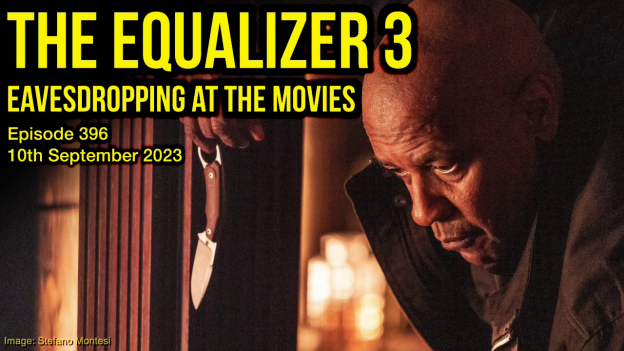
Denzel Washington returns for the third and final instalment of the Equalizer trilogy, in which former government assassin Robert McCall devotes his time and skills to avenging for the little guy. This time, he finds himself in Mediterranean Europe, embroiled in a fight to protect a coastal town from terrorisation by the Camorra, the Mafia of southern Italy.
The Equalizer 3 shares the contemplative tone and pervasive sense of loss of its predecessors. Here, there’s a focus on physical infirmity and vulnerability, a gunshot McCall receives early on forcing a long recuperation, slow, careful approaches to walking down stairs, and the use of a cane. Action erupts quickly and violently, emphasised by director Antoine Fuqua’s camera and editing – McCall is wounded, but maintains his ruthlessness and murderous efficiency.
We compare the action and Washington to Rambo: Last Blood and its star, Sylvester Stallone, which took a similarly staccato approach to its action, clearly informed by Stallone’s age and inability to move as gracefully as he used to – this film is doing something similar, but less thuggishly, if no less violently. We question the ease with which moral decisions are made in this world, in which right and wrong are easily distinguished and the involvement of a vigilante is sold as an obvious necessity and benefit; the film’s look, which fails to show off its spectacular location; and some of its writing and contrivances, particularly concerning Dakota Fanning’s character, a CIA analyst contacted by Robert, and the Camorra. And we discuss McCall as a neurodivergent superhero.
The Equalizer 3 is a flawed film with a fair bit of dumbness to overlook, but it is easy to do so when the portrait it paints of local life and close community is so absorbing and inviting, and its star has such presence, warmth, and intelligence. It’s an easy film to recommend, bearing in mind that it’s a work of vigilante fantasy. After all, if Batman’s allowed to take the law into his own hands when the institutions around him fail, why shouldn’t Denzel be? At least he doesn’t pretend not to kill people.
We take a trip to London to see Avatar: The Way of Water again, this time on the biggest screen in the country at the BFI IMAX, in high frame rate and 3D. We discuss the difference in experience between seeing it here and at the IMAX Digital cinema at Cineworld Broad Street, where we saw it previously. Mike questions why the film switches between 24fps and 48fps, rather than sticking with the high frame rate throughout – director James Cameron describes how HFR assists in making 3D imagery less difficult to resolve, and implies that he limits its use to avoid the so-called “soap opera effect” that made the Hobbit films and Gemini Man look so cheap, but Mike doesn’t buy that it’s necessary to keep returning to 24fps, and thinks Cameron’s a big scaredy-cat. José, on the other hand, can’t seem to tell the difference between the frame rates at all.
We also discuss what a second viewing of the film brings into focus that we hadn’t put our finger on before, Mike comparing it to the nature documentaries that IMAX have produced for years, and José implores the film community to drop its snootiness and embrace the opportunity to see such a marvellous spectacle while it’s still in cinemas. It’s really special.