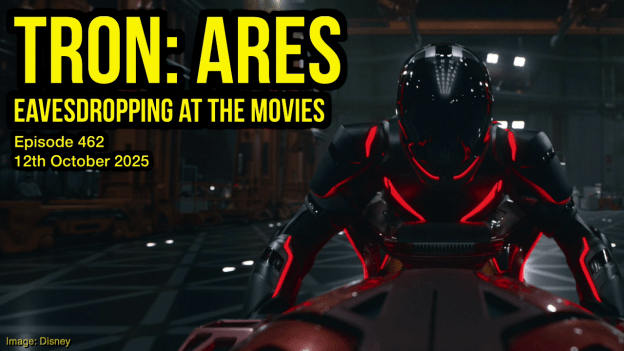
Far from an outstanding film, but amazing to look at and too much fun not to recommend, we had a great time in Tron: Ares, which reverses the reality-computer interface that brought humans into the digital world in the previous two films; it’s now the virtual that becomes real. An evil company searches for the code that will give its 3D printed computer assets longevity in the real world – so far, they crumble into dust after about twenty minutes – but the AI tasked with doing so goes rogue, hoping to use the code to bring itself to life. It’s Pinocchio and Frankenstein with neon-oozing motorbikes, and as entertaining as that sounds. (We think that sounds entertaining.)
We’re joined by our resident Paul Thomas Anderson expert (and Mike’s brother), Stephen Glass, to whom we’ve previously spoken about Phantom Thread and Licorice Pizza, for another discussion of One Battle After Another. Stephen’s seen it in both VistaVision and IMAX 70mm, and can offer a sense of the experience Mike and José missed seeing it in IMAX Digital, and so begins a wide-ranging conversation about the film’s aesthetics, tone, politics, influences and more.
By far Paul Thomas Anderson’s most expensive film, with a budget some four or five times what he’s used to, and probably his most accessible, One Battle After Another entertains us enormously and effortlessly without sacrificing the complexity and nuance for which his work is known. Set in an alternate America oppressed by Christofascism, the alternate part is that there’s a very active militant revolutionary group, the French 75, setting bombs off and freeing detained minorities. Leonardo DiCaprio is part of it, and sixteen years after the conclusion of his group’s activities, their work has entered countercultural legend, but he’s become a drug-addicted, paranoid burnout, trying to raise a teenage daughter. When the powers that be come looking for them, they’re separated, all hell breaks loose, and he has to step up.
José finds One Battle After Another to be the film of the moment, the state of the nation film that Eddington could only dream of being, a powerful, invigorating expression of what ails America and what it means to resist. Mike is more cynical, seeing an element of mockery in the revolution that has no apparent intention to end and is carried out over generations. We love the easygoing style of filmmaking that Anderson seems to have grown into, comparing it to the rigid formality of his early work, and finding that he has a talent for action cinema that’s never quite come out before. We also discuss the film’s themes of youth and ageing, parenting, the Christian right and more.
One Battle After Another is an unmissable film, the kind that fifty years ago would have defined America’s national conversation. Cinema no longer holds that level of cultural cachet, sadly, but One Battle After Another is a powerful, energetic, and very funny reminder of what film can do at its best.
The seventh instalment in the Jurassic Park (now Jurassic World) series, Jurassic World Rebirth might be the first of the sequels to really come close to capturing the kind of wonder, excitement and horror that the 1993 original offered. That might be in part because it cribs liberally from it, with both moments and entire sequences closely evocative of their 32-year-old counterparts. But there’s plenty else that’s new here, and Rebirth is a characterful expansion to the Jurassic Park story.
Thoughts of containment have finally been totally discarded – dinosaurs have now been roaming the Earth for some time, to the point that they’re dying out everywhere other than a narrow band around the equator, which is illegal for human travel. So that’s where we’re headed, of course, as a pharmecutical exec seeking to make a fortune from dino-sourced drugs hires a team of mercenaries to extract blood from three creatures: one that swims, one that walks, and one that flies. It’s a decent structure that tells you what to expect and allows for a variety of settings and action, into which are placed such charismatic stars as Scarlett Johansson, Mahershala Ali, Jonathan Bailey and Rupert Friend. Director Gareth Edwards builds the world beautifully, exploiting it for that sense of scale that so defines his aesthetic, and reminding Mike in particular of his feature debut Monsters; and although in simple terms – this is, ultimately, a blockbuster sequel – the film has a moral message worth expressing.
Jurassic World Rebirth is easily the best of the Jurassic sequels and equally easy to recommend. Just try not to focus too much on how it reminds you of a better film from 1993.
DC, which for the best part of two decades has failed to put together a cinematic universe of comic book adaptations to rival Marvel’s MCU, regroups and goes again with director James Gunn in charge of what will be known as the DCU – and what better superhero to introduce the new brand than the original: Superman.
David Corenswet’s performance and physique are extremely appealing, recalling an era before steroids and dehydration were considered compulsory in order for a man to be thought of as sexy. We appreciate the film’s lightness of tone and sense of humour, although one of us argues that the whole experience is so audiovisually hyperactive and loud that the tone doesn’t support all the jokes, and it’s simply exhausting to endure. We also discuss wokeness, the right wing’s determination to have a culture war, and obvious parallels between Lex Luthor’s villainy and that of Donald Trump; destruction of cities and the concomitant human cost; what made the previous Lex Luthor interesting; and why putting on glasses is an effective method of disguise.
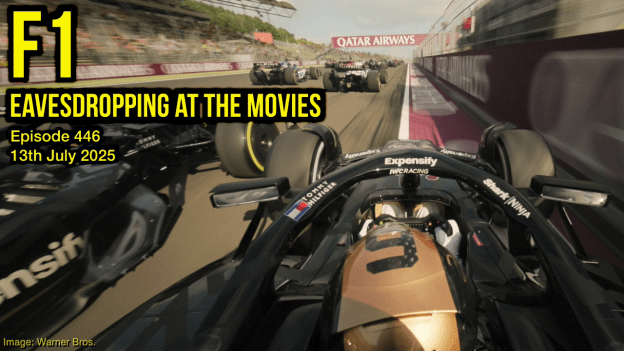
Hollywood collaborates with the FIA, the motorsport governing body, to try to convince us that Formula One is not, in fact, televised Microsoft Excel, but actually very exciting indeed. To this end, it brings in accomplished genre action director Joseph Kosinski, star Brad Pitt, and every cliché under the sun. And it’s great fun.
There’s hardly anything realistic about this story of a sixtysomething has-been given an unexpected shot at glory in racing’s most prestigious competition, despite the extraordinary effort that’s been made to evoke the world of F1, including shooting during real races and race events, with real drivers filling the scenes and even the real commentary team of Crofty and Brundle talking us through the action. The ironic curse of such detail is that the audience most attuned to recognising it is precisely that which will take issue with the film’s inaccuracies; José, on the other hand, doesn’t know F1 from a hole in the ground, and has no such problem.
We discuss the incredibly intense action and praise the cinematography that captures it; Pitt’s perfect fit for the role of a veteran driver who once had promise, made a series of mistakes, but nonetheless carries himself with a casual, appealing ease; whether the film is a corporate biopic, a term Mike is pretty sure he invented and is desperate to catch on; how you can’t call yourself an artist when you’re just selling a product; and whether Kosinski can make a film that depicts complex human interactions.
F1 is far from a great film, but it pretends to be nothing other than what it is: a deeply derivative, expensively made, fabulously shot and entertaining advert for Formula One. It’s easy to recommend. See it!
A wide-ranging discussion follows the release of the final Mission: Impossible film… perhaps. José doesn’t believe that they’ll stop making them, nor does he want them to, but he is glad that Tom Cruise appears to be hanging up his boots – he’s just too old now. While he reflects on Cruise’s career and stardom, Mike’s watched every Mission: Impossible film in anticipation of The Final Reckoning, and tracks changes in their aesthetics, sexuality, and comic tone, as the series worked its way towards finding the formula that’s become its signature.
Over the last couple of months, Chinese children’s fantasy Ne Zha 2 has quickly, and arguably quietly, become the fifth-highest-grossing film of all time, and the first animated film to gross over $2 billion. It’s hard to keep up with the records it’s been breaking – but can we keep up with the plot?
No is the answer, but we readily accept that younger minds, and minds more in tune with Ne Zha 2‘s cultural context and mythological basis, won’t feel as overwhelmed as we did. It did make us feel old, but this audiovisual whirlwind is beautiful and coherent – writer-director Jiaozi exhibits great control over the most energetic of action scenes, and has an eye for striking, colourful imagery. We discuss how closely some of the film’s visual design and messaging might reflect the particular culture from which it comes, or whether it’s so different from American cinema after all, and ask why this and last year’s Inside Out 2 have been able to make so much money (the Pixar film grossing $1.7 billion and becoming the then-eighth-highest-grossing film of all time) with such little response from critics.
Ridley Scott returns to Gladiator after more than twenty years, telling a story that’s broadly the same, but neatly picks up from the original too. Gladiator II stars Paul Mescal in the central role, and we discuss whether he has the movie star charisma to match his indie film credentials; we also talk action, visual effects, Denzel Washington’s Iago figure, the trope of the gay villain, and more.





 Eavesdropping at the Movies