403 – Killers of the Flower Moon

Listen on the players above, Apple Podcasts, Audible, Google Podcasts, or Spotify.

Based on true events, Killers of the Flower Moon tells a story that invokes the foundational genocide upon which the USA was built, but has its own peculiarities. The Osage Nation, a Native American tribe and unusually the owners of their reservation in Oklahoma, became extraordinarily wealthy in the early 20th century upon finding their land gushing oil – but in pursuit of their riches, the white population in the region devised a plan to rob them of their individual land rights, which were only allowed to be inherited. In telling this story, Killers of the Flower Moon justifies its three and a half hours of runtime – though there’s no reason not to include an intermission! – and Leonardo DiCaprio, in particular, has never been better.

We discuss the specific events depicted and the wider history to which they relate and that they evoke in microcosm; the complexities in DiCaprio’s character, who participates knowingly in hideous crimes but truly loves his wife, whose community and family he’s devastating, all the while not quite having the mental acuity to understand the full extent of what he’s involved in; the quality and qualities of the performances and characterisations; the visual design, effects of lighting, and evocation of the feeling of so many mid-20th century Westerns through subtle and specific elements of the cinematography; and the idiosyncratic ending and what it has to say to its audience.

With José Arroyo of First Impressions and Michael Glass of Writing About Film.

402 – Saw X

Listen on the players above, Apple Podcasts, Audible, Google Podcasts, or Spotify.

Listen to our podcasts on the previous two films in the series, Jigsaw and Spiral.

Mike’s favourite horror series, which fizzled out in 2010 after seven annual instalments, has been resurrected in fits and starts over the past few years, and if future sequels can maintain the quality of storytelling of Saw X, we want to see more of them. José still doesn’t understand the appeal of the gore and torture, but accepts that it’s part of the landscape here; what neither of us expects is such an involving and interesting first act.

The serialised story that became so hard to follow during the 2000s is here eschewed in favour of a relatively self-contained episode of Jigsaw’s life – the convolutions that followed his death way back in Saw III are nowhere to be seen here. We’re in pure prequel mode, following him on a trip to Mexico to receive an experimental miracle cure for his terminal cancer, during which the film confidently takes time to build surprising and effective hope for him – everybody likes Jigsaw, the adorable little sadist, after all. The savage redemption that he sets out to offer later on is given weight by this stage-setting, and in the light of how ugly these films can be, it’s a rather refreshing and bold bit of storytelling.

We discuss the racial composition of the group of victims and the varying viciousness of the games they’re forced to play, and just how hard they are to beat – disproportionate gruesomeness is this series’ stock-in-trade, but is only three minutes to sacrifice a body part really fair? Mike praises the lighting, which proves images need not be hard to see to be dark. And we discuss the series’ history, the differences between Saw X and its predecessors, and single out Tobin Bell, the man holding everything together. He got lucky in 2004 to find that his almost background role would quickly make him an iconic cinematic villain; the filmmakers got lucky that the bit-part player they’d hired to lie on the floor for two hours turned out to have the ability and presence to lead a billion-dollar franchise.

Mike’s always thrilled to see a new Saw film, and the fact that this one’s good is merely icing on the cake – but most remarkably, José has found one he needs no nudging or persuasion to recommend!

With José Arroyo of First Impressions and Michael Glass of Writing About Film.

401 – A Haunting in Venice

Listen on the players above, Apple Podcasts, Audible, Google Podcasts, or Spotify.

Kenneth Branagh continues to direct himself as Hercule Poirot in his ongoing project to make Agatha Christie’s classic whodunnits all about him. A Haunting in Venice has less focus on the process and nuances of investigation than its predecessors, Murder on the Orient Express and Death on the Nile – and those already felt the need to punctuate the procedural with action, lest the audience get bored – but shows just as much interest in Poirot’s story, at the expense of the suspects’ and victims’. It’s safe to say that these adaptations are not what they could, or should, be.

Branagh enthusiastically uses dramatic angles and camera movement; wonderful to see but for the fact that he does so with little motivation, failing to create with them the effects and mood that he could. The casting disappoints José, who looks to these sorts of films for the stars of yesteryear who fill the ensemble, bringing their histories and personas to their portrayals of the snooty dowagers, nervous accountants and so on; here, no such stars are present. A few current names pepper the cast list, but most of the players that this whodunnit hosts form a who’s who of “who’s that?”

We’re already into diminishing returns with Branagh’s Poirot series, the films increasingly missing the point of their genre – how can the audience play along with the mystery and marvel at the intricacy of its solution when we’re rushed past the details in favour of hearing about the detective’s inner life yet again? Mike found an element of that to like back in Murder on the Orient Express, but even a heart as large and generous as his can find no room for it any more. It’s simply not good enough.

With José Arroyo of First Impressions and Michael Glass of Writing About Film.

400 – The Nun II and The Exorcist: Believer

Listen on the players above, Apple Podcasts, Audible, Google Podcasts, or Spotify.

You can also hear our discussion of 2018’s The Nun, and our podcast on The Exorcist, part of our exploration of the oeuvre of William Friedkin.

For our 400th episode we indulge in a pair of horror sequels, both heavy on faith, possession, and Christianity. One is part of a modern universe of interconnected stories, characters, and demons, the other represents the reignition of a series whose sequels have been produced intermittently for fifty years without receiving anything like the acclaim of the film that spawned them. The Nun II is the eighth film in the ten-year-old Conjuring Universe; The Exorcist: Believer is only the sixth Exorcist film in half a century. Truly, they don’t make them like they used to.

Neither film in this double bill is very good in totality, but The Nun II contains imaginative and effective set pieces and visual ideas, while The Exorcist: Believer is content to discard a reasonably interesting first act in favour of useless and charmless reference to, and pathetic reenactment of, William Friedkin’s 1973 original. We discuss what we think the films are about, wittingly or otherwise – horror is commonly understood to often allegorise and express the ills and worries of the societies that produce them, and we consider the ways in which these films might be doing so. And there’s much to compare and contrast between them, including their characters’ attitudes to the supernatural; the ways in which religion, be it Catholicism specifically or Christianity more generally, plays into their stories and atmospheres; and the kinds of imagery through which they attempt to instil fear in their audiences. And we take time to criticise many, many examples of the weakness of the storytelling in Believer.

The Nun II, like its 2018 predecessor, is not very good, but it is fun. The Exorcist: Believer is neither good nor fun. Happy 400th episode!

With José Arroyo of First Impressions and Michael Glass of Writing About Film.
399 – The Creator

Listen on the players above, Apple Podcasts, Audible, Google Podcasts, or Spotify.

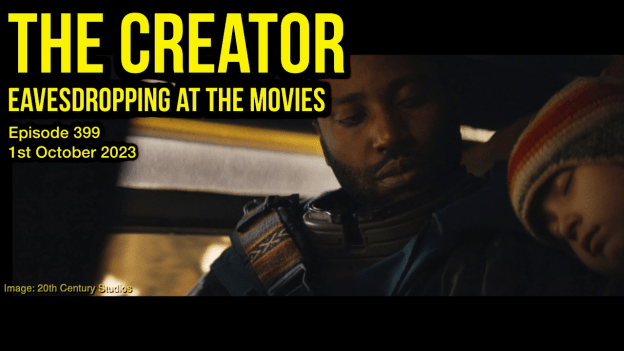
We heartily disagree on The Creator, a sci-fi film directed and co-written by Gareth Edwards, who made his name with Monsters in 2010, which he made largely by himself for half a million dollars, and quickly graduated to tentpole cinema with Godzilla and Rogue One. José had a wonderful time, finding it marvellous to look at and emotionally effective, though leaving room to criticise cinema’s continued insistence that John David Washington is a star. Mike finds it dull, brim-full of clichés, and even a little ugly at times, although Edwards’ sense of how to convey scale, already shown off in his monster movies, remains intact here.

Also featured: ChatGPT and how AI will kill us all.

With José Arroyo of First Impressions and Michael Glass of Writing About Film.
398 – The Old Oak

Listen on the players above, Apple Podcasts, Audible, Google Podcasts, or Spotify.

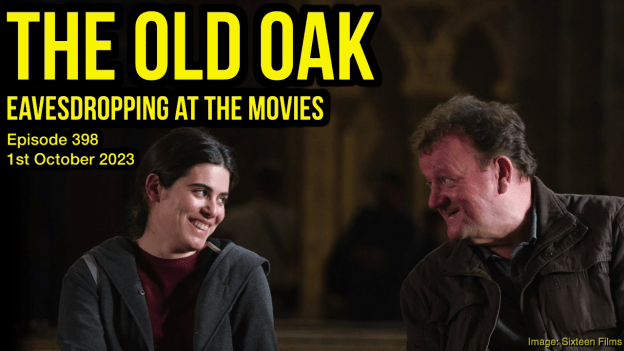
The Old Oak, possibly Ken Loach’s final film, is his least challenging for some time, and that’s perhaps why it’s an easier watch than normal. A northern English town sees the arrival of several Syrian families made refugees by the Assad regime; TJ, the owner of the local pub, begins a friendship with Yara, a daughter of one family. The film draws a connection between the displaced Syrians and British former mining communities, both of which groups have had their ways of life taken from them, and sees communal dining as a means to embrace other peoples and practise solidarity. We find it easy to see its cogs turning, and simplistic in its attitudes and characters, but although The Old Oak shows its share of misery and loss, it also conveys a hopeful feeling at times. An interesting film that will generate conversation, and worth seeing.

With José Arroyo of First Impressions and Michael Glass of Writing About Film.
397 – Stop Making Sense

Listen on the players above, Apple Podcasts, Audible, Google Podcasts, or Spotify.

One of the great concert films, if not the greatest, receives a 4K restoration four decades after its release, and comes to our local IMAX Digital screen. Talking Heads were huge at the time that 1984’s Stop Making Sense was released, and José loved their music, but something about the film didn’t appeal to him, and he never saw it. Though Mike is familiar with the band, he only knows a couple of Talking Heads songs and didn’t expect to ever get around to seeing the film, so what a way to experience it.

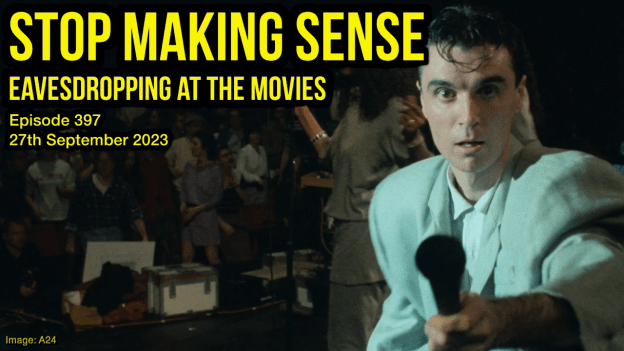
The restoration is beautiful and the huge IMAX screen shows it off spectacularly. We discuss the ability of celluloid to capture rich, textured imagery that digital acquisition formats have never matched; David Byrne’s captivating presence, handsomeness, and exuberant movement; the film’s cinematic style and what puts it above other concert films; the racial composition of the band, both the core members and additional musicians, and what it may or may not reflect about American culture of the time; and more.

We’re absolutely sold on Stop Making Sense‘s greatness, and, even forty years on from its release and the height of the band’s popularity, immediately grasp why it’s still held in such high esteem. See it at the cinema.
With José Arroyo of First Impressions and Michael Glass of Writing About Film.
396 – The Equalizer 3

Listen on the players above, Apple Podcasts, Audible, Google Podcasts, or Spotify.

Listen to our podcast on The Equalizer 2 here.

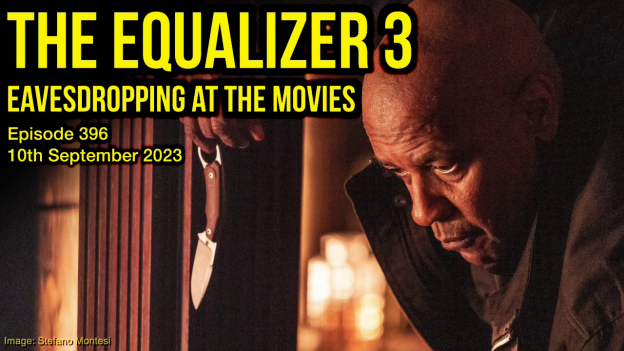
Denzel Washington returns for the third and final instalment of the Equalizer trilogy, in which former government assassin Robert McCall devotes his time and skills to avenging for the little guy. This time, he finds himself in Mediterranean Europe, embroiled in a fight to protect a coastal town from terrorisation by the Camorra, the Mafia of southern Italy.

The Equalizer 3 shares the contemplative tone and pervasive sense of loss of its predecessors. Here, there’s a focus on physical infirmity and vulnerability, a gunshot McCall receives early on forcing a long recuperation, slow, careful approaches to walking down stairs, and the use of a cane. Action erupts quickly and violently, emphasised by director Antoine Fuqua’s camera and editing – McCall is wounded, but maintains his ruthlessness and murderous efficiency.

We compare the action and Washington to Rambo: Last Blood and its star, Sylvester Stallone, which took a similarly staccato approach to its action, clearly informed by Stallone’s age and inability to move as gracefully as he used to – this film is doing something similar, but less thuggishly, if no less violently. We question the ease with which moral decisions are made in this world, in which right and wrong are easily distinguished and the involvement of a vigilante is sold as an obvious necessity and benefit; the film’s look, which fails to show off its spectacular location; and some of its writing and contrivances, particularly concerning Dakota Fanning’s character, a CIA analyst contacted by Robert, and the Camorra. And we discuss McCall as a neurodivergent superhero.

The Equalizer 3 is a flawed film with a fair bit of dumbness to overlook, but it is easy to do so when the portrait it paints of local life and close community is so absorbing and inviting, and its star has such presence, warmth, and intelligence. It’s an easy film to recommend, bearing in mind that it’s a work of vigilante fantasy. After all, if Batman’s allowed to take the law into his own hands when the institutions around him fail, why shouldn’t Denzel be? At least he doesn’t pretend not to kill people.

With José Arroyo of First Impressions and Michael Glass of Writing About Film.
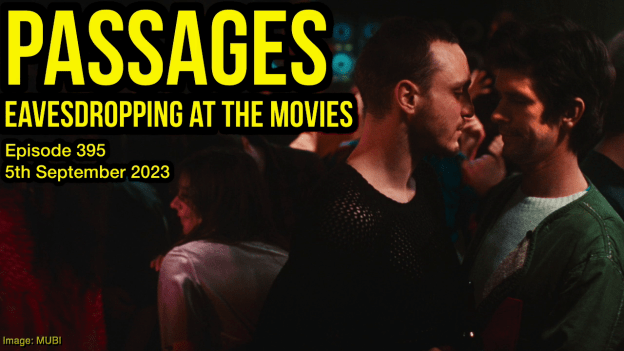
395 – Passages

Listen on the players above, Apple Podcasts, Audible, Google Podcasts, or Spotify.

José enjoys the examination of contemporary relationships in Ira Sachs’ Passages, a Paris-set romantic drama in which a marriage is disrupted when one partner begins an affair with a friend. Mike thinks that the characters’ problems aren’t real problems and that if the unfaithful partner just grew up then everything would be fine.

With José Arroyo of First Impressions and Michael Glass of Writing About Film.
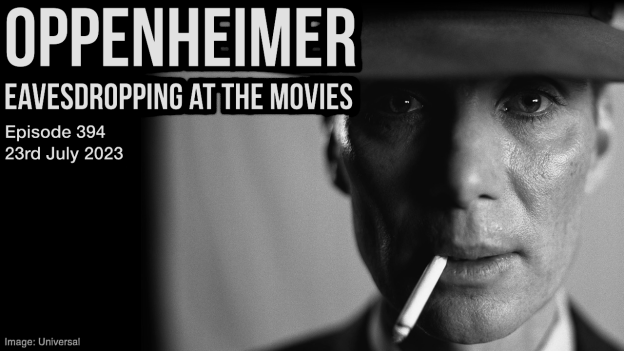
394 – Oppenheimer

Listen on the players above, Apple Podcasts, Audible, Google Podcasts, or Spotify.

The second half of our Barbenheimer double bill takes us to the BFI IMAX in London to see Oppenheimer, the complex story of J. Robert Oppenheimer’s infamous role in the development of the atomic bomb during World War II, the creation and use of which changed history. Writer-director Christopher Nolan, as he has done increasingly over his career, makes extensive use of IMAX 70mm film to tell the story, but as well the spectacle and landscape we’re used to it showing off, here it’s devoted to the intimate.

We’re joined by Mike’s brother and previous guest Stephen to discuss the film, and consider the use of IMAX for close-ups and portraiture, as well as the story’s structure and how the editing and music create pace, the film’s implicit attitude towards Communism, whether Florence Pugh is treated unfairly, the way in which black-and-white footage is used to convey a shift in perspective, how the attacks on Hiroshima and Nagasaki are handled, the Stan Brakhage-esque imagery that conveys the radical sense that all matter is energy waiting to be unleashed, and much more. For José, it’s Nolan’s best film. It certainly deserves to be seen on an IMAX screen.

With José Arroyo of First Impressions and Michael Glass of Writing About Film.