163 – Once Upon a Time in Hollywood

Mike feared it might be the most tasteless film ever made. José doesn’t look forward to Quentin Tarantino films. But we both came away from this fantastical reimagining of a near-mythological era of Hollywood history having had a great time. Tellingly, for a film that exceeds two and a half hours, we both felt the time fly by.

Tarantino’s love for and expert knowledge of Hollywood and cinema informs all of his work, and arguably not that consequentially – he cribs shots, pastiches genres, and evokes styles and tones specific to cinema, but to debatable significant effect beyond the superficial. But in Once Upon a Time in Hollywood (OUATIH for brevity’s sake), the decision to bring this passion to the surface and tell a story directly about Hollywood results in Tarantino’s most meaningful and personal film. What he values is brazenly displayed here, and, Mike suggests, isn’t entirely pleasant to examine. He finds OUATIH initially troubling in this regard – with a day’s reflection on it, he comes to see it as deeply conservative and protective of privilege. In digging this up, we discuss its sexual politics, the way it uses race, and the clash it represents between the old and the new in a rapidly changing 1969 Hollywood. Mike argues that, as in 2009’s Inglourious Basterds, Tarantino’s revisionism revealingly reflects his fantasy of what an ideal world would look like and contain, and in this case it’s a little uneasy to stomach. He also takes issue with the way the Manson family are used, but not, as he feared, for reasons of taste – Charles Manson wasn’t in Hollywood by chance, he wanted stardom, and for a film in which the desire for and loss of stardom are interests, to show no interest in drawing a thematic link here, instead only wanting to use the Manson family to rag on hippies, is more evidence of Tarantino’s retrograde attitude.

The flip side to this coin is that the things Tarantino loves are wonderfully, warmly depicted. OUATIH is as much about television as it is cinema, if not more so, and Tarantino offers imagined and reimagined TV shows of many types in evoking in detail the time and place in which he grew up. To José, about the same age as Tarantino, there abound countless nostalgic pleasures; to Mike, disgustingly born 30 years too late, the film’s enthusiasm and obvious knowledge about its setting rubs off easily. The film easily convinces you to love what it loves, be it silly, overblown action movies; cheesy, overblown TV acting; or Brad Pitt’s Hawaiian shirt, which in one scene blows off.

Speaking of Pitt, José considers this his best performance, one in which he switches from evoking coolness and control to dumb and tripping balls. But for all the little touches and tone he brings to his character, Leonardo DiCaprio brings entirely different registers. His performance is a tour de force, his Rick, a declining Western star, constantly performing, even only to himself at times, and at every moment his emotions and thoughts are crystal clear, even under layer upon layer of performance. DiCaprio practically shapeshifts in sketches depicting Rick’s old movies and television appearances, and offers a sympathetic portrait of a star unable to adapt to his changing environment. It’s a rich, demanding role, and DiCaprio is spellbinding in meeting its challenge.

You’d be doing yourself a disservice missing Once Upon a Time in Hollywood at the cinema. It’s an excited, passionate trip through a Hollywood fantasy, hilarious, light, and thoroughly enjoyable – though, like so many fantasies, its underbelly is dark.

The podcast can be listened to in the players above or on iTunes.

With José Arroyo of First Impressions and Michael Glass of Writing About Film.

162 – Fast & Furious Presents: Hobbs & Shaw

Fast & Furious Presents: Hobbs & Shaw. If there’s a clunkier title out there, we’d like to see it. The first standalone film in the Fast & Furious series, and the first Mike’s seen at all, while José gave up some years ago, after seeing the first two. But José liked the trailer, and coerced Mike into accompanying him, which means that Mike now gets to force José to do something he doesn’t want to one day.

But, with expectations at an all-time low, Mike can confirm that he, in his words, “did not hate it”. In fact, despite it being obvious trash, with an entire family of awful, lazy jokes – the extended metaphors and puerile insults that The Rock and Jason Statham trade are comedy sinkholes – there’s quite a lot that charms us here. While Mike argues for the creativity and execution of the film’s action, José expounds upon his fondness for its stars, on the one hand through the humour and enthusiasm of The Rock, who Mike (who writes these descriptions) refuses to call Dwayne Johnson; on the other, Statham’s working class charm, which sets him apart from any other English star you’d care to name, all conspicuous products of privileged backgrounds and public schools, and none of whom can claim his level of box office power.

The film travels from one character’s home to another, beginning in London and moving to Samoa, leading us to discuss the film’s star vehicle nature – its stars are two of its producers, and indeed, there’s much in it with regards to their images that is closely controlled and orchestrated, Mike noting in particular the manner in which Hobbs, The Rock’s character, annoyingly laughs off Shaw’s insults, as if to say, “I’m The Rock, I’m very likeable and can take jokes”. But the move to Samoa in particular is one we enjoy, especially Hobbs’ slipper-wielding, affectionate mother, and the way his family and friends act as a unit and support him despite his estrangement from them.

Though we happily expound upon the things we enjoyed about the film, which are several, it is far, far from valuable or unmissable. Mike notes the enthusiastic response from the audience we saw it with, a response that rendered him emotionally bleak at sharing a room with them. Hobbs & Shaw is very well-made, expensively-produced trash, and José, for one, wishes we’d all venerate trash a little less.

The podcast can be listened to in the players above or on iTunes.

With José Arroyo of First Impressions and Michael Glass of Writing About Film.

161 – Cold Weather

Cold Weather is a mumblecore crime thriller, if it is indeed possible to conceive of such a thing, which it must be, because Cold Weather is one. Gentle, leisurely, and with a close focus on character relationships and foibles, it’s a pleasant and surprisingly engrossing film, more evidence of the reliability of MUBI’s curation. Never has a brother-sister amateur detective duo been so laid back.

José has issues with the ending, Mike has an issue with the crime story, but neither takes issue with the film’s strength: its characters’ relationships. Whether between adversarial brother and sister, amicable exes, or newly bonding buddies, these are smartly observed and efficiently rendered, and the film relishes moments such as a familial debate over who gets to drive, and a detour in which a character hopes that taking up pipe smoking will allow him to think like Sherlock Holmes. With the exception of some self-consciously ‘art filmy’ shot choices, the film is well directed by Aaron Katz, who maintains a precise and agreeably unhurried tone throughout, and earns characterful performances from his cast. José also remarks upon the cinematography, some later scenes shot during dusk capturing Portland’s natural light and industrial landscape beautifully.

It’s the least interesting of the three films we’ve recently explored on MUBI (the other two being O Fantasma and Border), but this low-key indie is lovely to spend time with, and worth a glance.

The podcast can be listened to in the players above or on iTunes.

With José Arroyo of First Impressions and Michael Glass of Writing About Film.

160 – The Matrix

Listen to our episode on The Matrix Resurrections here.

The Matrix, the Wachowskis’ groundbreaking, iconic sci-fi, is twenty years old this year, and we catch a one-off screening of its 4K restoration. Mike can’t believe he’s old enough for a film he watched as a kid to have a restoration, but this is the world we live in. Or is it?

Well, what an experience The Matrix remains. None of its pleasures have diminished with time, and with the benefit of the years that have passed since its initial release, we see it with fresh eyes. Mike looks at it as part of a late-90s cyberpunk/rave culture era that acts like a time capsule, comparing it to films such as eXistenZ, The Beach, and Johnny Mnemonic, films born of the same culture and dealing with similar philosophical themes, and asking why only The Matrix has stood the test of time. José notes how the film is a product of its time in terms of technology – landline phones are not only everywhere but have plot functions, the computers are large and clunky, the text they display neon green.

We remark upon the film’s slow, noirish start, its willingness to flit between ideas and motifs, dropping them as quickly as it picks them up, and of course, the extraordinary action scenes, as thrilling today as they ever were. José considers the sustained, if not indeed increasing, appeal of Keanu Reeves, and the world’s affection for him. Mike asks whether Neo and Trinity’s love story really works, offering that he found the emotional core of the film to instead be the Oracle scene, and in particular the extraordinary warmth and humour that Gloria Foster brings to it. He also bangs on for a bit about Plato’s Allegory of the Cave and assorted other shite. (He would also like to add here that his phone background has for years been an image of the Matrix’s ‘green rain’, and he may, in fact, believe that he is the One.)

What an unadulterated thrill it was to see The Matrix again, on the big screen where it belongs, after so many years. It may be bizarre to think of it as an old film now, but time makes fools of us all, and it’s a true great.

The podcast can be listened to in the players above or on iTunes.

With José Arroyo of First Impressions and Michael Glass of Writing About Film.

159 – O Fantasma

We’re still with MUBI and grateful for the opportunity to see O Fantasma, directed by João Pedro Rodrigues: a film José had heard of and been encouraged to see by various friends, but hadn’t quite come his way until now. He thought the film was only a few years old and could now kick himself for having waited twenty years to see it. José thinks it a masterpiece, Mike doesn’t; though the film being clearly aimed at a gay male audience might help account for it, and it speaks to José deeply.

Following Sergio (Ricardo Meneses), a very handsome young garbageman in Lisbon, perpetually horny and on the hunt for sex, O Fantasma is feverish sex dream of a film, a reverie, that evokes the feeling of horniness, of being up for sex but having no one with whom to find release. What starts as a hunt eventually turns the hunter into the hunted. We discuss how the character of Sergio seems to have no filter and no fear. He lives in a homophobic culture fraught with danger but is free. The sexual situations seem to take on the form of a dare and, even in the most potentially dangerous encounters, Sergio’s glance seems to say “I’m not afraid of you and it could get sexual if you want it to”. We discuss how the film’s story is structured differently to a conventional narrative: there is a conveyance of a certain kind of sexual dreamscape. The various episodes might not cohere in terms of plot but do come together in the film’s conveyance of atmosphere and feeling.

We note how for an earlier generation this would have been an X-rated film due not only to its subject matter but to its explicitness. We also remark upon the film’s real queer gaze that is also a gay male gaze; something worth distinguishing. We compare the film to the New French Extremity films of the era but also note that where they possessed had a harsh kind of crudeness, O Fantasma is very stylised. José finds the film unusual and beautiful, with extraordinary images that are really potent and poetic.

Sergio feels his desires in a culture in which he’s allowed none of them. Yet this is a film that celebrates a full spectrum of desires, the freedom to desire and to act on one’s desires. O Fantasma is a film that will confirm every homophobe’s worst views of gay men – and that partly its strength. It’s a film that is made in and asserts freedom. Sergio’s gaze is radiant, subversive, and defiant.

If you’re a gay man interested in film, this is unmissable.

The podcast can be listened to in the players above or on iTunes.

With José Arroyo of First Impressions and Michael Glass of Writing About Film.

158 – Border

Pickings are slim at the cinema at the moment, so it’s MUBI to the rescue. We chose Border almost at random, our criteria being only something that looked interesting and would still be on rotation by the time we released the podcast. And what a fascinating film we picked.

Border is a Swedish art film that reeks of mud, pain and isolation, but with a sense of fantasy and irony that render it a curious, surprisingly light affair, despite some gruesome imagery and dark plot developments. It gives us a lot to talk about: the interstices of ideas of gender, place, what it is to be human, how we categorise ourselves, what makes us behave towards others as we do. The film takes a figure of fairy tale, fantasy, and horror, placing it in a contemporary setting. It supports all kinds of interesting interpretations: as a racial narrative, as a trans narrative, as an exploration of nature vs. nature, as a dramatisation of the fluidity of ‘the self’. It opens up beautifully as we discuss it.

The podcast can be listened to in the players above or on iTunes.

With José Arroyo of First Impressions and Michael Glass of Writing About Film.
157 – Toy Story 4

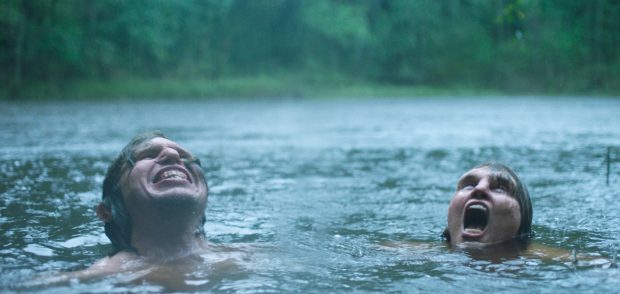
Following a break during which José has been exploring Argentina and Mike has been exploring John Grisham films, we reconvene with Toy Story 4, the latest in Pixar’s iconic animated children’s series. Mike’s seen it once already and is keen to revisit it.

José asks questions of the film’s messages, seeing the toys as faithful slaves, desperate for owners, and discarded once their value is exhausted. Mike argues for the characters’ internal lives and the idea that they are parents or stewards of their children. We at least agree on the Key and Peele characters, thoughtless and lazy stereotypes of blackness, and Mike suggests that the irony that Key and Peele bring to their personas might be intended to make their characters easier to swallow. And their characters have the effect of rendering in sharp focus everything that is white about the film, José picking up on what he sees a tokenism in the few human non-white or mixed race characters present.

Toy Story 4 finally makes something of Bo Peep, turning her into an action heroine, and we discuss feminism in the film and, again, whether this is simply tokenistic or not. And an argument ensues about whether the word “homeless” is appropriate to use with regards to her life, and what we can and should make of Woody’s fate.

And apart from all that, Mike laughed endlessly, and José laughed at Mike laughing endlessly! Despite there being much to pick apart, a great time was had by all in this charming, funny, and visually stunning film.

The podcast can be listened to in the players above or on iTunes.

With José Arroyo of First Impressions and Michael Glass of Writing About Film.
156 – Spider-Man: Far From Home

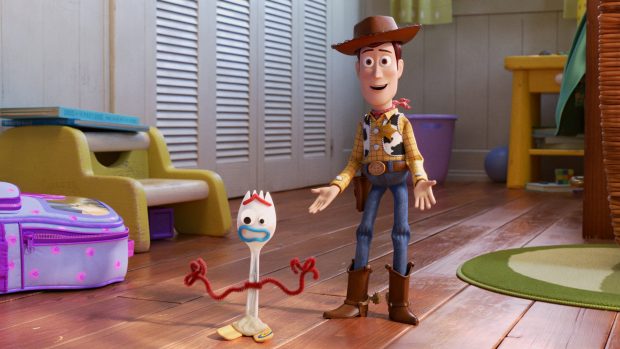
José returns from a week at Il Cinema Ritrovato in Bologna, just in time to see Venice crumble in Spider-Man: Far From Home, the latest injection of plot development to the Marvel series. It hits him in the gut and the film doesn’t recover, José seeing a lack of respect and intelligence that colours the entire experience for him. Mike, on the other hand, doesn’t particularly care for buildings, and finds a lot to like, including one of the more interesting villains Marvel has offered, one that self-referentially comments on image-making and the expanding chasm between what the public is shown and what is actually happening, and a setting – a school trip across Europe – that provides a way for the competing parts of Peter Parker’s life to interfere dramatically.

There’s much up for debate, our experiences differing severely. Two things we can agree on: it isn’t particularly well shot, and Tom Holland’s performance soars. Comme ci, comme ça, as they say in Europe.

The podcast can be listened to in the players above or on iTunes.

With José Arroyo of First Impressions and Michael Glass of Writing About Film.
155 – Diego Maradona

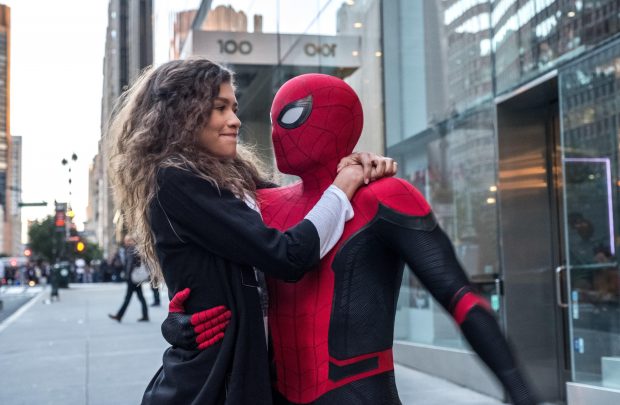
Following his critically acclaimed documentaries about Formula One legend Aryton Senna and troubled jazz singer Amy Winehouse, Asif Kapadia turns his inquisitive lens to Diego Maradona, arguably the greatest footballer of all time, and a man who moved rapidly from the slums of Buenos Aires to worldwide fame, winning the World Cup with Argentina and leading declining Italian club Napoli to two league championships. Kapadia’s film beautifully and economically tells his story, making understandable and human the dark side that accompanies the success, including an illegitimate son, his infamous addiction to cocaine, and perhaps less well-known, his association with the Camorra, the Neapolitan crime syndicate.

Mike has never really “got” these kinds of documentaries, and José is more than happy to oblige him with his impressions of what they do, and in particular what this one does so well. It is not just about the man but about the times, places, people and cultures that were the environment of his life. Maradona is rendered deeply human as the film details the grip that not only the Camorra held on him but also his football team, Napoli’s president refusing to sell him at his request, a capitalist demand for the value he holds, and then, when he is used up, this once-idolised, deified icon of Napoli is unceremoniously discarded, left to quietly slink away as his former worshippers turn on him – and all the while, the human cost to Maradona is incalculable, his extraordinary level of fame extraordinarily difficult to cope with, his descent into deeper drug dependence tragic and his punishment for beating Italy at the World Cup brutal. The film draws an important and poetic distinction between Diego and Maradona, as described by Fernando Signorini, his former fitness coach at Napoli: Diego is the youngster from the slum who loves to play, has insecurities and worries, and is, as Signorini says, “a wonderful boy”; Maradona is the star, the mask that cannot show any weakness, and an unpleasant counterpart to Diego – but without Maradona, Diego would still be in those slums. What the world has always seen is Maradona. What Kapadia shows us is Diego, hidden away, a victim of his own success, further and further buried but, nonetheless, always present.

We also talk a little about Amy, Kapadia’s 2015 documentary, which Mike has watched recently as José’s suggestion and truly loathed, finding it as exploitative and demon-feeding as the media frenzy it depicts and decries. José believes that Mike is too moralistic, but Mike disagrees, and that’s where we leave it.

But! Diego Maradona. It’s a truly great documentary, complex and rich, subtle and tragic, beautifully, smoothly edited, and featuring plenty of thrilling footage of one of the greatest footballers of all time doing the things that gave him that reputation. It’s fantastic. Don’t miss it.

The podcast can be listened to in the players above or on iTunes.

With José Arroyo of First Impressions and Michael Glass of Writing About Film.

154 – Ma

A horror movie that cleverly inverts one or two tropes of the genre, we ultimately feel Ma is less than the sum of its parts, but worth a look nonetheless.

Director Tate Taylor is clearly very good with actors, and every performance here is pitched well, but he doesn’t have such an aptitude for building tension or developing psychological creepiness. The writing doesn’t help him – while Mike insists that the film’s premise is full of potential, it’s not built upon very successfully. But Octavia Spencer is brilliant as the central villain, eliciting laughs and jumps at will, and her Ma is an engrossing character, if a bit reliant on cliché.

José points out the film’s concentration on women, male characters being secondary, and its interesting inversions of gender tropes, in particular a very male gaze: the objects of desire, men are disrobed and splayed out for Ma’s pleasure, and the camera doesn’t shy away from displaying them. Unfortunately, the film seems to have aimed for its 15 rating, sometimes appearing to edit around gore and explicit imagery rather than indulge in it, resulting in a somewhat disappointing feeling that it wants to be more graphic than it’s willing to be, to its detriment. One can’t shake the feeling that, for all Ma‘s boldness, there’s still a more visually expressive, confident film in here, itching to get out.

So it’s worth a look for the interesting way it deploys gender representation, and some wonderfully entertaining performances. Just don’t be disappointed if you’re a bit disappointed.

The podcast can be listened to in the players above or on iTunes.

With José Arroyo of First Impressions and Michael Glass of Writing About Film.