It’s Valentine’s weekend and we take a romantic trip to The Electric Cinema to see It Happened One Night, Frank Capra’s 1934 romantic comedy that is one of only three films to win all Big Five Oscars (Best Picture, Best Director, Best Actor, Best Actress, and Best Screenplay). As usual, Mike hasn’t seen it before, while José’s seen it plenty. Does it hold up?
José talks of its democratic appeal, set largely in the American South during the lowest point of the Great Depression and showing people coming together despite hardship, lack of work and even fainting from hunger. We discuss the development of the relationship between Clark Gable and Claudette Colbert, including the wisdom of sharing a motel room with a man you just met, the propriety depicted (such as forgoing a lucrative reward, instead only claiming your expenses), and of course, the madness of Alan Hale’s singing.
The podcast can be listened to in the players above or on iTunes.
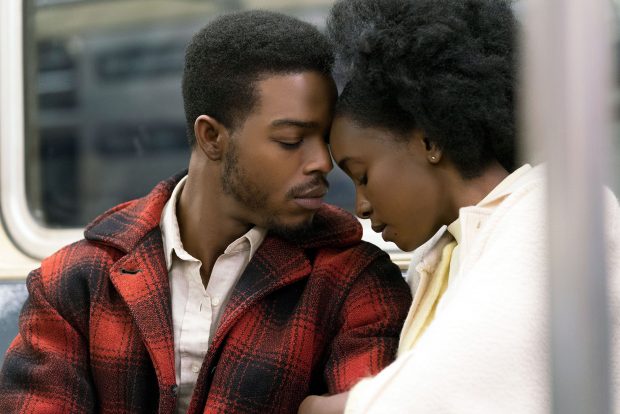
Achingly romantic and visually rapturous, If Beale Street Could Talk, Barry Jenkins’ adaptation of James Baldwin’s 1974 novel of the same name, utterly bowls Mike over, while José expresses some reservations about it, despite also finding it enormously impressive. A love story set in New York City in the late 60s/early 70s, the film follows Tish (KiKi Layne) and Fonny (Stephan James) as they fall in love, begin to build a life together, but are threatened with its destruction by a racist cop and a false accusation of rape.
The title refers to a street in New Orleans that Baldwin, and subsequently Jenkins, use as a metaphor for the black experience across America, and arguably this is overambitious (if not simply impossible). The universality implied by the title is dissonant with what the film offers, which is much more personal and idiosyncratic. José points out the lack of anger in the film, anger that would be absolutely justified to express given both the general institutional racism the characters face in their place and time, and the specific instance of racist behaviour to which they are subjected: the rape accusation. Instead of fury, we see coping, survival, sadness, resistance and love, all communicated with an extraordinary depth of feeling and a camera that finds the beauty and subtlety in everyone’s face. And ultimately this is wonderful, it’s just that the title and opening intertitle that explains it somehow don’t seem to quite understand their own story.
There’s a huge amount we discuss, including the narration; the film’s excursion to Puerto Rico and how its depiction of the experience of Latino people might or might not offer an interesting comparison to its central interest, the African-American community; how Brian Tyree Henry shows up for a scene and steals the entire film; how the film aims for visual poetry; how Jenkins conveys rich sense of different people’s lives and environments with just a few shots; and how the film chokes you up with its incredibly tactile depth of feeling that is sustained more or less throughout. We also bring up comparisons to Green Book, Get Out, and in particular, Moonlight, Jenkins’ previous film – José has issues with how he copped out of giving his story of a gay black boy’s difficulties growing up an honest ending, and takes issue with how viscerally one feels Tish’s desire for Fonny due to the way he’s shot, finding it even more disappointing than before that Jenkins didn’t do the same in Moonlight.
It’s a film we want to see again, infectious and emotionally rich, and if you don’t see it in a cinema you’re missing out. It’s great.
The podcast can be listened to in the players above or on iTunes.
It’s already being portrayed as the film that will undeservedly win Best Picture for its cuddly, comfortable, comedy-drama version of American racism in the Sixties, but do we dissent from that view? Green Book tells the true story of a road trip through the Deep South shared by jazz pianist Doctor Don Shirley (Mahershala Ali) and his Italian-American driver Tony (Viggo Mortensen).
Mike immediately seizes upon Tony’s inconsistent characterisation, the film using other characters to describe him as deeply racist, but his actual interactions with Shirley consisting of essentially polite microaggressions rather than real malevolence and anger. José also takes issue with the revelation that Shirley is gay, Tony having no problem with it, saying that in his regular job as a bouncer he sees it all the time – the film makes no attempt to explain how he can be entirely understanding and accepting of sexuality while intolerant of skin colour. Mortensen, though, is very characterful, imbuing Tony with entertaining irreverence, and the love Tony displays for his wife, writing her letters every day, is very sweet.
Ali doesn’t match Mortensen’s level of performance, though he is perhaps asked less of, largely remaining aloof throughout the film. Again, we find problems in Shirley’s characterisation. The film sets him up as a fish out of water, not just as a gay, black man in the Deep South, but also amongst other black people – it’s a quirk too far to believe that he’s never heard a Chubby Checker or Little Richard record. And the movements made in the film’s final minutes to engineer a classic happy ending (at Christmas, no less) are as predictable and obvious as they come, but Mike is moved by the ending nonetheless, leaving the cinema with a smile on his face.
Despite the character issues, lack of subtlety (every aspect of the issues it depicts is explained in dialogue), weak visual storytelling (this film doesn’t appear to actually know that it’s being shown in cinemas, so fully does it lack any sense of cinematic nous or style), and project of delivering an unchallenging, white man’s version of racism in which everyone can learn to get along without having to face any hard truths, we found things to like in Green Book, and recommend it as long as you keep your expectations low.
The podcast can be listened to in the players above or on iTunes.
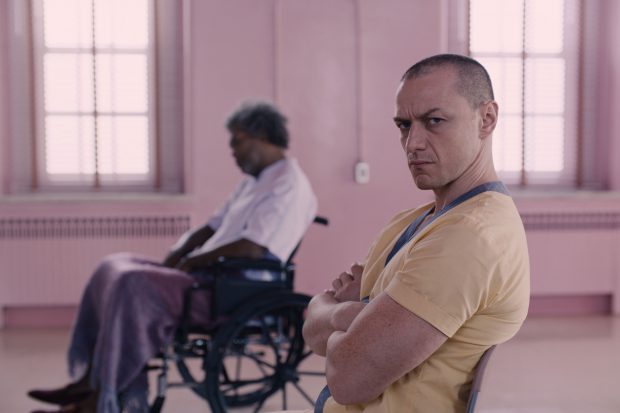
Concluding a trilogy two decades in the making, Glass brings together the characters of 2000’s Unbreakable and 2016’s Split in an unconventional superhero showdown. We both enjoyed it, though it’s a bit of a trifle, but it’s enjoyably oddball and features a particularly brilliant performance from James McAvoy. And we appreciate M. Night Shyamalan’s direction, staging and camerawork, which, while occasionally a little stilted and ‘filmmakery’, for want of a better word, is thoughtful and always strives to create interesting and meaningful imagery.
The film feels significantly affected by the Marvel Cinematic Universe’s influence on comic book movies and their public acceptance; there are things that Glass does, ways it behaves, that are difficult to imagine having made as much sense prior to that series. Indeed, this trilogy is a universe of sorts, with characters from different films being brought together in a shared world.
The podcast can be listened to in the players above or on iTunes.
Adam McKay brings the confrontational, fourth-wall-breaking style he employed in The Big Short to a story of lust for power, hidden agendas, opportunism, and as near as makes no difference a coup d’état of the American government, engineered from inside the White House. Christian Bale plays Dick Cheney as he transforms from a brainless layabout into the de facto President of the United States, operating with scary, virtually boundless power to do whatever he wishes. It’s energetic, interesting, self-aware, and makes statements and accusations as bold as you’re likely to see in mainstream cinema. But it’s difficult to trust, says only what you’d like to hear, narrates where there are obvious opportunities to dramatise, and, fundamentally, fails to do what a biopic should: develop and convey an understanding of who its subject is and why. We weren’t impressed with much more than the makeup, unfortunately – though it is brilliant makeup.
We also have a browse through the Oscar nominations, why not.
The podcast can be listened to in the players above or on iTunes.
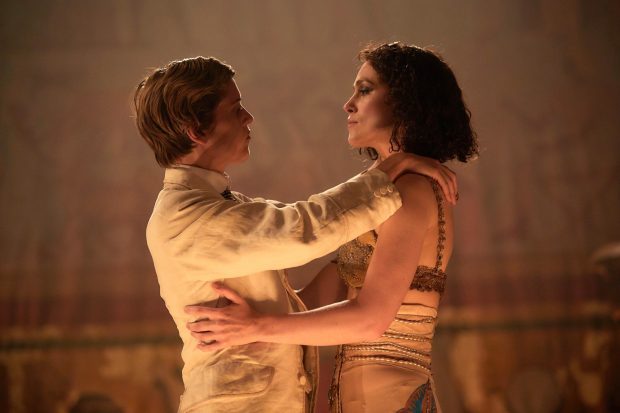
Gender-bending in turn-of-the-century France, with the true story of Colette, probably the most famous female writer in French history and author, although they were published under her husband’s name, of the Claudine stories. With representational interests that give voice and presence to people and lifestyles one might not expect in a period film, and two very good central performances, one sensitive and complex, from Keira Knightley, and the other fabulously charming, Dominic West’s, there are things we like. But our overall response is disappointed, the positives dulled by a poor script, some badly developed characters, and direction that allows no metaphor to pass unvocalised.
Mike considers it a potentially smart film destroyed by a pointless fear of its audience not getting it; José sees it as the middle-of-the-road cinema it is, for better and worse. It’s worth a look in some respects, but we can’t claim it’s a good film.
The podcast can be listened to in the players above or on iTunes.
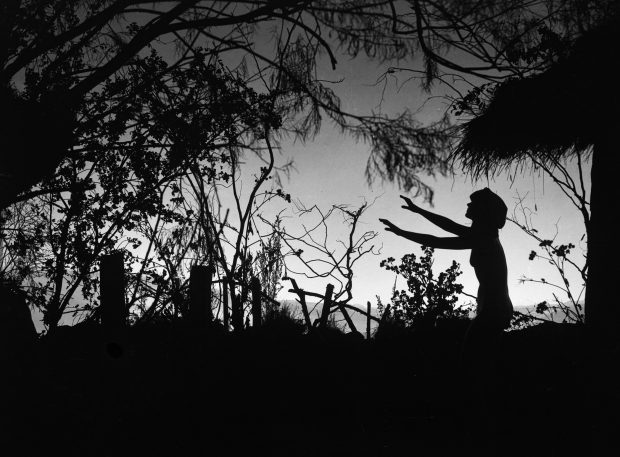
A 1922 Swedish-Danish silent film in the form of a semi-dramatised lecture, we had absolutely no idea what to expect of Häxan, written and directed by Benjamin Christensen. And what a great surprise it was, as we discover an extraordinary, perceptive, original, bold, witty piece of work that details the history of witchcraft, visualises medieval beliefs in wild set-pieces, and draws interesting parallels with modern-day institutionalisation of “hysterical” women.
The projection was out of this world, a 2K 2007 restoration by the Swedish Film Institute with unimaginable clarity, sharpness and contrast. It was unbelievable to look at. (Thanks to Holly Cooper for finding the technical details out for us.) And the film is full of images that benefit from the restoration; Bosch-esque dramatisations of Satanic seductions, a Witches’ Sabbath, and unholy births of demonic creatures. It was the most expensive silent film to ever emerge from Scandinavia, and it shows. Though neither Mike nor José is an expert on horror, and indeed despite Häxan‘s fundamental differences from horror, in its imagery its possibly foundational influences on several subgenres of horror is palpable.
There’s a remarkably sceptical, anti-clerical theme that runs throughout the film. While not strictly atheist, Häxan says clearly from the start it will discuss what folks in the Middle Ages believed without asking us to buy into it. Indeed, there’s a frankly dismissive tone: “Of course, this is all nonsense”, the film effectively says, “but let’s learn about it anyway, shall we?” This set-up, while unexpected, arguably creates a lack of direction and drive until the final chapter, in which we are brought into the modern day (of 1921) and Christensen draws direct links between the superstitions of old and what real-life events, phenomena and afflictions they may have been responding to. And that would be interesting, but the film goes further, talking about this all as not just a difference in the understanding of the physical world between people of different eras, but as a continuum of oppression and abuse of women. Burning at the stake, Christensen says, has been replaced by the mild shower of the mental institution, but how much progress does that really represent? Women are now considered to be ill or troubled rather than in league with the Devil, but is the difference between murdering and imprisoning them really so great? Not only does it pose these insightful and powerful questions, it even proposes things as specific as institutional sexual abuse keeping women in an inescapable cycle of incarceration and continued abuse; assaulted by the very men charged with running the system that’s supposed to protect them, they are left permanent victims, unable to plead their cases, for anything they say will be considered symptomatic of their hysteria, just as women on trial for witchcraft had no escape from torture and murder in a system that was ostensibly just.
We could go on. And in the podcast, we do. The 2007 SFI restoration we saw is available through Criterion, and you owe it to yourself to see it – it’s available on DVD and digitally on Amazon and iTunes, though the Blu-Ray appears to be available only in North America, unfortunately. Brilliant film.
(P.S. José would like to apologise for saying silent films ran at 8 frames per second, when they actually had frame rates that varied from 16-24 fps and often changed due to being hand-cranked.)
The podcast can be listened to in the players above or on iTunes.
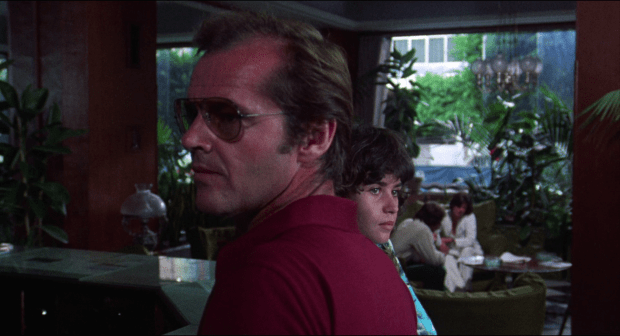
A remarkably lean Jack Nicholson steals a man’s identity in an attempt to leave his life behind in The Passenger, Michelangelo Antonioni’s existentialist thriller from 1975. Though the film contains many of the raw ingredients of a Bond film or Graham Greene novel – a charismatic leading man, a beautiful European love interest, criminal activity, subterfuge and globetrotting – Antonioni cooks up a deeply atmospheric, contemplative work about identity, dispossession and escape.
In the four days between seeing the film at the BFI Southbank and recording the podcast, the film grew in José’s estimation, while Mike was captivated by it immediately, commenting on the lucid, imaginative camerawork that brings past and present together in single takes and seems to give the camera a physical presence in the film’s world, and considering the displacement of Nicholson’s character, a man living between countries and cultures. José, having watched and written on a number of Antonioni’s films back in June (links below), expounds on why he loves them and what he sees as the connective tissue of his oeuvre.
Mike describes Maria Schneider’s unnamed companion character’s similarities to the modern trope of the Manic Pixie Dream Girl, José talks about the joy of seeing Spain in 1975, when he was but a wee nipper, and, of course, we give a few words to that penultimate shot, an extraordinary, brilliantly orchestrated long take that speaks of isolation and finality.
Something a little different for us today, as we visit the Tate Modern to view Christian Marclay’s 24 hour long video art installation, The Clock. It’s a looping supercut of clips from film and television that involve clocks, watches, and people telling each other the time, synchronised to the real world. If you watch it at 8:10pm, it’s 8:10pm in the film too. Supported by London’s White Cube gallery, some 12,000 clips were assiduously located and assembled over three years by Marclay and his team of six researchers to create The Clock, and since its first exhibition in 2010 it’s been popping up every now and again. We jumped at the chance to see it.
The Clock‘s scarcity, ambition, and strength of concept have arguably been partially responsible for its uniformly positive reception since 2010. We, however, find plenty to criticise, including a certain imperial flavour to the overwhelmingly Anglo-American choices of source films, not to mention the whiteness that pervades the entire project and lack of imagination displayed by its reluctance to explore outside the canon. If one of the ideas behind the piece is to draw commonalities between cultures and eras, as Mike suggests, then this is a failure not just to please our sensibilities but to achieve its own purpose. The few non-English language clips that do intermittently show up serve only to highlight their own absence.
There’s also a discussion to be had about the piece’s presentation. On the one hand, with the film housed in a vast, purpose-built room, entirely darkened, with sofas lined up in perfect geometric alignment, it’s an unadulterated joy to let the time fly by, even when you know full well that you’ve been stood up for two hours because no seat is available and the artwork itself has been counting the minutes, mocking you. José decries the dismissive, contemptuous treatment cinema receives in art galleries, on which he has also recently written – https://notesonfilm1.com/2018/12/22/the-museums-disdain-for-cinema/ – but finds The Clock‘s presentation in this respect faultless. On the other, likely for the sake of a smooth viewing experience, the source clips have all been cropped (and in a few cases, stretched) to fit the same aspect ratio, a decision that we feel shows disrespect for the images and people behind them that far outweighs any benefit it has as to unifying them.
There are, though, ways in which Marclay manipulates the source material that we find valuable. Indeed, the entire piece assembles clips from thousands of films, and editing is what it’s all about. When The Clock edits clips together along thematic lines, such as when we see people in different films, places, and eras all taking their seats for concerts and plays at the same time, and when it indulges in formal exercises, cutting together car doors slamming or people smoking, it qualitatively changes its source footage into something different, achieving interesting and sometimes simply swoony effects. At other times, a character in one film will pick up the phone and speak to a character in a different film (often in a different era), the piece using humorous juxtaposition to connect them. And the piece constantly edits and mixes its own soundtrack, using the source films as a basis and typically fading between them, again smoothing the viewing experience, and occasionally building a soundtrack that sits behind an entire section of clips, binding them and creating something new, such as the anticipation generated by Run Lola Run‘s soundtrack as the film chases down noon. It’s at these times that Mike is most impressed, seeing a marked difference between when The Clock is a film and when it’s a film project, finding that too often is it the latter. But those moments of filmmaking are quite fantastic.
The Clock is a singular work and one we’d urge anybody to see given the chance, but with room for significant and fair criticism. Keep an eye out for it.
The podcast can be listened to in the players above or on iTunes.
Greek weirdo Yorgos Lanthimos, whose off-kilter thriller The Killing of a Sacred Deer divided and provoked us a year ago, brings us The Favourite, a wild dramatisation of the power games surrounding Queen Anne’s bedchamber in the early 18th century. It’s his first feature on which neither he nor his usual partner Efthymis Filippou is credited as a writer, and that might account for its liveliness compared to his previous work, which tends to offer significant downtime in which the audience can ponder what it’s seeing. The Favourite moves rapidly and fluidly, the shifting dynamics between Olivia Colman’s Queen Anne, Rachel Weisz’s Lady Marlborough, and Emma Stone’s Abigail Hill constantly exciting, with their plans always subject to change depending on who knows what about others. And on top of the intrigue, it’s really, really funny.
The Favourite offers us a brilliantly cast and even more brilliantly performing female trio, picking on a rare historical moment in which all the most important and influential people were women. (The men are all secondary, made physical jokes of, with their extravagant costumes and makeup outdoing the women’s.) Sex is always on the table and made to mean different things to different people: to Marlborough and Abigail it’s a tool to be used to manipulate and control the Queen, to whom it offers intimacy and emotional satisfaction she deeply craves and is allowed to feel she doesn’t deserve. The film doesn’t offer titillation, nor does it wish to shock or surprise with its depictions of sex or even the concept of the lesbian relationships. It’s actually quite remarkable how the film so casually avoids making it superficial and gratuitous.
We take our time to appreciate the cinematography, extraordinary wide-angle and occasionally fisheye shots that render characters, particularly the Queen, tiny playthings in a ludicrously ostentatious doll’s house. Mike remarks upon the way status is conferred by placing characters above and below each other and shooting at extreme angles to emphasise; José picks up on the costuming and its relationship to gender, mentioning in particular his admiration for Nicholas Hoult’s self-effacing, generous performance as Robert Harley, impressed by his willingness to make himself a feminised figure of fun.
There’s so much more we loved and we’re effusive throughout the podcast. And again. It’s a really, really, really, really, very very funny film indeed.
The podcast can be listened to in the players above or on iTunes.