Tag Archives: thriller

467 – It Was Just an Accident

Listen on the players above, Apple Podcasts, Audible, Spotify, or YouTube Music.

One of Iran’s most celebrated filmmakers, Jafar Panahi, has spent the last quarter of a century in conflict with the Iranian government, which objects to his films’ criticisms of their actions and the wider social conditions in the country, and has both arrested him several times and banned him from making films for twenty years – which hasn’t stopped him. His latest, It Was Just an Accident, won the 2025 Palme d’Or, and tells the story of former political prisoners who capture a man they suspect was their torturer.

It’s a brilliant thriller which, despite the gravity and darkness of its subject matter, is energetic and entertaining. It effortlessly raises both moral and practical questions – What’s the right thing to do with their captive? Have they become the torturers? If they let him live, won’t he just come after them again? – without entering morality play territory, neither pretending to have the answers nor admonishing its characters for their choices and emotional responses. It’s a vivid expression of the lasting effect the actions of the Iranian regime have had on its people, for whom merely the suggestion that they might be able to exact revenge on their torturer causes instant emotional outbursts.

We discuss all this and more, including the depiction of a lawless culture in which you’re constantly expected to give bribes to get by; the filmmaking, in which no filming permits were provided and Panahi had to once again violate his filmmaking ban; the question of how ambiguous the end might be and what that means; and a comparison with American cinema in Trump’s America and the question of what might be happening under ICE, the immigration enforcement agency that’s expanded into a neo-paramilitary force over the last year.

It Was Just an Accident is a magnificent film. See it.

With José Arroyo of First Impressions and Michael Glass of Writing About Film.
466 – Nuremberg

Listen on the players above, Apple Podcasts, Audible, Spotify, or YouTube Music.

Russell Crowe shines in Nuremberg as Hermann Göring, who became the face of the Nazi Party following Hitler’s suicide and the end of the war, as he’s held in custody and probed by a psychiatrist as the titular trials approach. Indeed, while a mediocre film, its actors’ performances are a pleasure – with the exception of Rami Malek, whose psychiatrist is twitchy, busy, and a failure. A shame that he’s the protagonist, then.

We discuss the film’s structure and screenplay: José contends that Malek’s character is not just badly played but an irrelevance, and the drama would be much better served by focusing on Michael Shannon’s prosecutor; Mike criticises what he claims is a stupid person’s idea of clever writing.

And there’s more to think about: how Nuremberg compares to Bridge of Spies, which similarly depicted a novel trial that had obvious implications beyond the courtroom, and Judgment at Nuremberg, the other major dramatisation of the trials; the film’s tone, which is able to handle moments of humour but sometimes veers into the overly glib and kitsch; the present-day rise of fascism and the genocide in Gaza to which the film speaks; the use of real footage of Holocaust victims and the purpose to which it’s put; and whether we think that its critique of the Catholic Church for its support of the Nazis, and suggestion that dropping the atomic bomb on Japan was an unjustifiable atrocity, are surprising and bold things for a mainstream American film to do… or not particularly impressive, and shouldn’t people just know this stuff anyway?

With José Arroyo of First Impressions and Michael Glass of Writing About Film.

464 – Bugonia

Listen on the players above, Apple Podcasts, Audible, Spotify, or YouTube Music.

Yorgos Lanthimos’ fourth collaboration with Emma Stone yields a darkly comedic thriller about two conspiracy theorists who kidnap a CEO, determined to reveal the truth that she’s an alien from Andromeda. We’ve all at least considered it.

While funny and absurd, Bugonia is also tragic and misanthropic, and we’re unconvinced that its ending is either earned or fitting, despite Mike’s insistence that he’s seen it coming for weeks. We consider the film’s messaging, aesthetics, and tone; what its stars bring to it and how they differ; what the title might mean; and how a comparison with Alex Garland’s Ex Machina reveals the lacks in the storytelling here. We pick at Bugonia left, right and centre, but despite our complaints, it showed us a very entertaining time, and there’s a lot about it to recommend.

With José Arroyo of First Impressions and Michael Glass of Writing About Film.

461 – One Battle After Another – Second Screening

Listen on the players above, Apple Podcasts, Audible, Spotify, or YouTube Music.

Listen to our first podcast on One Battle After Another here.

We’re joined by our resident Paul Thomas Anderson expert (and Mike’s brother), Stephen Glass, to whom we’ve previously spoken about Phantom Thread and Licorice Pizza, for another discussion of One Battle After Another. Stephen’s seen it in both VistaVision and IMAX 70mm, and can offer a sense of the experience Mike and José missed seeing it in IMAX Digital, and so begins a wide-ranging conversation about the film’s aesthetics, tone, politics, influences and more.

With José Arroyo of First Impressions and Michael Glass of Writing About Film.

458 – The Long Walk

Listen on the players above, Apple Podcasts, Audible, Spotify, or YouTube Music.

Cheap, simple, high-concept and reasonably graphic, The Long Walk is a throwback to the days of the B-movie. In its dystopian, totalitarian version of the USA, an annual event, the Long Walk, is designed to inspire a work ethic and national pride in the citizenry, and in so doing restore the country to that self-defined global number one status it craves; to make America great again. The televised competition sets fifty young men, one from each state, against each other in a test of endurance: they must walk for as long as they can, maintaining a speed of over 3mph at all times, with success rewarded with unimaginable riches and the fulfilment of a personal wish, and repeated failure to keep up punished with on-the-spot execution. There is one winner.

What promises to be quite dumb is not quite as dumb as Mike anticipates. The worldbuilding is fairly thin, and the premise of the competition an immediate hurdle for the audience to clear, but The Long Walk is able to develop thematically in surprising depth through the interactions and conversations between its competitors, who share their thoughts on the event, the personal histories that draw them to it, and their intentions if they win. With a number of reservations – we find its visual direction lacking and differ on how good the performances and screenplay are – it’s easy to recommend The Long Walk, which shows us an America in need of revolution, and asks its characters what it might take to achieve it.

With José Arroyo of First Impressions and Michael Glass of Writing About Film.
457 – One Battle After Another

Listen on the players above, Apple Podcasts, Audible, Spotify, or YouTube Music.

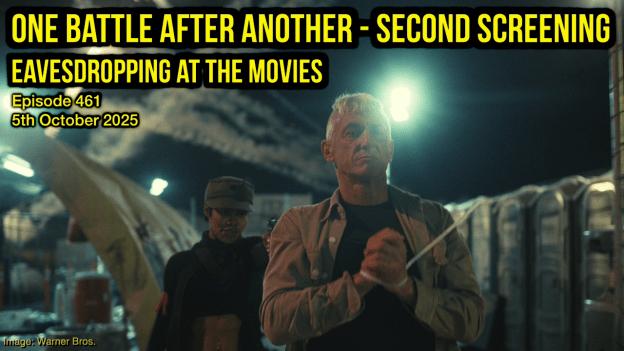
By far Paul Thomas Anderson’s most expensive film, with a budget some four or five times what he’s used to, and probably his most accessible, One Battle After Another entertains us enormously and effortlessly without sacrificing the complexity and nuance for which his work is known. Set in an alternate America oppressed by Christofascism, the alternate part is that there’s a very active militant revolutionary group, the French 75, setting bombs off and freeing detained minorities. Leonardo DiCaprio is part of it, and sixteen years after the conclusion of his group’s activities, their work has entered countercultural legend, but he’s become a drug-addicted, paranoid burnout, trying to raise a teenage daughter. When the powers that be come looking for them, they’re separated, all hell breaks loose, and he has to step up.

José finds One Battle After Another to be the film of the moment, the state of the nation film that Eddington could only dream of being, a powerful, invigorating expression of what ails America and what it means to resist. Mike is more cynical, seeing an element of mockery in the revolution that has no apparent intention to end and is carried out over generations. We love the easygoing style of filmmaking that Anderson seems to have grown into, comparing it to the rigid formality of his early work, and finding that he has a talent for action cinema that’s never quite come out before. We also discuss the film’s themes of youth and ageing, parenting, the Christian right and more.

One Battle After Another is an unmissable film, the kind that fifty years ago would have defined America’s national conversation. Cinema no longer holds that level of cultural cachet, sadly, but One Battle After Another is a powerful, energetic, and very funny reminder of what film can do at its best.

With José Arroyo of First Impressions and Michael Glass of Writing About Film.

455 – Eddington

Listen on the players above, Apple Podcasts, Audible, Spotify, or YouTube Music.

Most film and TV has quietly agreed to pretend that the Covid pandemic never happened. Perhaps it’s too awkward to discuss it. Perhaps it’ll date your work. Writer-director Ari Aster doesn’t share these worries, telling a story about the days of lockdowns, mask mandates and conspiracy theories – days of particular hostility and division in the USA, in which individual freedom does constant battle with the greater good.

Eddington is an ambitious attempt at the state-of-the-nation film: a darkly comic thriller with wild tonal shifts, a mass of interwoven themes, uneven pacing, and an eventual climb out of reality into absurdity. José finds much to dislike, particularly its dismissive attitude towards the young people it depicts supporting the Black Lives Matter movement; Mike is surprised at how much he likes it, given how let down he felt by Hereditary. Eddington is certainly a mixed bag, but we’re glad to have seen it.

With José Arroyo of First Impressions and Michael Glass of Writing About Film.
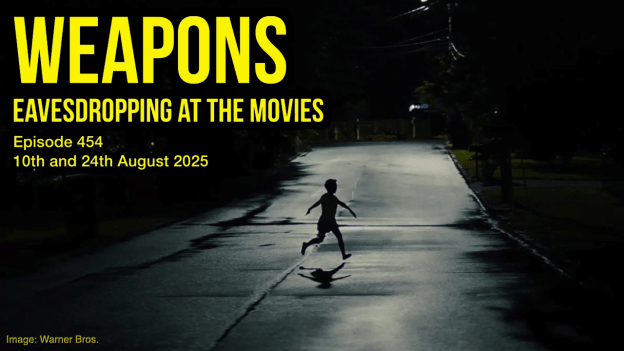
454 – Weapons

Listen on the players above, Apple Podcasts, Audible, Spotify, or YouTube Music.

One of the most hotly-anticipated horror films in recent memory, Weapons begins with seventeen third-grade children in a Pennsylvania town mysteriously waking up at 2:17am one Wednesday and running from their homes into the darkness. The shocking, unexplained disappearance and imagery of an empty classroom alone suggest an allegory of school shootings, and we ask what else can be read into the film, and discuss the depth with which it handles its themes. We have our issues with Weapons but enjoy it very much all the same, and find a lot to like. It’s probably just a little overpraised.

Two weeks later, with the film still on his mind, Mike opens up further discussion and proposes that maybe there’s more to it than he gave it credit for – or that you have to be American to properly get it.

With José Arroyo of First Impressions and Michael Glass of Writing About Film.

453 – The Shrouds

Listen on the players above, Apple Podcasts, Audible, Spotify, or YouTube Music.

A psychosexual thriller that’s neither psychosexual nor thrilling enough, The Shrouds is a disappointment. There’s great promise to businessman Vincent Cassel’s invention of a technologically advanced shroud that creates a 3D model of the decaying body it houses, when we’re shown the lust with which he observes his deceased wife’s corpse. The film is peppered with recurrent imagery of her disfigured body, and its importance to Cassel’s character is constantly reinforced, but the film is too talky, its imagery too bland, and its plot too convoluted to make the most of it. A shame.

With José Arroyo of First Impressions and Michael Glass of Writing About Film.
437 – Babygirl

Listen on the players above, Apple Podcasts, Audible, Spotify, or YouTube Music.

Nicole Kidman gives a compelling, vulnerable performance in Babygirl, as a woman for whom sexual satisfaction requires her to relinquish the power she otherwise projects throughout her life, and who begins an affair with a much younger man she finds herself unable to resist. Unfortunately, that’s the only significant thing to recommend about the film, which we find superficial, badly thought out, and most crucially of all for Mike, nowhere near steamy enough. It’s good fun to discuss, though, and gives us opportunity to reminisce about sneaking into films we weren’t allowed to see when we were kids. Stick around to learn José’s Looney Tunes technique for fooling the ticket guy.

With José Arroyo of First Impressions and Michael Glass of Writing About Film.