Yorgos Lanthimos’ fourth collaboration with Emma Stone yields a darkly comedic thriller about two conspiracy theorists who kidnap a CEO, determined to reveal the truth that she’s an alien from Andromeda. We’ve all at least considered it.
While funny and absurd, Bugonia is also tragic and misanthropic, and we’re unconvinced that its ending is either earned or fitting, despite Mike’s insistence that he’s seen it coming for weeks. We consider the film’s messaging, aesthetics, and tone; what its stars bring to it and how they differ; what the title might mean; and how a comparison with Alex Garland’s Ex Machina reveals the lacks in the storytelling here. We pick at Bugonia left, right and centre, but despite our complaints, it showed us a very entertaining time, and there’s a lot about it to recommend.
Most film and TV has quietly agreed to pretend that the Covid pandemic never happened. Perhaps it’s too awkward to discuss it. Perhaps it’ll date your work. Writer-director Ari Aster doesn’t share these worries, telling a story about the days of lockdowns, mask mandates and conspiracy theories – days of particular hostility and division in the USA, in which individual freedom does constant battle with the greater good.
Eddington is an ambitious attempt at the state-of-the-nation film: a darkly comic thriller with wild tonal shifts, a mass of interwoven themes, uneven pacing, and an eventual climb out of reality into absurdity. José finds much to dislike, particularly its dismissive attitude towards the young people it depicts supporting the Black Lives Matter movement; Mike is surprised at how much he likes it, given how let down he felt by Hereditary. Eddington is certainly a mixed bag, but we’re glad to have seen it.
After a little time off, we’re back at the cinema to see Bong Joon Ho’s sci-fi comedy, Mickey 17, in which Robert Pattinson dies. Repeatedly. Leaving Earth on a spaceship seeking to colonise an icy planet, Pattinson’s Mickey is an “Expendable”: a disposable worker given lethal assignments, regenerated by a biological printer, and sent out to die again. But when the 17th version of Mickey fails to die at the mandibles of the local fauna, he finds his way back to the colony, only to find that he’s already been reprinted as Mickey 18 – and clone coexistence is strictly prohibited.
We’re disappointed by what looked like a marvellously energetic, knockabout comedy and social satire from the trailer. Even considering the film’s very broad tone, there’s too little in the characterisation to really buy in to, a severe lack of pace, and an ending that betrays it. Nonetheless, as failures go, it’s an interesting one, playing with plenty of ideas, and featuring more than enough good jokes to support it. Our recommendation of Mickey 17 is far from whole-hearted, but you ought to give it a whirl.
We’ve enjoyed Adam McKay’s previous couple of films, The Big Short and Vice, in which he dramatises real events in a pointed, opinionated, satirical manner. He now brings the same attitude to the apocalypse, painting a picture of a world in which an asteroid is headed on a collision course with Earth, poised to end the human race’s existence unless something is done… and nobody cares.
We debate its merits and failures, agreeing that it’s a comedy with few laughs, but José arguing for its place in the national theatre of ideas that cinema has always been in America, and as a response to that question we’ve been hearing asked for several years now – how can you satirise a reality that’s this absurd to begin with? Mike asks why McKay’s previous films worked where this fails, and suggests that it’s an inability to be indirect, to work in poetic ways – something that’s effective when being openly sarcastic, as in The Big Short and Vice, but that falls short in Don’t Look Up‘s appeal for earnestness and depth of character.
An ambitious film, then, attempting to holistically satirise the state of things as they currently stand – but at best, a mixed bag.
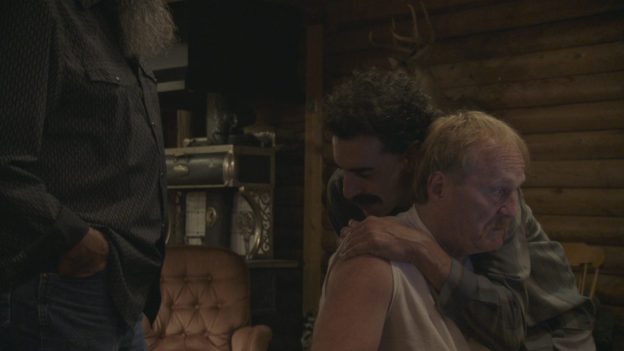
Fourteen years have passed since Sacha Baron Cohen’s first tour of the USA as Borat, his friendly, clueless, and decidedly un-PC Kazakh journalist. Borat gave his unwitting participants, real people who didn’t know that he was a character, space and encouragement to display their bigotry, sexism, racism, and stupidity – now he’s back to do it again, in a world in which bigotry, sexism, racism and stupidity are no longer deemed necessary to hide.
Sexism in particular is this film’s bedrock, the film introducing a daughter, Tutar, who Borat didn’t know about, and when she stows away on her father’s trip, he decides to offer her to Mike Pence as a token of Kazakhstan’s friendship. Women are chattel, and the only objection raised when Borat decides to give the fifteen-year-old Tutar breast implants is that he can’t afford them. Women’s role as playthings for men, and the society that refuses to allow them control over their bodies, shape almost every scene, including a debutante ball, a conversation with a Christian doctor, and of course, THAT scene with Rudy Giuliani.
We also discuss the question of the reality of what we’re seeing and how the film’s camerawork and editing fails to convince us of it, how comedy has changed in the last decade and a half, and how the film unexpectedly gives its unwitting participants the opportunity to be tolerant and welcoming. And we each share memories of our grandmothers.
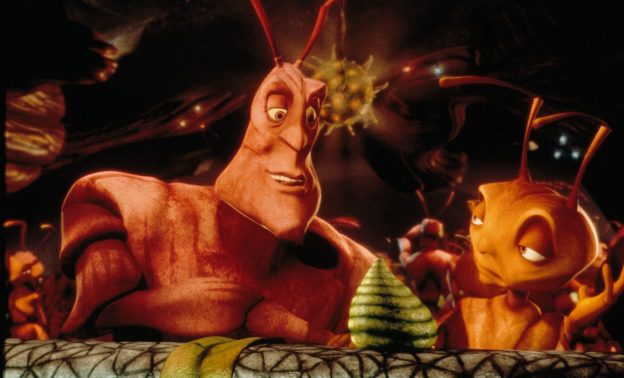
The second feature-length computer-animated film ever made, after Pixar’s groundbreaking Toy Story, Antz is an oddball. A public feud between Jeffrey Katzenberg and then-CEO of Disney, Michael Eisner, led to Katzenberg founding Dreamworks SKG and subsequently feuding with Pixar’s John Lasseter, who was making the suspiciously similar – and ultimately more successful – A Bug’s Life. Pixar is the historically more successful and well-regarded studio, and the direct comparison between these two films usually sees Antz considered inferior, but Mike’s long been fond of it, and in revisiting it we discuss both how far it shows us animation has come in the last twenty years, and its many qualities, including its rather grown-up tone and references, imaginative and expressive visual design and cinematography, and witty dialogue.
Jacques Tati’s masterpiece, 1967’s Playtime, is an extraordinarily ambitious work of visual comedy and social satire. Mike’s been keen to see this for fifteen years or more, knowing of its reputation for detailed visual design and the 70mm cinematography that shows it off, waiting for the right moment. José, when Mike suggests we watch it, thinks he’s seen it many years ago, but soon realises he was probably thinking of Monsieur Hulot’s Holiday, Tati’s rather more charming comedy of fourteen years prior, so it takes him a while to get into Playtime‘s rather more offbeat gear.
And he is ultimately a little cold to the film, though not immune to its appeal and pleasures, while Mike loves it unconditionally. In a somewhat alternate, near-future Paris, the plot, such as it is, follows two characters: Monsieur Hulot, the character Tati played in several films, as he stumbles through a France he finds unfamiliar and devoid of humanity; and Barbara, an American tourist visiting the city. In approximately six fairly distinct vignettes, Tati explores a vision of a consumerist, modern, and alienating Paris, the Eiffel Tower, symbolising the warm, cosy Paris of old, a long way away, merely a distant feature on the horizon or a reflection in a window. It’s an attitude for which José has little sympathy, though Mike suggests that the development of the final scene, a kind of funfair around a traffic jam, can be seen as a synergy of the traditional and modern, and finds it moving.
There’s a huge amount to discuss, including the design and execution of the jokes; the impossible scale of the set, nicknamed ‘Tativille’ and whose astronomical cost would ruin Tati, who was forced to file for bankruptcy; to what other films, if any, it can be compared; the visual design, cinematography, choreography, and colour; the use of nationality, particularly American; and how the film might play differently today compared to upon its initial release – Mike arguing that it may have anticipated changes to the real world that would later materialise, such as the cubicle office, whose familiarity to us diminishes the otherworldliness we might otherwise feel.
Playtime is a significant work of satire and well worth seeing, particularly given its beautiful restoration in 2014. Don’t miss it for fifteen years. Don’t be Mike.
Carole Lombard and Jack Benny lead chaos in 1942’s To Be or Not to Be, Ernst Lubitsch’s classic black comedy set amongst a group of actors turned resistors in occupied Poland. Considered to be in bad taste at the time, it was, to say the least, a bold film to make, one that mocked the very real and active threat of the Nazis to their faces. It’s also endlessly witty and truly hilarious, generous and kind. It’s a treat.
We think about it in comparison to other satire, in particular that of Mel Brooks, who José argues has an aggression and contempt that Lubitsch avoids, while Mike suggests that their work shares an absolute unambiguity as to the targets they set and the messages they convey. But there’s unquestionably a remarkable sensitivity of tone to To Be or Not to Be, as well as an effortlessly executed intelligence in plotting, with the love triangle of the opening leading cleverly, smoothly, and unpredictably, into the unmasking of a Gestapo spy.
José can’t speak highly enough of Lubitsch, above whom there sits nobody in the pantheon of the great filmmakers. And Mike likes him too.
P.S. Corrections and clarifications: Mike begs your forgiveness for incorrectly claiming that Sid Caesar famously played a comedy Nazi on television in the 1950s. He in fact played a German general. A comedy German general.
A film many have heard of and few have seen, Southland Tales is writer-director Richard Kelly’s infamous difficult second album. Six years after his eventual cult hit Donnie Darko, this sprawling, confusing mess of an end-of-days parable was released to thunderous bafflement and almost no box office. We dive in and find that perhaps all we needed was to give it thirteen years to breathe.
There’s no defending much of the film’s execution. Kelly’s visuals are functional at best, almost never expressive, and rather obvious, there’s an abundance of plot that feels at once over- and under-developed, and there’s no emotional way in to significantly connect with any character. But Southland Tales is chock full of ideas and ambition, and there’s much to respond positively to. José considers how its critique of American culture continues to resonate today; Mike suggests that alongside M. Night Shyamalan’s The Village, it captures the state of mind of post 9/11, pre-financial crash, perpetually warring, deeply conservative and fearful America. Kelly may show little instinct for visual expression, but his ability to cast well and get the best out of his actors is remarkable, and for José, Justin Timberlake and Dwayne Johnson have never been better. And we consider the use of Revelations in the voiceover, and wonder where Seann William Scott has been for the last ten years.
For a Saturday night in, it’s tough to recommend Southland Tales. As a sizzlingly ambitious attempt to combine just about every worry it was possible to have in mid-2000s America into a grand work of sci-fi satire, it’s fascinating and worth your time. Its reach far exceeds its grasp, but that’s so much more appealing than the other way round.
A political parable, satire, thriller, high-concept actioner, horror, and Western all at once, 2019 Cannes Jury Prize winner Bacurau is a wild experience and well worth your time. Set in a tiny, remote village in a near-future Brazil, we’re given a portrait of life within an open, tolerant community under the thumb of a distant but powerful mayor, and shortly after the funeral of one of the town’s elders, things start going awry.
To say more would be to spoil the surprises, and we encourage you to check the film out knowing as little as possible. As a fable, it’s a potent piece of work – themes of political abuses, the ownership and withholding of water conferring power, and the value of community and the knowledge of history are all made manifest as Bacurau straddles its genres and provides its thrills. It’s a film that’s as open to interpretation as it is clear about what it thinks – its clunkiness in this respect a positive for Mike while occasionally a little overegged for José. But quibbles here and there pale in significance to Bacurau‘s boldness and intelligence, and you should see it.





 Eavesdropping at the Movies