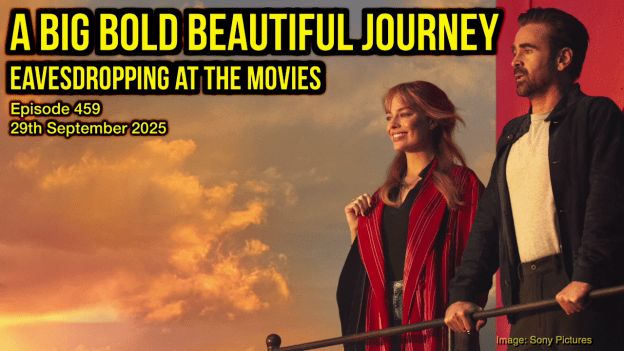
A Big Bold Beautiful Journey, directed by former video essayist Kogonada, is beautiful to look at and very likeable, but derivative and ultimately unsatisfying. We discuss its lighting, its attitude towards people’s histories and the memories that live with them, and why a rubbish script Mike once wrote makes him particularly keen to sneer at it.
Over the last couple of months, Chinese children’s fantasy Ne Zha 2 has quickly, and arguably quietly, become the fifth-highest-grossing film of all time, and the first animated film to gross over $2 billion. It’s hard to keep up with the records it’s been breaking – but can we keep up with the plot?
No is the answer, but we readily accept that younger minds, and minds more in tune with Ne Zha 2‘s cultural context and mythological basis, won’t feel as overwhelmed as we did. It did make us feel old, but this audiovisual whirlwind is beautiful and coherent – writer-director Jiaozi exhibits great control over the most energetic of action scenes, and has an eye for striking, colourful imagery. We discuss how closely some of the film’s visual design and messaging might reflect the particular culture from which it comes, or whether it’s so different from American cinema after all, and ask why this and last year’s Inside Out 2 have been able to make so much money (the Pixar film grossing $1.7 billion and becoming the then-eighth-highest-grossing film of all time) with such little response from critics.
Writer-director Andrew Haigh’s romantic fantasy, All of Us Strangers, flows beautifully from scene to scene, inviting the audience to question the reality of what they’re shown but seldom requiring them to – it’s about the feeling it creates. It’s a film about isolation, building and rebuilding connections, how the past reverberates, and in particular, experiences of growing up gay in the homophobic society of the 1980s. Its themes are universal and easily understood, but people who share those experiences will identify with it more closely than most.
We discuss the complexity and natural feeling of the protagonist’s conversations with his parents, who carry with them, alongside love for their son, those homophobic attitudes; the way scenes flow into each other; how letting go of those questions of what and how things are real allows us to get the most out of the film; and we ask those questions anyway. We also take the opportunity to revisit the ending of The Zone of Interest, discuss audiences proudly displaying their dislikes, and have another think about The Holdovers with that in mind.
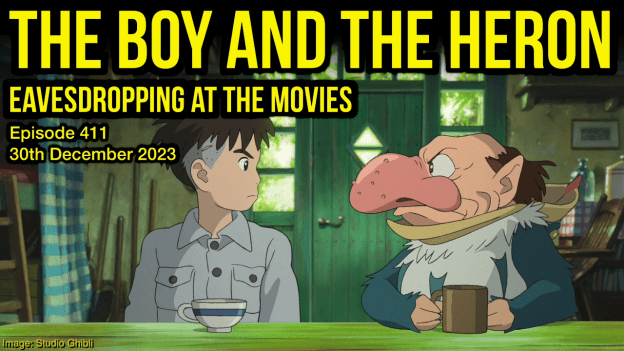
Hayao Miyazaki, the legendary Japanese animator and co-founder of Studio Ghibli, who has previously announced his retirement three times, tells us all that The Boy and the Heron (as it’s titled in most of the world; How Do You Live? in Japan) is really, honestly, for real this time, I’m super serious, his last film. His longtime producer, Toshio Suzuki, has already cast doubt on this new claim, but for now, here we have Miyazaki’s final film, which tells the story of Mahito, a young boy in wartime Japan, who loses his mother in a fire and is evacuated to his aunt’s countryside estate, whereupon he meets a talking grey heron that promises that his mother is alive.
José sees The Boy and the Heron as a masterpiece of cinema, a film that does things that other films have forgotten to do, a doorway to thinking about life, loss, and worlds within worlds. Mike… didn’t really get on with it, but he puts it down to taste and maybe mood – any objection he has can be equally levelled at things he loves. We easily agree that Miyazaki’s and Ghibli’s reputation for visual design and craft holds, with image upon image here that dazzles. As for what it all adds up to? Take José’s side. It’s better to like things than be bored by them.
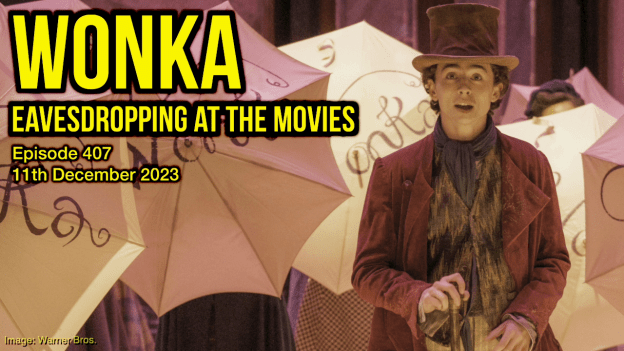
Paul King, the director of Paddington and Paddington 2, brings us Wonka, another reimagining of a British children’s classic. Roald Dahl’s beloved 1964 novel, Charlie and the Chocolate Factory, has been adapted twice: once in 2005 by Tim Burton, but most memorably in 1971 by Mel Stuart, with Gene Wilder as eccentric chocolatier Willy Wonka. It’s from the 1971 version that Wonka takes some of its cues (including musical ones), but in the service of that most 21st-century of cinematic artefacts: an origin story.
Within, discussions of: What we make of the world in which Wonka is set, one in which institutions purportedly in place for the public good are instead supportive only of corporate power; the reinterpretation of the Oompa-Loompas as a wronged people whose representative is out to retrieve what was stolen from them; Mike’s dissatisfaction with CGI and visual effects in British films and the production of the vocals in Wonka‘s songs; José’s opinion on Timothée Chalamet’s career and (apparently) uneven face; whether this film really benefits from its sentimental backstory and overtones; and how chocolate is best enjoyed.
Nicolas Cage plays a meme. Not just in real life any more, but now also in Dream Scenario, a quirky fantasy in the mould of Charlie Kaufman and Woody Allen, although nowhere near as funny. Cage’s biology professor starts appearing in countless people’s dreams for no obvious reason, blankly observing the events within, and soon becomes a minor celebrity – but as his presence in the dreams grows more active, public opinion turns on him.
Dream Scenario flirts with a variety of themes of modern society, such as fame, celebrity, cancel culture, power dynamics in academia, male ego, and the grammar of social media – arguably without meaningfully committing to any of them, but equally arguably avoiding the pitfalls that doing so might create. It dramatises the difference between who a public figure of opprobrium actually is and who the version of that figure is in the minds of the public that reviles him, depicting its angry mob with a mix of horror and amused fascination, but also refuses to indulge in cancel culture whining, explicitly critiquing the anti-woke world of the likes of Jordan Peterson and Joe Rogan. (An additional and crucial detail of the film is that, unlike people at the centre of similar real-life pile-ons, Cage’s professor has done nothing to instigate the hatred – his presence in people’s dreams and behaviour within them is entirely without explanation.)
Dream Scenario is an interesting film that builds on the infamous memeability – memeness? memeitude? – of its star to explore observations and nuances of modern, hyper-online, highly personalised culture. With all that said… we wish it were funnier.
Upon revisiting our podcast on the previous entry in the Harry Potter-adjacent Fantastic Beasts series, The Crimes of Grindelwald, we find that we could virtually have copied and pasted its content for our discussion of The Secrets of Dumbledore. It’s again less than the sum of its parts, a fantasy adventure with some charms, several good performances, but incoherent storytelling, and too little that convinces us to get invested in the characters’ lives and the fate of the world they seek to save.
The fairytale figure of the undine has been used and developed in the arts for two hundred years, and Christian Petzold, whose Transit we loved, brings his clear-eyed but sensitive aesthetic to it in Undine. Paula Beer plays the titular character with transparent emotion, in the opening scene regretfully informing her ex-boyfriend, as he dumps her, that she will have to kill him. It’s a moment that captures the timbre of the film that follows – fantastical, potent, full of drama, but grounded throughout.
We also discuss Undine‘s knowing and deliberate setting against a sociopolitical backdrop, the film devoting significant time to Undine’s lectures on the history of Berlin, tying them and the city to her relationships, and the way the film conveys the tactility of new lovers, unable to keep from touching each other. We disagree on the film’s greatness – to Mike, it’s something of a trifle, particularly in comparison with Transit, but José is in deep love with it. But we’re agreed that it’s well worth your time.
Pickings are slim at the cinema at the moment, so it’s MUBI to the rescue. We chose Border almost at random, our criteria being only something that looked interesting and would still be on rotation by the time we released the podcast. And what a fascinating film we picked.
Border is a Swedish art film that reeks of mud, pain and isolation, but with a sense of fantasy and irony that render it a curious, surprisingly light affair, despite some gruesome imagery and dark plot developments. It gives us a lot to talk about: the interstices of ideas of gender, place, what it is to be human, how we categorise ourselves, what makes us behave towards others as we do. The film takes a figure of fairy tale, fantasy, and horror, placing it in a contemporary setting. It supports all kinds of interesting interpretations: as a racial narrative, as a trans narrative, as an exploration of nature vs. nature, as a dramatisation of the fluidity of ‘the self’. It opens up beautifully as we discuss it.
The podcast can be listened to in the players above or on iTunes.





 Eavesdropping at the Movies