Tag Archives: documentary

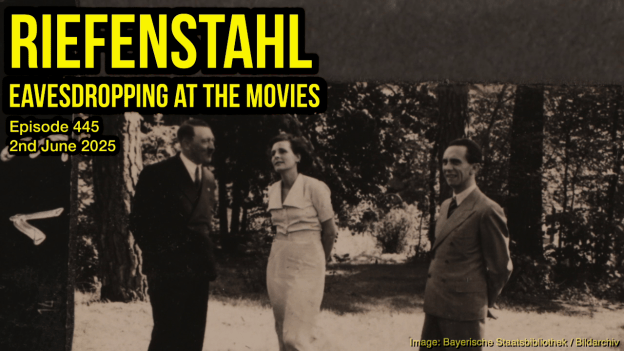
445 – Riefenstahl

Listen on the players above, Apple Podcasts, Audible, Spotify, or YouTube Music.

In the 1930s, Leni Riefenstahl infamously directed two propaganda films, Triumph of the Will and Olympia, for the Nazi Party. For the rest of her life, which ended in 2003, she denied knowledge of the regime’s crimes, including the Holocaust. In 2016, her heirs gave her estate, which included a vast collection of personal documents, correspondence, and film and tape recordings, to the Prussian Cultural Heritage Foundation, which itself gave permission to Sandra Maischberger and Andres Veiel, a journalist and filmmaker respectively, to use the material as the basis of a documentary. Riefenstahl, comprising countless elements of the archive, along with documents from other sources, builds a biography of a person who never came clean about what she knew about Nazi Germany, and never took responsibility for her part in it.

It’s a complex and layered examination of a life led between pride and denial, and has resonances today: take Riefenstahl’s television appearance in 1976 alongside Elfriede Kretschmer, an anti-Nazi activist and contemporary who refuses to believe her claims of ignorance during wartime, which is followed by recordings of phone calls to Riefenstahl in support of her stance and contempt for Kretschmer. The line between those calls and the metastasising popularity of extreme right-wing, “anti-woke” and similar ideologies today is self-evident, as is the difference between ideas expressed publicly and privately. Riefenstahl is more outspoken off the record than on it, demanding interviewers’ cameras be turned off to prevent them from capturing candid revelations. In this sense and others, her life provides a window into fascism – what drives it – her initial response to seeing and hearing Adolf Hitler speak is almost sexual – what it represents and offers to its adherents, and how it shrinks and cowers when it doesn’t get everything it wants.

It’s a problem for Mike that the film doesn’t seem to think that the artistic and cultural impact of Riefenstahl’s work is worth exploring, where to him it’s the most interesting thing about her. Not only were her films technically and artictically innovative – something claimed by subjects in the film but not explained or examined – but her work arguably gives the Nazis their key, and enduring, victory. As thuggish and vile as the regime was, and despite its collapse, through Triumph of the Will and Olympia it created an image of itself as glorious and powerful with which we continue to associate it, and to which neo-Nazis today aspire to emulate. Few filmmakers have left a cultural legacy of such significance and duration, but the documentary isn’t interested in the work – only the person.

Quibbles apart, Riefenstahl is an excellent example of how to tell a complex tale with intention, clarity, and concision, while allowing for interpretation of the material presented, and it’ll be the basis of endless conversations. Highly recommended.

With José Arroyo of First Impressions and Michael Glass of Writing About Film.
330 – Daguerréotypes

Listen on the players above, Apple Podcasts, Audible, Google Podcasts, or Spotify.

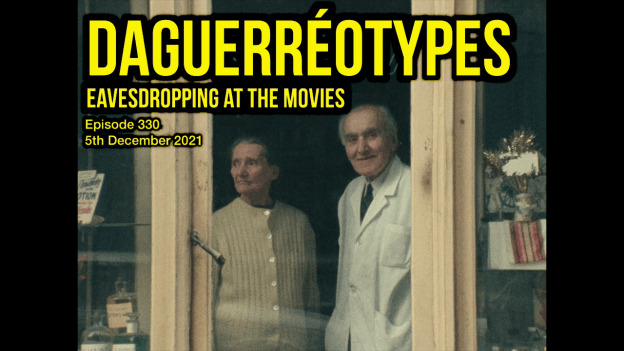
In 1975, caring for her infant son and unable to spend much time away from home, Agnès Varda turned her camera on her neighbours on her street, Rue Daguerre in Paris. In Daguerréotypes – the title a pun on the photographic process for whose inventor the road is named – she both observes them at work, running their shops and providing their services, and asks them questions about their lives, discovering where they’re originally from (most are not Paris natives) and how they met their husbands and wives. It’s a gentle, relaxed form of portraiture, one that combines imagery of the practicalities of daily work with the subjects’ descriptions of dreams and histories – although the use of a travelling magician’s show is arguably a little too precious. We discuss the different ways in which we respond to their stories, José commenting on Varda’s clear affection for the subjects, Mike arguing that there’s a tragic dimension that overhangs the film, with talk of dreams and escape.

Daguerréotypes is a sensitive portrait of a local community and a time capsule of an era that is now half a century old, and worth watching.

With José Arroyo of First Impressions and Michael Glass of Writing About Film.

283 – Dear Zachary: A Letter to a Son About His Father

Listen on the players above, Apple Podcasts, Google Podcasts, or Spotify.

Ethics and truth in the land of documentary come under the microscope in our discussion of Dear Zachary: A Letter to a Son About His Father. Filmmaker Kurt Kuenne’s love letter to his childhood friend, Andrew Bagby, is a sensational and moving film that you should know as little as possible about before watching. It’s exceptionally effective, built out of a combination of interviews, home footage, still photos and more, masterfully edited to generate emotional affect – but despite its qualities, there are real issues fundamental to its form. It’s a hybrid of two types of film that find themselves in competition here: it’s a documentary, a form about openness and truth; and a thriller, withholding information until it reshapes everything you’ve learned so far. It’s a tension that may well be impossible to avoid – to resolve it might be to totally change Dear Zachary from the deeply personal, passionately made film it is.

The story Dear Zachary tells is powerful, moving and utterly gripping, and the conversation to which it will lead you is rich and illuminating. We recommend it without reservation, even though we have serious reservations about it.

With José Arroyo of First Impressions and Michael Glass of Writing About Film.

250 – What She Said: The Art of Pauline Kael

Listen on the players above, on Apple Podcasts, or on Spotify.

What She Said: The Art of Pauline Kael gives us the opportunity to reflect on a woman who, for José, stands above all other popular film critics, and whose work has always remained resonant. Pauline Kael effused about, excoriated, and defined an era of cinema and the culture that surrounded it, and changed the way films were written about. Through interviews with other critics, filmmakers and her daughter, Gina James, What She Said tells the story of Kael’s life, work, philosophies, and controversies.

And not very well. The documentary doesn’t ask interesting enough questions about Kael’s life, glossing over areas that just beg to be explored, such as the relationship that produced Kael’s daughter, which is handled only with a cursory line of superimposed text. José finds fault with the use of Sarah Jessica Parker to recite excerpts of Kael’s reviews, feeling it to be wasted time; Mike argues that we’re here because of her work, so it’s sensible to include examples of it, and the use of appropriate film clips to accompany the words works well. Wasted time or not, the film doesn’t show much interest in digging deep.

However, there’s pleasure to be had in spending time with What She Said‘s interviewees, and sinking into its vast assortment of archive footage and illustrative film clips. It’s a fan film, in the end, and enjoyable if approached with that in mind, and though Mike finds it hagiographic, José is glad of it as a corrective to Kael’s detractors, of whom there were many, who saw her as a harridan and whose sparring with her almost always had an obviously misogynist component. It’s an unsatisfying documentary, but well-meaning, and recommended to anyone with an interest in film culture and its history.

With José Arroyo of First Impressions and Michael Glass of Writing About Film.

233 – Hoop Dreams

Listen on the players above, on Apple Podcasts, or on Spotify.

From a central focus on two aspiring young basketball hopefuls from Chicago, Hoop Dreams weaves an incredible tapestry of race and class in America, without once explaining itself to the audience, without once winking and imploring us to notice something. William Gates and Arthur Agee, two black boys of about 14 or 15 years old, are plucked from their neighbourhoods by a scout for St. Joseph’s High School in Westchester, a white suburban private school that dips into the inner city looking for talent to boost its basketball team, chucking back any kid that doesn’t show enough promise. Over the course of several years, we follow William and Arthur’s development.

William and Arthur don’t start in the same place – William is touted as the next Isiah Thomas, a former St. Joseph’s alumnus who reached the NBA, and receives as an individual gift a personally guaranteed scholarship to St. Joseph’s from a wealthy benefactor. Arthur is labelled with no particular expectation beyond that he shows the potential to go pro, and whose partial scholarship becomes a financial burden once the school decides they’ve had enough of him – they want tuition fees from him now. The stresses put on these boys come from all angles – their school demands they perform for the team while keeping their grades up, their parents and communities put all their hopes into their success, and achieving stardom, a vanishingly unlikely prospect, feels like the only hope for a life free of minimum wage jobs and the power being cut off because of unpaid bills. Over the course of three hours, we understand intimately who William and Arthur are, the familial and socioeconomic circumstances that shape them, and follow them as they grow, learn, and encounter hurdles throughout their time at St. Joseph’s.

Hoop Dreams is an all-time great documentary, a portrait of life in early Nineties America that is both a state-of-the-nation declaration for its time and effortlessly legible and relevant today.

With José Arroyo of First Impressions and Michael Glass of Writing About Film.

214 – American Factory

Listen on the players above, on Apple Podcasts, or on Spotify.

The latest winner of the Academy Award for Best Documentary Feature, Julia Reichert and Steven Bognar’s American Factory is a complex and brilliant examination of a clash of cultures and management styles and the diminishment of a class of workers having to grovel for jobs they cannot do without.

In 2014, the recently closed GM factory in Moraine, Ohio, was acquired and reopened by Fuyao Glass, a Chinese company; many of the former GM employees, often out of regular work since the closure in 2008, would occupy new jobs there. While the film depicts clashes between the Moraine locals and the Chinese employees flown in to supervise them, it also ensures that it doesn’t accept any indulgence in xenophobia, instead showing employees of both nationalities spending leisure time together and getting along. The film is less interested in moderating the clash between the Chinese and American supervisors – a trip to a Chinese plant, intended to show the Americans how things should be done, with robotic employees, militaristic roll calls and company songs, long hours, hardly any days off, non-existent safety standards and a focus on quantity of production over quality, is met with raised eyebrows by all but one conspicuously enthusiastic visitor. That those unconvinced bosses are eventually replaced by more Chinese overseers is no surprise – nor is it a surprise that a bubbling movement to unionise the Moraine workers is suppressed by an appeasing extra couple of dollars of pay – that still keeps salaries at half of what they’d been at GM – and an expensive propaganda campaign that successfully scares most of the employees into voting against unionisation.

There’s a vast amount going on in this concise and potent film, and Reichert and Bognar work magic to marshal a sprawling web of people, plots and themes, and to allow the workers to narrate their own story smoothly and with little outside help (just a few lines of superimposed text here and there). It’s available on Netflix, and you should not miss out on it.

With José Arroyo of First Impressions and Michael Glass of Writing About Film.
200 – Luis Ospina on MUBI – The Vampires of Poverty, A Paper Tiger, and It All Started at the End

Luis Ospina, the influential Colombian filmmaker who died very recently, was last month the subject of an mini retrospective of his work by MUBI, who showed three of his films: Agarrando pueblo/The Vampires of Poverty (1977, co-directed by Carlos Mayolo), Un tigre de papel/A Paper Tiger (2008), and his final feature documentary, Todo comenzó por el fin/It All Started at the End (2015), and we’re grateful to them for making these works available to us with subtitles. We begin by considering how such an influential filmmaker, not only in Colombia but across Latin America, remains so little known in Anglo-American film cultures. We talk about the ‘Caliwood’ group and how we’re so used to talking about structures that we forget how individuals make a difference. A group of young friends with shared interests get together and share a house, turning it into studios, an art gallery, a publishing house and a cinema. This group happens to include, amongst others, Luis Ospina, Andrés Caicedo and Carlos Mayolo. We’re shown how shared cinephilia leads to collaborative cultural production, one that’s left an imprint, proven to be very influential and now become part of the cultural history of Colombia and Latin America.

In Todo comenzó por el fin/It All Started at the End we see how the friendships and shared interests of these irreverent, druggy, countercultural dissidents bore fruit and left a legacy – which is not to say that structures are not important (they wouldn’t have been able to do so had they not been of a particular class, one with relatives who could afford to lend out empty houses). The film serves as an important reminder that individuals can make a difference and that collaboration is essential. Harold Innis’ observation in Empire and Communications that colonised people need to be fully conversant with their colonisers’ culture as well as their own is amply evident in the conjunction of the group’s programming and their own production.

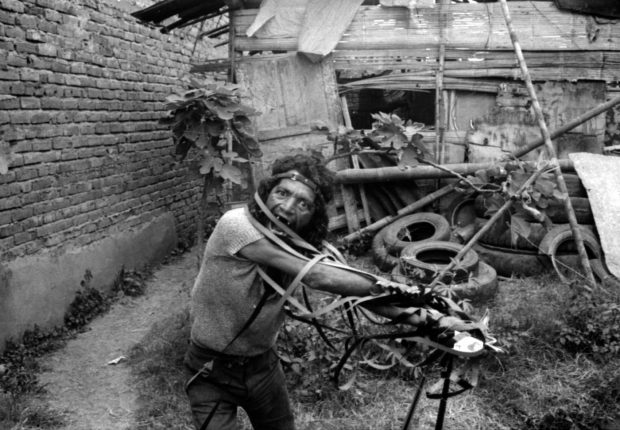
All three of Ospina’s works are concerned with documentary, representation, ethics. In Un tigre de papel/A Paper Tiger, the Zelig-like mockumentary about an imaginary person, the form itself acts as a way of commenting on broad strands of cultural and political movements internationally that had an effect on the local and synthesises and evokes all of the virtues we admire: the playfulness, quirkiness, intelligence, the concern with politics and ethics but also fun, a pin-prick to pomposity. And we share admiration for the savage satire of Agarrando pueblo/The Vampires of Poverty, a statement against the exploitation of the poor, unfortunate and mentally ill on the streets of Cali, by filmmakers keen to sell their work, and the image of Colombia that goes along with it, to Europe.

José is in thrall to Ospina’s work and the culture to which it speaks, and has boundless thoughts; and although Mike asks questions of the ethics at play in Agarrando pueblo/The Vampires of Poverty, even in a film so clearly well-intentioned and with such a valid point, and comments on weaknesses he perceives in the cinematic quality of Todo comenzó por el fin/It All Started at the End, finding it less expressive artistically than simply informative of a time, place and culture, he’s glad to have spent this time exploring Ospina’s work.

This episode has been released early (keen listeners will have noticed a jump from number 196 to 200), and that’s to coincide with yesterday’s homage for Luis Ospina, hosted by the Filmoteca de Catalunya, one we hope will be but the first of many to come.

The podcast can be listened to in the players above or on iTunes.

With José Arroyo of First Impressions and Michael Glass of Writing About Film.

155 – Diego Maradona

Following his critically acclaimed documentaries about Formula One legend Aryton Senna and troubled jazz singer Amy Winehouse, Asif Kapadia turns his inquisitive lens to Diego Maradona, arguably the greatest footballer of all time, and a man who moved rapidly from the slums of Buenos Aires to worldwide fame, winning the World Cup with Argentina and leading declining Italian club Napoli to two league championships. Kapadia’s film beautifully and economically tells his story, making understandable and human the dark side that accompanies the success, including an illegitimate son, his infamous addiction to cocaine, and perhaps less well-known, his association with the Camorra, the Neapolitan crime syndicate.

Mike has never really “got” these kinds of documentaries, and José is more than happy to oblige him with his impressions of what they do, and in particular what this one does so well. It is not just about the man but about the times, places, people and cultures that were the environment of his life. Maradona is rendered deeply human as the film details the grip that not only the Camorra held on him but also his football team, Napoli’s president refusing to sell him at his request, a capitalist demand for the value he holds, and then, when he is used up, this once-idolised, deified icon of Napoli is unceremoniously discarded, left to quietly slink away as his former worshippers turn on him – and all the while, the human cost to Maradona is incalculable, his extraordinary level of fame extraordinarily difficult to cope with, his descent into deeper drug dependence tragic and his punishment for beating Italy at the World Cup brutal. The film draws an important and poetic distinction between Diego and Maradona, as described by Fernando Signorini, his former fitness coach at Napoli: Diego is the youngster from the slum who loves to play, has insecurities and worries, and is, as Signorini says, “a wonderful boy”; Maradona is the star, the mask that cannot show any weakness, and an unpleasant counterpart to Diego – but without Maradona, Diego would still be in those slums. What the world has always seen is Maradona. What Kapadia shows us is Diego, hidden away, a victim of his own success, further and further buried but, nonetheless, always present.

We also talk a little about Amy, Kapadia’s 2015 documentary, which Mike has watched recently as José’s suggestion and truly loathed, finding it as exploitative and demon-feeding as the media frenzy it depicts and decries. José believes that Mike is too moralistic, but Mike disagrees, and that’s where we leave it.

But! Diego Maradona. It’s a truly great documentary, complex and rich, subtle and tragic, beautifully, smoothly edited, and featuring plenty of thrilling footage of one of the greatest footballers of all time doing the things that gave him that reputation. It’s fantastic. Don’t miss it.

The podcast can be listened to in the players above or on iTunes.

With José Arroyo of First Impressions and Michael Glass of Writing About Film.
127 – Häxan

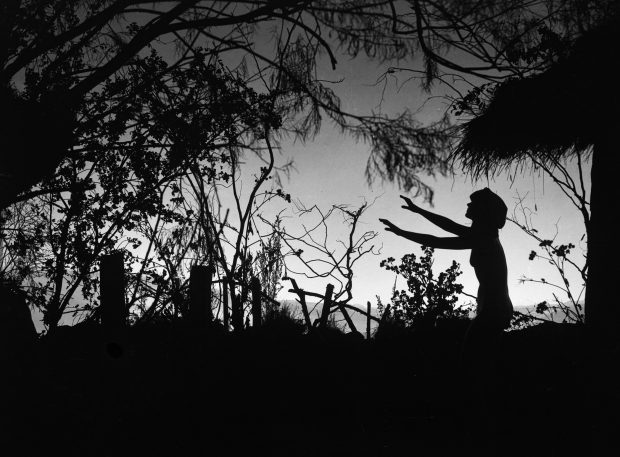
A 1922 Swedish-Danish silent film in the form of a semi-dramatised lecture, we had absolutely no idea what to expect of Häxan, written and directed by Benjamin Christensen. And what a great surprise it was, as we discover an extraordinary, perceptive, original, bold, witty piece of work that details the history of witchcraft, visualises medieval beliefs in wild set-pieces, and draws interesting parallels with modern-day institutionalisation of “hysterical” women.

The projection was out of this world, a 2K 2007 restoration by the Swedish Film Institute with unimaginable clarity, sharpness and contrast. It was unbelievable to look at. (Thanks to Holly Cooper for finding the technical details out for us.) And the film is full of images that benefit from the restoration; Bosch-esque dramatisations of Satanic seductions, a Witches’ Sabbath, and unholy births of demonic creatures. It was the most expensive silent film to ever emerge from Scandinavia, and it shows. Though neither Mike nor José is an expert on horror, and indeed despite Häxan‘s fundamental differences from horror, in its imagery its possibly foundational influences on several subgenres of horror is palpable.

There’s a remarkably sceptical, anti-clerical theme that runs throughout the film. While not strictly atheist, Häxan says clearly from the start it will discuss what folks in the Middle Ages believed without asking us to buy into it. Indeed, there’s a frankly dismissive tone: “Of course, this is all nonsense”, the film effectively says, “but let’s learn about it anyway, shall we?” This set-up, while unexpected, arguably creates a lack of direction and drive until the final chapter, in which we are brought into the modern day (of 1921) and Christensen draws direct links between the superstitions of old and what real-life events, phenomena and afflictions they may have been responding to. And that would be interesting, but the film goes further, talking about this all as not just a difference in the understanding of the physical world between people of different eras, but as a continuum of oppression and abuse of women. Burning at the stake, Christensen says, has been replaced by the mild shower of the mental institution, but how much progress does that really represent? Women are now considered to be ill or troubled rather than in league with the Devil, but is the difference between murdering and imprisoning them really so great? Not only does it pose these insightful and powerful questions, it even proposes things as specific as institutional sexual abuse keeping women in an inescapable cycle of incarceration and continued abuse; assaulted by the very men charged with running the system that’s supposed to protect them, they are left permanent victims, unable to plead their cases, for anything they say will be considered symptomatic of their hysteria, just as women on trial for witchcraft had no escape from torture and murder in a system that was ostensibly just.

We could go on. And in the podcast, we do. The 2007 SFI restoration we saw is available through Criterion, and you owe it to yourself to see it – it’s available on DVD and digitally on Amazon and iTunes, though the Blu-Ray appears to be available only in North America, unfortunately. Brilliant film.

(P.S. José would like to apologise for saying silent films ran at 8 frames per second, when they actually had frame rates that varied from 16-24 fps and often changed due to being hand-cranked.)

The podcast can be listened to in the players above or on iTunes.

With José Arroyo of First Impressions and Michael Glass of Writing About Film.
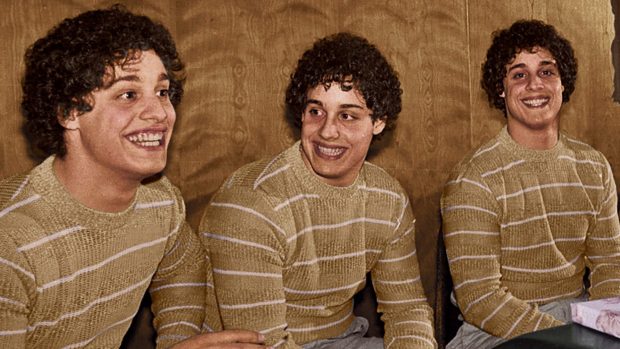
118 – Three Identical Strangers

A documentary in the hard-hitting, extraordinary revelations, true-story-you’ve-never-heard mode, Three Identical Strangers follows three identical triplets, separated at birth, discovering each others’ existences at the age of 19. At first a joyous reunion, the story takes dark twists as the triplets and their families investigate the reasons behind their separation. That’s all for your summary – we won’t spoil the story for you!

Suffice it to say, we have severe reservations about the film, and in many respects. José is particularly unimpressed with the storytelling and weak focus – there are significant obstacles that the film has in understanding what happened to these men, obstacles that are no fault of its own; however, the things the film could investigate, such as their life experiences, it shows little interest in pursuing.

Mike, more forcefully, takes significant issue with the film’s ethics and failure to build a convincing case for most of what it wants to argue. Some of what the film decries is already self-evidently bad, requiring no elaboration; in other aspects, the film seems to assume we’ll all concur, doing the bare minimum to put across a point of view, expecting us to uncritically agree rather than arguing its case. And he finds it a deeply cynical and manipulative piece of work, accusing it of unethical behaviour just as it accuses some of its subjects.

As the conversation goes on, Mike takes against the film more and more, in what can surely be described as a hard-hitting and dramatic podcast worthy of many many awards.

The podcast can be listened to in the players above or on iTunes.

With José Arroyo of First Impressions and Michael Glass of Writing About Film.