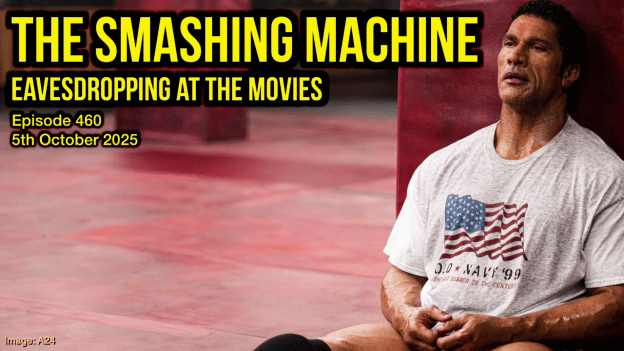
Mike isn’t impressed with The Rock’s attempt to take on a dramatic role in an intimate biopic after decades of popcorn blockbusters, seeing it as Oscar bait. José doesn’t share his cynicism and likes the lead performance. We discuss what The Smashing Machine depicts – disagreeing, in particular, about whether the protagonist shares any blame for the issues in his relationship – as well as whether its look and storytelling are problems, and just how shoddy things are getting at Cineworld. Yet we keep going back.
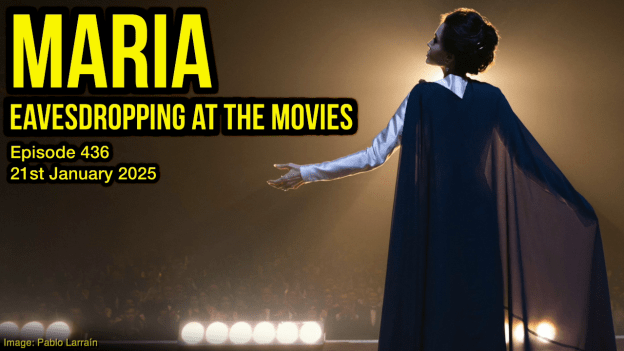
The third film in Pablo Larraín’s trilogy of iconic women, following 2016’s Jackie and 2021’s Spencer, Maria shows us the final week of the life of opera singer Maria Callas, who at the age of 53 is experiencing delusions, hallucinations, and the fear that her once-perfect singing voice has abandoned her. Mike isn’t familiar with Maria Callas; José is (despite worrying before we started recording that he wouldn’t have much to say when expected to explain who she is).
No familiarity with her is required, however, to enjoy the film. Larraín’s elegant direction, Steven Knight’s intelligent screenplay, and Angelina Jolie’s extraordinary, subtle performance combine beautifully to explore Maria’s ego, fears, and passion. Maria’s delusions, in which choirs fill town squares, orchestras back her in her apartment, and a fascinated journalist follows her around Paris chronicling her memories, are evident throughout the film… everywhere but in song. She knows all too well that her voice is leaving her, she hopes for and needs its return, and ultimately, the film renders her struggle with it a fight to hold on to life itself. It’s sympathetic, understandable, and beautiful.
Maria is the best film of Larraín’s impressive body of work, and features perhaps the best performance of Jolie’s. See it.
(We also discuss Robbie Williams, because Mike saw Better Man, the Robbie Williams monkey movie, and is desperate to talk about it.)
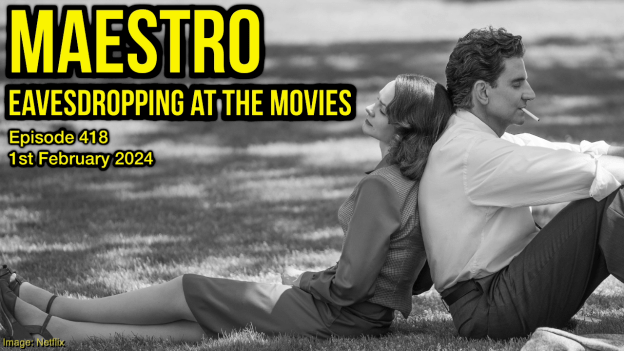
We find Maestro, Bradley Cooper’s latest actor-director star vehicle, which dramatises the life of iconic conductor Leonard Bernstein, to be dishonest, illustrative, and superficial Oscar bait. We also find it cinematically ambitious at times, with great production values – not many films of this type are being made with $80 million budgets. A mixed bag.
Hot on the heels of Baz Luhrmann’s Elvis, which cast the titular rock & roll icon as the victim of a life controlled by his manager, comes Priscilla, written and directed by Sofia Coppola, which tells a similar story of a life controlled – but here, Elvis is the culprit. in 1959, 14-year-old Priscilla Beaulieu meets 24-year-old Elvis during his military service in West Germany; by 1963, she’s moved in with him at Graceland, his famous Memphis estate. But the romantic life she desires is kept from her.
Priscilla is as rich an experience and as rewarding in conversation as we could have hoped for. Coppola intelligently and insightfully weaves together themes of unequal power dynamics, in which pleasure is withheld; the societally-defined roles of men and women and how they harm those who enforce them upon themselves; the significant age difference between Elvis and Priscilla, especially exacerbated by her youth; why and how beauty is constructed; and so much more. Its gaze is a female one, and a particular one at that. It understands the appeal of Elvis to Priscilla, the world in which she becomes involved and the men for whom it’s maintained, and the ways in which it deceives her, restricts her, and leaves her disillusioned. A marvellous, complex film.
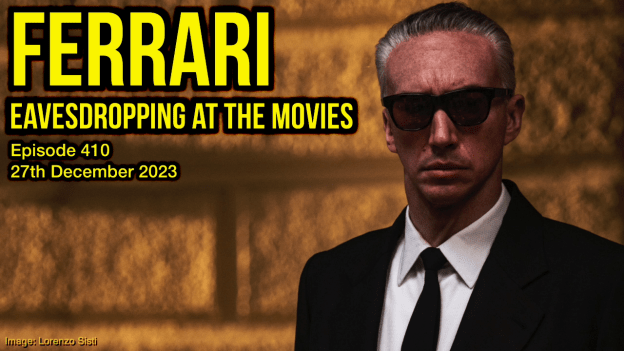
Adam Driver and Penélope Cruz star as lovers, business partners, and rivals, in a motorsport biopic that’s much more about the drama off the track than on it. In 1939, Italian racing driver, team owner, and entrepreneur Enzo Ferrari founded the car manufacturer that would become one of the best-known and most prestigious marques in history; Ferrari the film tells the story of events in 1957, with the company in financial difficulties and his wife, Laura, distanced from him as they grieve the recent loss of their son, Dino. She tolerates Enzo’s dalliances with mistresses, as long as he’s home before the maid arrives – but his second family is secret from her.
Mike sees an opportunity to right his wrongs from our podcast on Ford vs Ferrari, aka Le Mans ’66, in which, he declares, he overfocused on insignificant details, while José rightly and happily enjoyed the big personalities, charming and interesting central friendship, and entertaining, dramatic races… by suggesting they’ve switched seats. José finds the cultural specificity of the time and place in which Ferrari‘s set lacking, criticising missed or misunderstood nuances, and is let down by Driver’s blankness in key scenes opposite Cruz, whose brilliant performance subtly conveys Laura’s richly complex competing feelings. Details schmetails, counters Mike: here we have a big brooding drama about deep interpersonal clashes, grief, loss, power struggles and ambition, centred around an actor with fake grey hair and a faker Italian accent – what’s not to love?
As with Ford v Ferrari, we both enjoyed Ferrari. It’s just that one of us did so with a big, beaming, untroubled smile, and the other with a raised eyebrow that said “hmm”.
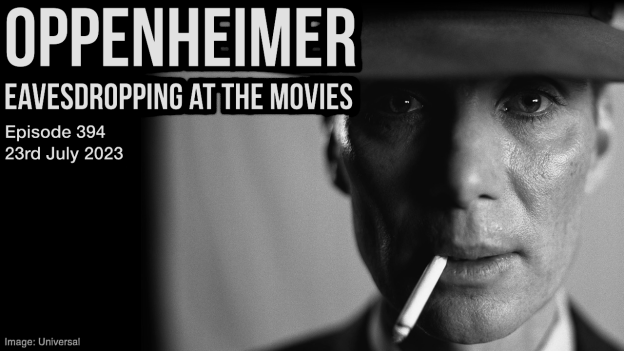
The second half of our Barbenheimer double bill takes us to the BFI IMAX in London to see Oppenheimer, the complex story of J. Robert Oppenheimer’s infamous role in the development of the atomic bomb during World War II, the creation and use of which changed history. Writer-director Christopher Nolan, as he has done increasingly over his career, makes extensive use of IMAX 70mm film to tell the story, but as well the spectacle and landscape we’re used to it showing off, here it’s devoted to the intimate.
We’re joined by Mike’s brother and previous guest Stephen to discuss the film, and consider the use of IMAX for close-ups and portraiture, as well as the story’s structure and how the editing and music create pace, the film’s implicit attitude towards Communism, whether Florence Pugh is treated unfairly, the way in which black-and-white footage is used to convey a shift in perspective, how the attacks on Hiroshima and Nagasaki are handled, the Stan Brakhage-esque imagery that conveys the radical sense that all matter is energy waiting to be unleashed, and much more. For José, it’s Nolan’s best film. It certainly deserves to be seen on an IMAX screen.
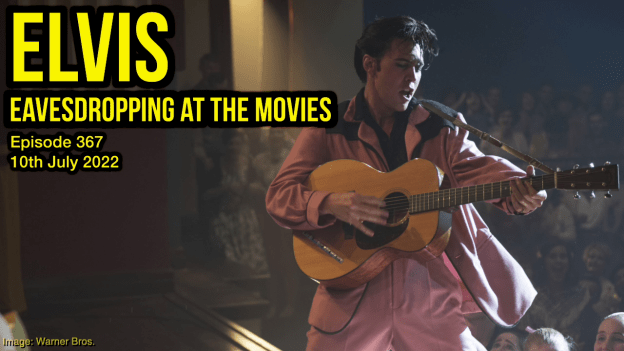
Baz Luhrmann’s Elvis is here: a colourful, expressive telling of the story of Elvis Presley, through the eyes of his manager, Colonel Tom Parker, who opens the film by claiming that he’s not the villain he’s renowned to have been. But the film flattens any complexities in the history it tells so thoroughly that we have no option but to continue to see him as one.
Still, it starts vibrantly and excitingly, understands and loves the sexual allure of Elvis – the lengthy introduction to him leads up to a fabulous scene of crotch-gyration – and Austin Butler is fantastic in the starring role. But once it settles down, is it anything more than a filmed Wikipedia page? Does it offer insight into the story it tells? José will have to tell you, because Mike fell asleep.
As he did with 2016’s Jackie, director Pablo Larraín explores the life, image, and legacy of a woman publicly struck by tragedy in Spencer, a fabulistic biopic that imagines a Christmas holiday spent with the royal family at Sandringham, during which Princess Diana struggles with the knowledge of her husband’s affair and the watchful eyes of both the royals and the paparazzi.
We discuss our own relationships to both Larraín and Diana, and consider how the film draws on various aspects of the princess’s public image in painting a portrait of a woman losing her mind. The film is set squarely within that mind, and Mike argues that it uses several tropes and techniques common to horror in order to dramatise Diana’s fracturing mental state. José expresses his love for Kristen Stewart’s outstanding lead performance, one that doesn’t impersonate but evokes, and conveys differing stages of psychosis with subtlety.
We don’t agree on everything, and the film isn’t perfect, but Spencer is a really remarkable, expressive exploration of an iconic figure.
Aretha Franklin, an icon of American music, receives a dispiritingly by-the-numbers biopic in Respect, which takes this perfect subject for such a film and does nothing very interesting with her. We discuss, among other topics, the film’s dependence on clichés, its poor lighting, Franklin’s relationship with her father and upbringing in a prosperous household, Jennifer Hudson’s performance in the central role, and that scene, so common to music biopics, in which the signature song is developed.
If one of the functions of the biopic is to introduce newcomers to a person’s work and provide an insight into what made them worthy of their story being told… then the Queen of Soul needs another biopic. Respect certainly isn’t devoid of entertaining and engaging moments, but, ultimately, it fails its subject.
The story of a civil rights activist who deserved a biopic long before now, told from the perspective of the man who killed him. Fred Hampton chaired the Illinois chapter of the Black Panther Party, and using his oratorical skills and powers of persuasion formed the Rainbow Coalition, a political movement in which black, white and Puerto Rican organisations combined and worked together. Hampton was identified as a threat by the FBI and his death is considered an assassination under COINTELPRO, the FBI’s illegal programme of disruption of domestic political organisations. He was killed in December 1969 at the age of 21.
We ask whether it’s a problem that Judas and the Black Messiah frames his story as part of his murderer, William O’Neal’s. For José, the entire story is badly conceived, as Hampton should be the clear focus; for Mike, the problem is in the execution, with O’Neal underdeveloped – but it’s possible that this informant thriller genre structure is what allowed the film to get made in the first place. Mike remarks upon Hampton’s pragmatism in contrast to the narratives around Martin Luther King Jr., murdered only a year before Hampton, which arguably tend to convey idealism for the future as opposed to action in the here and now.
Judas and the Black Messiah is an imperfect but important exploration of an extraordinarily impressive man we should have known more about before now.



 Eavesdropping at the Movies