Mike isn’t impressed with The Rock’s attempt to take on a dramatic role in an intimate biopic after decades of popcorn blockbusters, seeing it as Oscar bait. José doesn’t share his cynicism and likes the lead performance. We discuss what The Smashing Machine depicts – disagreeing, in particular, about whether the protagonist shares any blame for the issues in his relationship – as well as whether its look and storytelling are problems, and just how shoddy things are getting at Cineworld. Yet we keep going back.
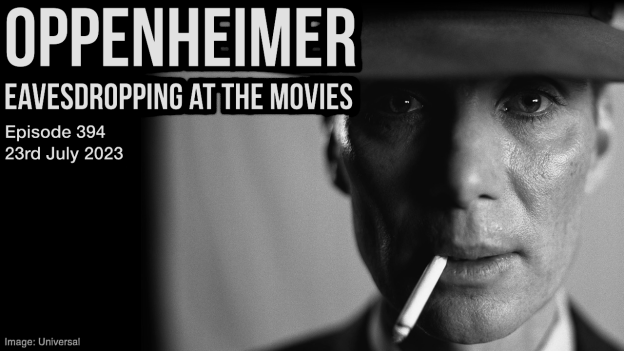
The second half of our Barbenheimer double bill takes us to the BFI IMAX in London to see Oppenheimer, the complex story of J. Robert Oppenheimer’s infamous role in the development of the atomic bomb during World War II, the creation and use of which changed history. Writer-director Christopher Nolan, as he has done increasingly over his career, makes extensive use of IMAX 70mm film to tell the story, but as well the spectacle and landscape we’re used to it showing off, here it’s devoted to the intimate.
We’re joined by Mike’s brother and previous guest Stephen to discuss the film, and consider the use of IMAX for close-ups and portraiture, as well as the story’s structure and how the editing and music create pace, the film’s implicit attitude towards Communism, whether Florence Pugh is treated unfairly, the way in which black-and-white footage is used to convey a shift in perspective, how the attacks on Hiroshima and Nagasaki are handled, the Stan Brakhage-esque imagery that conveys the radical sense that all matter is energy waiting to be unleashed, and much more. For José, it’s Nolan’s best film. It certainly deserves to be seen on an IMAX screen.
We’re remotely joined by filmmaker, previous guest, and, crucially, Mike’s brother, Stephen Glass, for a discussion of Paul Thomas Anderson’s period romance, Licorice Pizza. Stephen last helped us explore Anderson’s previous film, Phantom Thread, and again brings his knowledge of and passion for the director’s work to our discussion.
We consider the efficiency with which Anderson creates rich portraits of characters and their lives from few details; how the blossoming love between the protagonists, a boy of 15 and woman of 25, avoids feeling exploitative or uneasy as the age difference suggests it might; how the film is able to feel loose and free despite conforming to its genre; the likability, or otherwise, of the setting and era; Anderson’s focus on faces and use of reflective surfaces; and whether one particular running joke that begins as hilariously, stunningly outrageous, overplays its hand and ends up in the realm of the unacceptable.
Licorice Pizza is a sweet romance draped in a loving portrait of a particular place and time, and laced with good jokes. Still, your mileage may vary, as Mike’s devoted, grumpy intransigence in the face of José’s and Stephen’s enthusiasm demonstrates, but even he has to admit it’s a very good film.


 Eavesdropping at the Movies