413 – Priscilla

Listen on the players above, Apple Podcasts, Audible, Google Podcasts, or Spotify.

Hot on the heels of Baz Luhrmann’s Elvis, which cast the titular rock & roll icon as the victim of a life controlled by his manager, comes Priscilla, written and directed by Sofia Coppola, which tells a similar story of a life controlled – but here, Elvis is the culprit. in 1959, 14-year-old Priscilla Beaulieu meets 24-year-old Elvis during his military service in West Germany; by 1963, she’s moved in with him at Graceland, his famous Memphis estate. But the romantic life she desires is kept from her.

Priscilla is as rich an experience and as rewarding in conversation as we could have hoped for. Coppola intelligently and insightfully weaves together themes of unequal power dynamics, in which pleasure is withheld; the societally-defined roles of men and women and how they harm those who enforce them upon themselves; the significant age difference between Elvis and Priscilla, especially exacerbated by her youth; why and how beauty is constructed; and so much more. Its gaze is a female one, and a particular one at that. It understands the appeal of Elvis to Priscilla, the world in which she becomes involved and the men for whom it’s maintained, and the ways in which it deceives her, restricts her, and leaves her disillusioned. A marvellous, complex film.

With José Arroyo of First Impressions and Michael Glass of Writing About Film.

412 – The Goldfinger

Listen on the players above, Apple Podcasts, Audible, Google Podcasts, or Spotify.

In 2002, Tony Leung and Andy Lau starred in the Hong Kong classic Infernal Affairs, which Martin Scorsese remade in the US as The Departed; twenty years on, the inspiration flows in the opposite direction, Scorsese’s The Wolf of Wall Street a clear reference point for this fictionalised tale of real-life stock market manipulation, deeply embedded corruption, and the growth of a multi-billion-dollar company from meagre beginnings on the back of scams, confidence, and lies, with Leung starring as the charming, oleaginous company founder, and Lau as the anti-corruption official on his tail. We had terrific fun in The Goldfinger.

Which isn’t to say it’s a perfect film. We have our issues. The imagery could be more expressive – though director Felix Chong (another Infernal Affairs alumnus: he wrote the trilogy) clearly has an eye for visual impact, and there’s lots to be impressed by. We’d like to know why Lau’s corruption investigator believes that chasing Leung’s CEO is worth the disruption and danger to his family, beyond simply justice. We’d like any similar insight into what drives Leung, beyond simply greed. And if it is simply justice and greed, we’d like it to be better sold, bigger and brasher. We’d like the clash between the two to be more explosive. And the rather pat ending induces eye-rolling. But never mind all that. The Goldfinger is an entertaining and exciting tale of the rise and fall of a business empire that lived and died based on the fundamental corruption of the system and interests that built and supported it.

With José Arroyo of First Impressions and Michael Glass of Writing About Film.
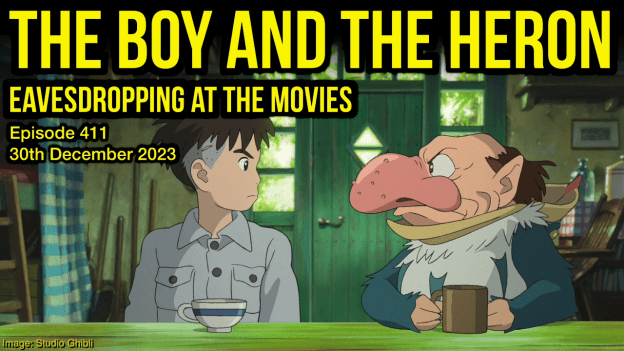
411 – The Boy and the Heron

Listen on the players above, Apple Podcasts, Audible, Google Podcasts, or Spotify.

Hayao Miyazaki, the legendary Japanese animator and co-founder of Studio Ghibli, who has previously announced his retirement three times, tells us all that The Boy and the Heron (as it’s titled in most of the world; How Do You Live? in Japan) is really, honestly, for real this time, I’m super serious, his last film. His longtime producer, Toshio Suzuki, has already cast doubt on this new claim, but for now, here we have Miyazaki’s final film, which tells the story of Mahito, a young boy in wartime Japan, who loses his mother in a fire and is evacuated to his aunt’s countryside estate, whereupon he meets a talking grey heron that promises that his mother is alive.

José sees The Boy and the Heron as a masterpiece of cinema, a film that does things that other films have forgotten to do, a doorway to thinking about life, loss, and worlds within worlds. Mike… didn’t really get on with it, but he puts it down to taste and maybe mood – any objection he has can be equally levelled at things he loves. We easily agree that Miyazaki’s and Ghibli’s reputation for visual design and craft holds, with image upon image here that dazzles. As for what it all adds up to? Take José’s side. It’s better to like things than be bored by them.

With José Arroyo of First Impressions and Michael Glass of Writing About Film.
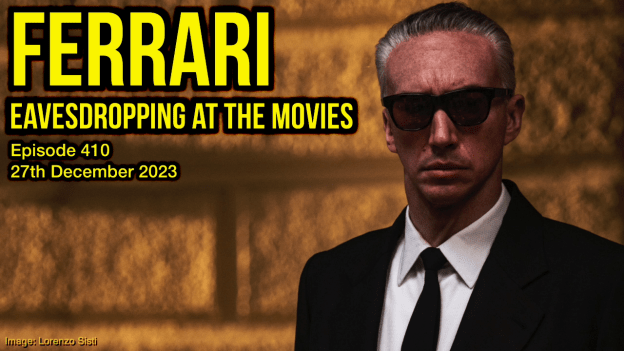
410 – Ferrari

Listen on the players above, Apple Podcasts, Audible, Google Podcasts, or Spotify.

Adam Driver and Penélope Cruz star as lovers, business partners, and rivals, in a motorsport biopic that’s much more about the drama off the track than on it. In 1939, Italian racing driver, team owner, and entrepreneur Enzo Ferrari founded the car manufacturer that would become one of the best-known and most prestigious marques in history; Ferrari the film tells the story of events in 1957, with the company in financial difficulties and his wife, Laura, distanced from him as they grieve the recent loss of their son, Dino. She tolerates Enzo’s dalliances with mistresses, as long as he’s home before the maid arrives – but his second family is secret from her.

Mike sees an opportunity to right his wrongs from our podcast on Ford vs Ferrari, aka Le Mans ’66, in which, he declares, he overfocused on insignificant details, while José rightly and happily enjoyed the big personalities, charming and interesting central friendship, and entertaining, dramatic races… by suggesting they’ve switched seats. José finds the cultural specificity of the time and place in which Ferrari‘s set lacking, criticising missed or misunderstood nuances, and is let down by Driver’s blankness in key scenes opposite Cruz, whose brilliant performance subtly conveys Laura’s richly complex competing feelings. Details schmetails, counters Mike: here we have a big brooding drama about deep interpersonal clashes, grief, loss, power struggles and ambition, centred around an actor with fake grey hair and a faker Italian accent – what’s not to love?

As with Ford v Ferrari, we both enjoyed Ferrari. It’s just that one of us did so with a big, beaming, untroubled smile, and the other with a raised eyebrow that said “hmm”.

With José Arroyo of First Impressions and Michael Glass of Writing About Film.

409 – Next Goal Wins

Listen on the players above, Apple Podcasts, Audible, Google Podcasts, or Spotify.

In something of a return to the sort of film that made his name, Taika Waititi co-writes and directs a quirky, charming comedy-drama set in Polynesia. Next Goal Wins adapts the true story of the American Samoan football team (and the 2014 documentary about it that gives this film its title), famously one of the worst teams on the planet, who begin the film in despair following their 31-0 world-record international defeat to Australia. Seeking new inspiration, they recruit Thomas Rongen, a Dutch-American coach with a reputation for losing his temper and getting sacked, to lead them in their quest for World Cup qualification.

We discuss Waititi’s comedic style, to what extent the film requires knowledge of the culture and sport it shows, the complexities of Rongen’s history and relationship with his ex-wife, and how Fassbender, not known for his work in comedy, fits uncomfortably into such a role, but what he brings to it dramatically that you wouldn’t typically expect. Most of all – we have fun! Next Goal Wins is an immensely likeable and charming film and it’s Christmas, after all. Or at least it was when we saw it.

With José Arroyo of First Impressions and Michael Glass of Writing About Film.
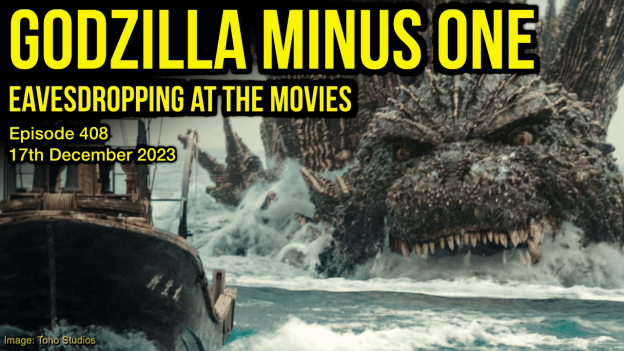
408 – Godzilla Minus One

Listen on the players above, Apple Podcasts, Audible, Google Podcasts, or Spotify.

A new, low-budget, Japanese-produced Godzilla movie takes us by surprise. Toho, with whom the series began in 1954 and who have produced over 30 Godzilla films since, have given Godzilla Minus One a wider release than usual, and we’re glad of it. Unburdened by the lore and worldbuilding of the Legendary Pictures MonsterVerse films, writer-director Takashi Yamazaki tells a story of Japan’s post-World War II depression, a spiritual and blood debt a pilot feels for shirking his wartime duty, and a community brought together in defiance of both a culture that treated their lives as expendable, and of course, a monster attacking their city.

Godzilla Minus One looks sensational for a film of its budget – reported to be under $15 million – and while hitting all the beats you’d expect of a blockbuster, arguably exhibits a subtly different pace and style of storytelling than Western audiences are used to, Mike suggesting that it gives an audience tired of having relentlessly convoluted cinematic universes foisted upon them a change in cinematic attitude for which they’re hungry. It’s not a perfect film – some of the performances let its emotional moments down, and there’s little you can’t see coming – but Godzilla Minus One is thoughtful entertainment that’s really worth seeing at a cinema.

With José Arroyo of First Impressions and Michael Glass of Writing About Film.
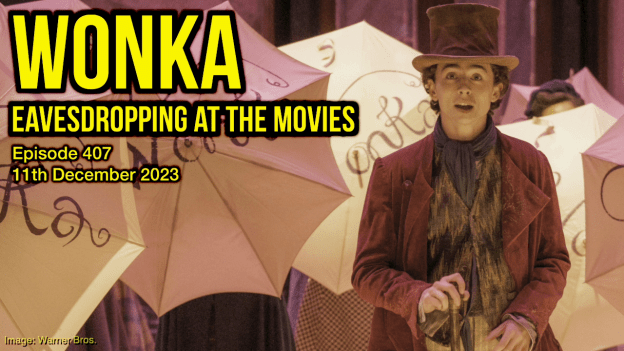
407 – Wonka

Listen on the players above, Apple Podcasts, Audible, Google Podcasts, or Spotify.

Paul King, the director of Paddington and Paddington 2, brings us Wonka, another reimagining of a British children’s classic. Roald Dahl’s beloved 1964 novel, Charlie and the Chocolate Factory, has been adapted twice: once in 2005 by Tim Burton, but most memorably in 1971 by Mel Stuart, with Gene Wilder as eccentric chocolatier Willy Wonka. It’s from the 1971 version that Wonka takes some of its cues (including musical ones), but in the service of that most 21st-century of cinematic artefacts: an origin story.

Within, discussions of: What we make of the world in which Wonka is set, one in which institutions purportedly in place for the public good are instead supportive only of corporate power; the reinterpretation of the Oompa-Loompas as a wronged people whose representative is out to retrieve what was stolen from them; Mike’s dissatisfaction with CGI and visual effects in British films and the production of the vocals in Wonka‘s songs; José’s opinion on Timothée Chalamet’s career and (apparently) uneven face; whether this film really benefits from its sentimental backstory and overtones; and how chocolate is best enjoyed.

With José Arroyo of First Impressions and Michael Glass of Writing About Film.

406 – Dream Scenario

Listen on the players above, Apple Podcasts, Audible, Google Podcasts, or Spotify.

Nicolas Cage plays a meme. Not just in real life any more, but now also in Dream Scenario, a quirky fantasy in the mould of Charlie Kaufman and Woody Allen, although nowhere near as funny. Cage’s biology professor starts appearing in countless people’s dreams for no obvious reason, blankly observing the events within, and soon becomes a minor celebrity – but as his presence in the dreams grows more active, public opinion turns on him.

Dream Scenario flirts with a variety of themes of modern society, such as fame, celebrity, cancel culture, power dynamics in academia, male ego, and the grammar of social media – arguably without meaningfully committing to any of them, but equally arguably avoiding the pitfalls that doing so might create. It dramatises the difference between who a public figure of opprobrium actually is and who the version of that figure is in the minds of the public that reviles him, depicting its angry mob with a mix of horror and amused fascination, but also refuses to indulge in cancel culture whining, explicitly critiquing the anti-woke world of the likes of Jordan Peterson and Joe Rogan. (An additional and crucial detail of the film is that, unlike people at the centre of similar real-life pile-ons, Cage’s professor has done nothing to instigate the hatred – his presence in people’s dreams and behaviour within them is entirely without explanation.)

Dream Scenario is an interesting film that builds on the infamous memeability – memeness? memeitude? – of its star to explore observations and nuances of modern, hyper-online, highly personalised culture. With all that said… we wish it were funnier.

With José Arroyo of First Impressions and Michael Glass of Writing About Film.
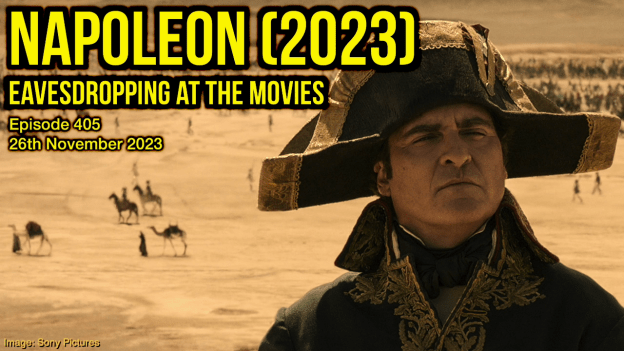
405 – Napoleon (2023)

Listen on the players above, Apple Podcasts, Audible, Google Podcasts, or Spotify.

For our discussion of Ridley Scott’s new historical epic, Napoleon, we have the privilege of being joined by Paul Cuff, a film historian and expert on the Napoleonic era in cinema, including and especially Abel Gance’s Napoléon from 1927, about which he wrote A Revolution for the Screen: Abel Gance’s Napoleon. Together, we ask whether Scott’s film has anything to say about the man whose life it depicts – and if so what? – whether its ahistoricity matters, and how substantially it fleshes out its characters and the events and relationships dramatised.

With José Arroyo of First Impressions and Michael Glass of Writing About Film.

404 – The Killer

Listen on the players above, Apple Podcasts, Audible, Google Podcasts, or Spotify.

David Fincher’s precise, controlled direction is a perfect match for Michael Fassbender’s precise, controlled performance in this lean but complex story of a botched assassination, revenge, and the hitman’s attempts to reassert precise control over his life.

We discuss the world in which The Killer is set and the way in which its title character operates, lives, and sees his place within it; the functions we see in its premise of a murderer-for-hire bored with his job, be it a critique of capitalism or a satire on work; the many names he assumes and what we take from the fact that they’re all drawn from sitcoms; the extraordinary audiovisual craft that we’re used to seeing from Fincher and thankfully not inured to; how the film uses noir and thriller tropes and where it might overplay them; the film’s obsession with process and procedure and why Mike likes playing it more than watching it; and more.

The Killer is a brilliantly conceived and assembled thriller filled with cinematography and editing to admire, and a lot to chew on despite its slight appearance. See it.

With José Arroyo of First Impressions and Michael Glass of Writing About Film.