We indulge in a caper inspired by a real-life attempted overthrow of the US government – no, not that one. The Business Plot of 1933 was alleged to have been planned by business leaders, aggrieved by Franklin D. Roosevelt’s election, who sought to remove him and install a retired major general as dictator, and in telling a loose version of this story, writer-director David O. Russell chucks in a doctor, a lawyer, and a wildcard, played by Christian Bale, John David Washington, and Margot Robbie, respectively.
Amsterdam has been a colossal bomb at the box office, and despite its many attractions – including surely the richest and most exciting cast you’ll see all year – we can understand why. It’s on the long side, it’s fuzzy, it’s overwritten, and its messaging, while agreeable, is banal… but it’s also full of charm and novelty, and Christian Bale hasn’t been this fun to watch for ages. Mike’s typically had a cool relationship with Russell’s films but finds this one easy to like; José is less in tune with it, particularly its comic tone, but still enjoys his time with it. It’s imperfect, but deserving of a more welcome reception than it’s had, and worth seeing.
Trauma as metaphor has become a trope of horror in recent years, and Smile features it more bluntly than you’ve ever seen. We discuss its messaging, storytelling, and camerawork, and remark upon the ways in which 2014’s It Follows may have inspired it. In the sense of Ali Baba and the Forty People Who Were Inspired.
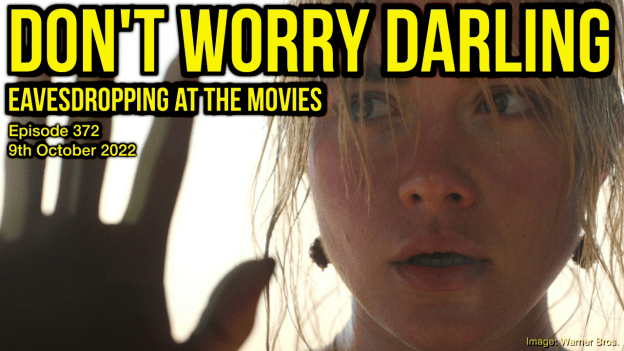
Don’t Worry Darling, Olivia Wilde’s second feature as director, after Booksmart, which we loved, is an irredeemable mess of a psychological thriller. We pick through its carcass in an attempt to figure out which bit of it we liked the least.
The absence of presence that is Idris Elba, who we’d like to like one day, stars in Beast, a Jurassic Park knock-off that pitches him against both his distant daughter and an excessively affectionate lion. It’s a film that Mike enjoyed unironically but can’t claim to find much quality in; José, showing off, provides a coherent response, seeing the film’s weaknesses and having no fun.
It’s a mechanical film in more ways than one. The character relationships crash inelegantly into place, the action hasn’t met an idea from a better film that it didn’t try to copy – and the seats share the load, tilting and rumbling along with the images. For reasons beyond our understanding, our local Cineworld offeredBeast only in 4DX, the theme park-style augmented exhibition format that purports to enhance the cinematic experience through practical effects such as moving seats, wind, and strobe lighting. It’s a technology that José despises to its core, arguing that it betrays a lack of trust in the film’s own ability to excite its audience, while Mike, who is in his thirties, likes filling himself up with fizzy liquid and sugar and being shaken around all afternoon.
Still, no amount of physical animation can either distract from or add to the vacuum of cinematic substance that is Idris Elba, Beast‘s central problem and central lack. It makes for a film you won’t regret ignoring.
Nope, Jordan Peele’s third film as writer-director, following his zeitgeist-capturing Get Out and complex, ambitious Us, invites its audience to speculate on audiences and spectacle. The kinds of things it wants us to think about are clear, and we discuss its themes of commercialised tragedy, fear of the audience, and photography as truth, among others – but what it has to say about them is at best muddled, and, more frankly, disappointingly uncritical. Like Peele’s previous films, Nope is a terrific conversation starter, but unlike them, its contribution to that conversation is weak.
David Leitch, who directed the surprisingly enjoyable Hobbs & Shaw, delivers another surprisingly enjoyable action comedy. Bullet Train is set upon the eponymous Japanese train, which, for two hours, hosts an assortment of assassins getting into scraps and scrapes at the behest of their various employers. It’s stylish, funny, smart, and features a wonderful central comic presence from Brad Pitt, who seems to have relaxed into himself in recent years, his performances exhibiting a delightful spontaneity. Definitely worth a watch, and going on the trailers, Mike really didn’t think he’d be saying that.
We visit the MAC for a screening of the new 4k restoration of Psycho, one of the most analysed films of all time, and arguably director Alfred Hitchcock’s most famous. It’s a film we’ve both seen several times, but not for a few years, and in the cinema setting for which it’s meant, instead of the classroom, there’s a renewed and reinvigorated wonder to its imagery and editing.
We share our feelings about this screening, remark upon things we’d forgotten or had never noticed before, discuss how elements of the film have aged, and compare it to Brian de Palma’s Dressed to Kill, which was, shall we say, inspired by Psycho, and which we recently saw. We find plenty of room for criticism, but although we conclude that Psycho works for us more as a collection of a few iconic scenes than a thoroughly engrossing story from beginning to end, those scenes shine, and nowhere more vividly than on a cinema screen.
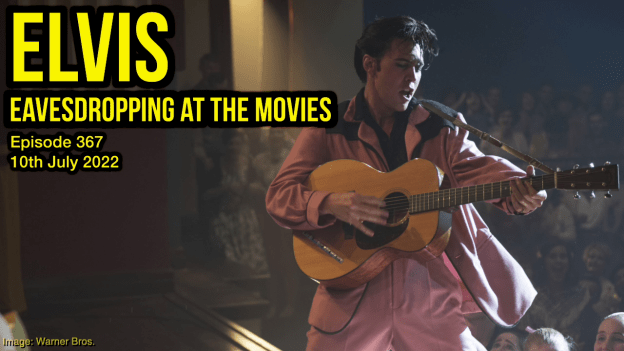
Baz Luhrmann’s Elvis is here: a colourful, expressive telling of the story of Elvis Presley, through the eyes of his manager, Colonel Tom Parker, who opens the film by claiming that he’s not the villain he’s renowned to have been. But the film flattens any complexities in the history it tells so thoroughly that we have no option but to continue to see him as one.
Still, it starts vibrantly and excitingly, understands and loves the sexual allure of Elvis – the lengthy introduction to him leads up to a fabulous scene of crotch-gyration – and Austin Butler is fantastic in the starring role. But once it settles down, is it anything more than a filmed Wikipedia page? Does it offer insight into the story it tells? José will have to tell you, because Mike fell asleep.
We’re into the land of diminishing returns with Marvel, it seems, with the novelty of a shared cinematic universe having worn off and the big storyline everything was building to for ten years now over. Of course, another big event is sure to be on its way in another decade, but will we care by then?
Not if Thor: Love and Thunder is anything to go by. Between the thinning appeal of Taika Waititi’s self-satisfied comedy and the uninvolving and lazy plot, characters, and imagery, it’s an unmemorable failure of Marvel’s action comedy formula. Admittedly, Christian Bale makes his Voldemort-esque villain, Gorr the God Butcher, more threatening than you might expect, given his simplicity and lack of screen time, and there’s some fairly charming comic business between Thor and his semi-sentient weaponry. Tough to recommend just for those, though.
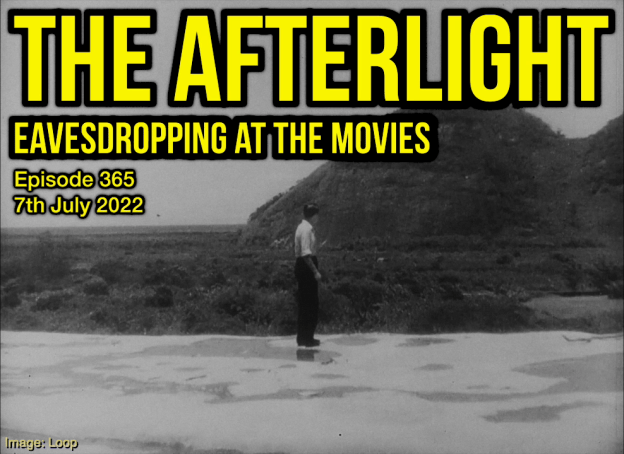
A one-off experience visits Birmingham’s Electric Cinema: The Afterlight, an 82-minute collage assembled from footage in which every person in frame is now dead. Director Charlie Shackleton accompanies the film on its tour, not only to give post-screening Q&A sessions, but also because he is in possession of the only copy of the film in existence – a single 35mm print that gradually degrades with each successive screening, picking up scratches and other wear and tear, and when it’s finally too damaged to watch any longer, it’s gone for good.
It’s a compelling idea, invoking questions of film preservation, the ways in which film captures and preserves moments in time, and the peculiar cinematic magic (and particularly magic of celluloid) that brings ghosts to life through illumination. And Shackleton is a charming, intelligent and witty speaker, the best advertisement for his own film, although his style and confidence activate José’s cynicism circuits – do we really believe that he hasn’t kept a copy of the film for himself?
But as for the film? It’s an enjoyable experience, the footage assembled into a rough narrative of sorts that takes us through similar actions and settings seen across countless cinematic sources, and both the choices of source material and the editing’s sense of rhythm create an appealing mood throughout, but much of the specific choices feel too vaguely motivated. Why has this shot in particular been included? Why the focus on one setting or action instead of some other? These questions are never satisfactorily answered, and the film meanders with too little intention.
One point of comparison in particular comes up in our discussion: The Clock, Christian Marclay’s 24-hour installation film that we saw large segments of both together and separately when it visited the Tate Modern three years ago. It’s similarly constructed of clips from films, its rubric to find shots that show clocks and other timepieces so that the film itself can function as a clock. We think about the difference in how often Shackleton and Marclay take creative liberties with their source material and build something new and expressive with it, and the different ranges of that source material to begin with (one of our biggest criticisms of The Clock being the unimaginative Anglo-American cinephile context from which most, if not all, of its sources came).
Criticisms notwithstanding, The Afterlight is an interesting and enjoyable one-off experience that literally – and we do mean literally – has to be seen in person, and if it screens near you it’s worth the evening. It won’t look as good as it did for us, admittedly, but at least you’ll be helping it look even worse for the next audience.