Category Archives: Podcasts

409 – Next Goal Wins

Listen on the players above, Apple Podcasts, Audible, Google Podcasts, or Spotify.

In something of a return to the sort of film that made his name, Taika Waititi co-writes and directs a quirky, charming comedy-drama set in Polynesia. Next Goal Wins adapts the true story of the American Samoan football team (and the 2014 documentary about it that gives this film its title), famously one of the worst teams on the planet, who begin the film in despair following their 31-0 world-record international defeat to Australia. Seeking new inspiration, they recruit Thomas Rongen, a Dutch-American coach with a reputation for losing his temper and getting sacked, to lead them in their quest for World Cup qualification.

We discuss Waititi’s comedic style, to what extent the film requires knowledge of the culture and sport it shows, the complexities of Rongen’s history and relationship with his ex-wife, and how Fassbender, not known for his work in comedy, fits uncomfortably into such a role, but what he brings to it dramatically that you wouldn’t typically expect. Most of all – we have fun! Next Goal Wins is an immensely likeable and charming film and it’s Christmas, after all. Or at least it was when we saw it.

With José Arroyo of First Impressions and Michael Glass of Writing About Film.

408 – Godzilla Minus One

Listen on the players above, Apple Podcasts, Audible, Google Podcasts, or Spotify.

A new, low-budget, Japanese-produced Godzilla movie takes us by surprise. Toho, with whom the series began in 1954 and who have produced over 30 Godzilla films since, have given Godzilla Minus One a wider release than usual, and we’re glad of it. Unburdened by the lore and worldbuilding of the Legendary Pictures MonsterVerse films, writer-director Takashi Yamazaki tells a story of Japan’s post-World War II depression, a spiritual and blood debt a pilot feels for shirking his wartime duty, and a community brought together in defiance of both a culture that treated their lives as expendable, and of course, a monster attacking their city.

Godzilla Minus One looks sensational for a film of its budget – reported to be under $15 million – and while hitting all the beats you’d expect of a blockbuster, arguably exhibits a subtly different pace and style of storytelling than Western audiences are used to, Mike suggesting that it gives an audience tired of having relentlessly convoluted cinematic universes foisted upon them a change in cinematic attitude for which they’re hungry. It’s not a perfect film – some of the performances let its emotional moments down, and there’s little you can’t see coming – but Godzilla Minus One is thoughtful entertainment that’s really worth seeing at a cinema.

With José Arroyo of First Impressions and Michael Glass of Writing About Film.
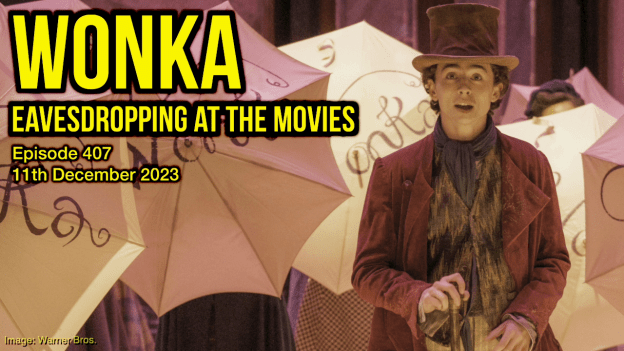
407 – Wonka

Listen on the players above, Apple Podcasts, Audible, Google Podcasts, or Spotify.

Paul King, the director of Paddington and Paddington 2, brings us Wonka, another reimagining of a British children’s classic. Roald Dahl’s beloved 1964 novel, Charlie and the Chocolate Factory, has been adapted twice: once in 2005 by Tim Burton, but most memorably in 1971 by Mel Stuart, with Gene Wilder as eccentric chocolatier Willy Wonka. It’s from the 1971 version that Wonka takes some of its cues (including musical ones), but in the service of that most 21st-century of cinematic artefacts: an origin story.

Within, discussions of: What we make of the world in which Wonka is set, one in which institutions purportedly in place for the public good are instead supportive only of corporate power; the reinterpretation of the Oompa-Loompas as a wronged people whose representative is out to retrieve what was stolen from them; Mike’s dissatisfaction with CGI and visual effects in British films and the production of the vocals in Wonka‘s songs; José’s opinion on Timothée Chalamet’s career and (apparently) uneven face; whether this film really benefits from its sentimental backstory and overtones; and how chocolate is best enjoyed.

With José Arroyo of First Impressions and Michael Glass of Writing About Film.

406 – Dream Scenario

Listen on the players above, Apple Podcasts, Audible, Google Podcasts, or Spotify.

Nicolas Cage plays a meme. Not just in real life any more, but now also in Dream Scenario, a quirky fantasy in the mould of Charlie Kaufman and Woody Allen, although nowhere near as funny. Cage’s biology professor starts appearing in countless people’s dreams for no obvious reason, blankly observing the events within, and soon becomes a minor celebrity – but as his presence in the dreams grows more active, public opinion turns on him.

Dream Scenario flirts with a variety of themes of modern society, such as fame, celebrity, cancel culture, power dynamics in academia, male ego, and the grammar of social media – arguably without meaningfully committing to any of them, but equally arguably avoiding the pitfalls that doing so might create. It dramatises the difference between who a public figure of opprobrium actually is and who the version of that figure is in the minds of the public that reviles him, depicting its angry mob with a mix of horror and amused fascination, but also refuses to indulge in cancel culture whining, explicitly critiquing the anti-woke world of the likes of Jordan Peterson and Joe Rogan. (An additional and crucial detail of the film is that, unlike people at the centre of similar real-life pile-ons, Cage’s professor has done nothing to instigate the hatred – his presence in people’s dreams and behaviour within them is entirely without explanation.)

Dream Scenario is an interesting film that builds on the infamous memeability – memeness? memeitude? – of its star to explore observations and nuances of modern, hyper-online, highly personalised culture. With all that said… we wish it were funnier.

With José Arroyo of First Impressions and Michael Glass of Writing About Film.
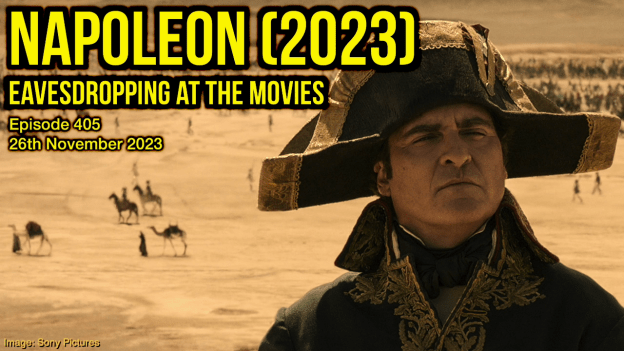
405 – Napoleon (2023)

Listen on the players above, Apple Podcasts, Audible, Google Podcasts, or Spotify.

For our discussion of Ridley Scott’s new historical epic, Napoleon, we have the privilege of being joined by Paul Cuff, a film historian and expert on the Napoleonic era in cinema, including and especially Abel Gance’s Napoléon from 1927, about which he wrote A Revolution for the Screen: Abel Gance’s Napoleon. Together, we ask whether Scott’s film has anything to say about the man whose life it depicts – and if so what? – whether its ahistoricity matters, and how substantially it fleshes out its characters and the events and relationships dramatised.

With José Arroyo of First Impressions and Michael Glass of Writing About Film.

404 – The Killer

Listen on the players above, Apple Podcasts, Audible, Google Podcasts, or Spotify.

David Fincher’s precise, controlled direction is a perfect match for Michael Fassbender’s precise, controlled performance in this lean but complex story of a botched assassination, revenge, and the hitman’s attempts to reassert precise control over his life.

We discuss the world in which The Killer is set and the way in which its title character operates, lives, and sees his place within it; the functions we see in its premise of a murderer-for-hire bored with his job, be it a critique of capitalism or a satire on work; the many names he assumes and what we take from the fact that they’re all drawn from sitcoms; the extraordinary audiovisual craft that we’re used to seeing from Fincher and thankfully not inured to; how the film uses noir and thriller tropes and where it might overplay them; the film’s obsession with process and procedure and why Mike likes playing it more than watching it; and more.

The Killer is a brilliantly conceived and assembled thriller filled with cinematography and editing to admire, and a lot to chew on despite its slight appearance. See it.

With José Arroyo of First Impressions and Michael Glass of Writing About Film.

403 – Killers of the Flower Moon

Listen on the players above, Apple Podcasts, Audible, Google Podcasts, or Spotify.

Based on true events, Killers of the Flower Moon tells a story that invokes the foundational genocide upon which the USA was built, but has its own peculiarities. The Osage Nation, a Native American tribe and unusually the owners of their reservation in Oklahoma, became extraordinarily wealthy in the early 20th century upon finding their land gushing oil – but in pursuit of their riches, the white population in the region devised a plan to rob them of their individual land rights, which were only allowed to be inherited. In telling this story, Killers of the Flower Moon justifies its three and a half hours of runtime – though there’s no reason not to include an intermission! – and Leonardo DiCaprio, in particular, has never been better.

We discuss the specific events depicted and the wider history to which they relate and that they evoke in microcosm; the complexities in DiCaprio’s character, who participates knowingly in hideous crimes but truly loves his wife, whose community and family he’s devastating, all the while not quite having the mental acuity to understand the full extent of what he’s involved in; the quality and qualities of the performances and characterisations; the visual design, effects of lighting, and evocation of the feeling of so many mid-20th century Westerns through subtle and specific elements of the cinematography; and the idiosyncratic ending and what it has to say to its audience.

With José Arroyo of First Impressions and Michael Glass of Writing About Film.

402 – Saw X

Listen on the players above, Apple Podcasts, Audible, Google Podcasts, or Spotify.

Listen to our podcasts on the previous two films in the series, Jigsaw and Spiral.

Mike’s favourite horror series, which fizzled out in 2010 after seven annual instalments, has been resurrected in fits and starts over the past few years, and if future sequels can maintain the quality of storytelling of Saw X, we want to see more of them. José still doesn’t understand the appeal of the gore and torture, but accepts that it’s part of the landscape here; what neither of us expects is such an involving and interesting first act.

The serialised story that became so hard to follow during the 2000s is here eschewed in favour of a relatively self-contained episode of Jigsaw’s life – the convolutions that followed his death way back in Saw III are nowhere to be seen here. We’re in pure prequel mode, following him on a trip to Mexico to receive an experimental miracle cure for his terminal cancer, during which the film confidently takes time to build surprising and effective hope for him – everybody likes Jigsaw, the adorable little sadist, after all. The savage redemption that he sets out to offer later on is given weight by this stage-setting, and in the light of how ugly these films can be, it’s a rather refreshing and bold bit of storytelling.

We discuss the racial composition of the group of victims and the varying viciousness of the games they’re forced to play, and just how hard they are to beat – disproportionate gruesomeness is this series’ stock-in-trade, but is only three minutes to sacrifice a body part really fair? Mike praises the lighting, which proves images need not be hard to see to be dark. And we discuss the series’ history, the differences between Saw X and its predecessors, and single out Tobin Bell, the man holding everything together. He got lucky in 2004 to find that his almost background role would quickly make him an iconic cinematic villain; the filmmakers got lucky that the bit-part player they’d hired to lie on the floor for two hours turned out to have the ability and presence to lead a billion-dollar franchise.

Mike’s always thrilled to see a new Saw film, and the fact that this one’s good is merely icing on the cake – but most remarkably, José has found one he needs no nudging or persuasion to recommend!

With José Arroyo of First Impressions and Michael Glass of Writing About Film.

401 – A Haunting in Venice

Listen on the players above, Apple Podcasts, Audible, Google Podcasts, or Spotify.

Kenneth Branagh continues to direct himself as Hercule Poirot in his ongoing project to make Agatha Christie’s classic whodunnits all about him. A Haunting in Venice has less focus on the process and nuances of investigation than its predecessors, Murder on the Orient Express and Death on the Nile – and those already felt the need to punctuate the procedural with action, lest the audience get bored – but shows just as much interest in Poirot’s story, at the expense of the suspects’ and victims’. It’s safe to say that these adaptations are not what they could, or should, be.

Branagh enthusiastically uses dramatic angles and camera movement; wonderful to see but for the fact that he does so with little motivation, failing to create with them the effects and mood that he could. The casting disappoints José, who looks to these sorts of films for the stars of yesteryear who fill the ensemble, bringing their histories and personas to their portrayals of the snooty dowagers, nervous accountants and so on; here, no such stars are present. A few current names pepper the cast list, but most of the players that this whodunnit hosts form a who’s who of “who’s that?”

We’re already into diminishing returns with Branagh’s Poirot series, the films increasingly missing the point of their genre – how can the audience play along with the mystery and marvel at the intricacy of its solution when we’re rushed past the details in favour of hearing about the detective’s inner life yet again? Mike found an element of that to like back in Murder on the Orient Express, but even a heart as large and generous as his can find no room for it any more. It’s simply not good enough.

With José Arroyo of First Impressions and Michael Glass of Writing About Film.

400 – The Nun II and The Exorcist: Believer

Listen on the players above, Apple Podcasts, Audible, Google Podcasts, or Spotify.

You can also hear our discussion of 2018’s The Nun, and our podcast on The Exorcist, part of our exploration of the oeuvre of William Friedkin.

For our 400th episode we indulge in a pair of horror sequels, both heavy on faith, possession, and Christianity. One is part of a modern universe of interconnected stories, characters, and demons, the other represents the reignition of a series whose sequels have been produced intermittently for fifty years without receiving anything like the acclaim of the film that spawned them. The Nun II is the eighth film in the ten-year-old Conjuring Universe; The Exorcist: Believer is only the sixth Exorcist film in half a century. Truly, they don’t make them like they used to.

Neither film in this double bill is very good in totality, but The Nun II contains imaginative and effective set pieces and visual ideas, while The Exorcist: Believer is content to discard a reasonably interesting first act in favour of useless and charmless reference to, and pathetic reenactment of, William Friedkin’s 1973 original. We discuss what we think the films are about, wittingly or otherwise – horror is commonly understood to often allegorise and express the ills and worries of the societies that produce them, and we consider the ways in which these films might be doing so. And there’s much to compare and contrast between them, including their characters’ attitudes to the supernatural; the ways in which religion, be it Catholicism specifically or Christianity more generally, plays into their stories and atmospheres; and the kinds of imagery through which they attempt to instil fear in their audiences. And we take time to criticise many, many examples of the weakness of the storytelling in Believer.

The Nun II, like its 2018 predecessor, is not very good, but it is fun. The Exorcist: Believer is neither good nor fun. Happy 400th episode!

With José Arroyo of First Impressions and Michael Glass of Writing About Film.