Big shark, big Cockney, big fun. We dive into The Meg, a film we can all agree should have been called Chomp. It’s definitely trashy, though precisely how trashy is an area of disagreement. For José, it’s a bad movie. For Mike, it’s a good bad movie.
The podcast can be listened to in the players above or on iTunes.
Low-budget, unexceptionally made, and absolutely vital. The First Purge takes the story of the Purge series back to the beginning, with a poor community composed of people of colour being savagely experimented upon for political purposes. Mike slightly had to drag José to see it, as it was showing only in single late-night screenings, but both were glad he did, as it’s perhaps the most direct and powerful critique of white hegemony that popular cinema has offered in recent memory.
We examine the imagery of the deliberate terrorisation of black communities in the USA. It draws on real-life attacks on black churches, Ku Klux Klan members wielding guns in pick-up trucks, and the resurgence of Nazis – one image of a blackface mask being removed to reveal an Aryan stereotype is particularly poetic. Mike finds that the film protects the white audience from their own complicity in the inequality portrayed, but it’s only a nuance, and as José says, we should be so lucky to have such flaws in most films! And José explains why films of this sort come along so rarely. (It’s not about risk. It’s about power.)
There’s simply so much food for thought and we urge you to see it.
The podcast can be listened to in the players above or on iTunes.
The sequel to 2015’s Ant-Man maintains that film’s lightness of tone, happily comic sensibility, and fabulously enjoyable visual effects. So often today we take exceptional effects work for granted but the conceptualisation and realisation of the images in Ant-Man and the Wasp make you notice, make you remark upon them. We had a great time.
We find room for nitpicks, of course, with José expressing irritation with Ant-Man’s malfunctioning suit and Mike finding the quantum realm too vague to provide real jeopardy, but our quibbles are minor. It’s a lovely film, it got big laughs from the audience, and even gasps at one notable point. You should see it!
The podcast can be listened to in the player above or on iTunes.
A mega bumper double podcast today, as we see Mission: Impossible – Fallout twice and incorporate both discussions into one episode. Long story short, we had tons of fun both times and you should see it.
We both adore the visual storytelling and the elegance of the action. We fawn over gripping sequences that evoke silent cinema. We discuss in depth the idea of Ethan Hunt as a moral character, something that the film places front and centre throughout, giving him choices to make and emphasising the protection of innocents and self-sacrifice. José doesn’t quite buy it but Mike does his best to talk him round.
Neither of us is quite sold on the concept of the villain – he’s not enough of an idealist – but Cavill’s performance unquestionably elevates him and he’s a constant delight to watch. To José, he’s the new Errol Flynn. Mike focuses on two implausible scenes to compare and contrast, exploring why he believed in one but not the other. José describes how the action scenes develop like good jokes, with ideas building on top of each other in logical ways. And we go off on a tangent about Idris Elba for some reason.
The podcast can be listened to in the player above or on iTunes.
We are joined by Celia Nicholls, another former Warwick student, for a discussion of Paul Schrader’s First Reformed, a careful drama following a Protestant minster’s personal crises and relationships with his parishioners and community. Comparisons with Robert Bresson, informed by Schrader’s Transcendental Style in Film, are drawn; we consider how trite or meaningful we find the film’s moral questions; and we pick apart the film’s flat aesthetic and occasional flights of fancy.
The podcast can be listened to in the player above or on iTunes.
A tight yet sprawling high-concept thriller, Hotel Artemis features glorious performances from Jodie Foster and the wonderful cast that surrounds her, surprising pathos and a beautifully built world. José expounds upon his love for Foster and explores the details of her performance here; Mike discusses what makes the world-building so effective and elegant. We’d have liked to have seen stronger, more expressive visual storytelling – there’s so much potential in this single sanctuary hidden within an unforgiving world – but, well, nobody’s perfect.
The podcast can be listened to in the player above or on iTunes.
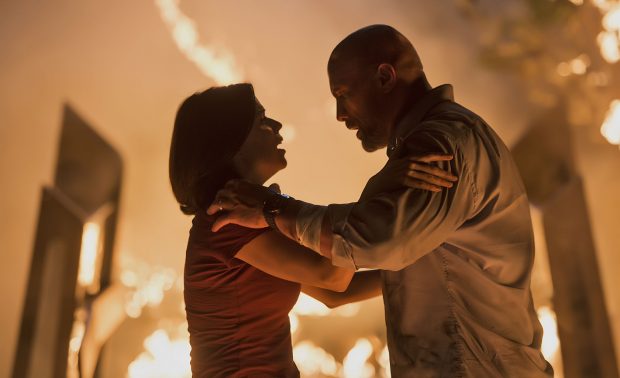
The Rock is the action star of the moment and despite Skyscraper‘s lacklustre title, we enjoy his latest vehicle a lot. It’s mechanical, predictable, corporate, obvious, and not even shot and edited that well, but we don’t really care. It features a gem of a setting, a great central performance from an enormously likeable star, depicts disability in a remarkably sensitive way, generates decent threat and tension despite obvious flaws in how it does so, is wholesome as hell, and Mike wants The Rock to be his dad.
The podcast can be listened to in the player above or on iTunes.
After a fourteen-year wait, the Incredibles are back! We discuss how well the comedy is directed, how full of ideas the action is, and our love of Edna Mode and the mad baby. José finds food for thought in the conceptualisation of the antagonist, while Mike makes sure the animation, somehow so often overlooked in animated films, is given its due. And we discuss the imbalance in the treatment of the two main characters, Mr. Incredible and Elastigirl.
The podcast can be listened to in the player above or on iTunes.
We only thought of it in this way after we finished the podcast, but Sicario 2 is the best movie for watching on a plane we’ve ever seen. It’s pacey, entertaining, catchy, and entirely insubstantial. José discusses some issues he has with the film, including how many Mexicans it’s happy to kill while keeping every American alive, and the lack of tension in scenes that are crying out for it – Mike agrees with everything José says and knows he should have a problem with this stuff but just doesn’t. We agree that it’s a joy to see so much of Benicio del Toro and Josh Brolin, and when they share the screen there’s a special feeling, but the conscience that Emily Blunt brought to the first film is perhaps lacking here.
It doesn’t live up to the first Sicario – and really, how could it – but it’s good, rough, dark fun.
The podcast can be listened to in the player above or on iTunes.
We go deep on Hereditary, occult/folk horror, and indeed horror in a wider perspective with guest contributor and horror guru (Mike’s words) Dr. Matt Denny from the University of Warwick, a film scholar with a particular interest in precisely the milieu Hereditary occupies. (He’s also a former student of José’s who was an undergrad alongside Mike, so it’s not all down to his credentials.) He brings an insightful and informed perspective to the film, picking up the baton where Mike and José dropped it in the previous podcast, and running off with it.
We consider what the occult subgenre is, what makes such stories interesting and where Hereditary in particular digresses from them, and the effects that has. Matt offers a historical perspective on the treatment of women in horror and how the film puts forth a muddled version of that, and the influence of Kubrick (in particular The Shining) on the film. We consider Mike’s dislike of how the film hides information or clues behind codes, and Matt suggests that this is really just a function of how this type of film works – and indeed how the occult works. And is it reasonable that Mike associates the occult film with British cinema in particular?
All this and more in a fascinating discussion.
The podcast can be listened to in the player above or on iTunes.






 Eavesdropping at the Movies