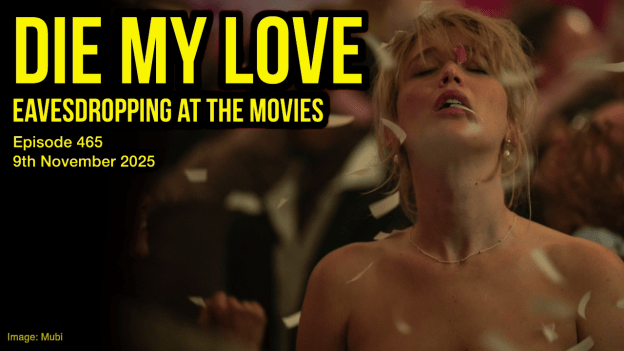
Jennifer Lawrence gives a career-best performance as a new mother struggling with depression and a rocky relationship in Die My Love, directed by Lynne Ramsay, whose remarkable instinct for tone and atmosphere shouldn’t be taken for granted. It’s a character study whose artistry is all in the filmmaking and performances, which bring out great richness of feeling in material that, on the page, might seem to lack complexity. One could suggest that those who’ve experienced similar struggles to the film’s characters hold the key to unlocking its depths, but that’s a temptation to avoid – one of the film’s achievements is the ease with which it gets you to feel what its characters are feeling. See it at the cinema, where you’ll be able to properly submit yourself to it.
After a little time off, we’re back at the cinema to see Bong Joon Ho’s sci-fi comedy, Mickey 17, in which Robert Pattinson dies. Repeatedly. Leaving Earth on a spaceship seeking to colonise an icy planet, Pattinson’s Mickey is an “Expendable”: a disposable worker given lethal assignments, regenerated by a biological printer, and sent out to die again. But when the 17th version of Mickey fails to die at the mandibles of the local fauna, he finds his way back to the colony, only to find that he’s already been reprinted as Mickey 18 – and clone coexistence is strictly prohibited.
We’re disappointed by what looked like a marvellously energetic, knockabout comedy and social satire from the trailer. Even considering the film’s very broad tone, there’s too little in the characterisation to really buy in to, a severe lack of pace, and an ending that betrays it. Nonetheless, as failures go, it’s an interesting one, playing with plenty of ideas, and featuring more than enough good jokes to support it. Our recommendation of Mickey 17 is far from whole-hearted, but you ought to give it a whirl.
The latest in a long line of Batman reboots, The Batman claims the definite article for itself – and deserves to. Richly shot, dark, romantic expressiveness spilling from every frame, The Batman leans in hard on bringing the noir of the source material to the screen with unabashed sincerity. It’s the best Batman film of them all.
Birmingham’s full-size IMAX cinema closed in 2011, having proved unprofitable (the independent venue it became, the Giant Screen, closed four years later for the same reason), so it’s off to the Manchester Printworks, home of the second-largest screen in the UK, for our second viewing of Tenet. We ask whether the full IMAX experience is worth it, Mike comparing the feeling of the images offered to those he saw in Dunkirk and The Dark Knight; José argues that it’s detrimental to the film to be exhibited in different cinema formats, as shooting in IMAX’s 1.43:1 aspect ratio, where the film is supposedly best seen, with the knowledge that it’ll be cropped for conventional cinema screens for its wide release and home media, means that artistic, interesting composition is impossible – you can’t compose well for two frames at once.
Mike suggests that an easily overlooked pleasure of Christopher Nolan’s cinema is turning his films over in your own head, playing with the logic, asking questions of it and trying to unlock the puzzle box – something he’s been doing since his first screening, and which we both spend some time on after this one. Laying out the timeline, speculating on what might happen that we’re not shown – this isn’t the first of Nolan’s films to invite that type of reflection. And Mike describes the pleasure of understanding things that aren’t hidden but simply too many to grasp all at once the first time – now that he broadly knows the film, things that left him confused at first now smoothly fall into place.
We reflect again on the film’s score, performances, and action scenes, finding that rather than changing our initial impressions, this second viewing helps us to perceive and explain better what made us feel the way we did at first. We find more to discuss – the use of Elizabeth Debicki’s height, the cost of Nolan’s adherence to achieving visual effects without the use of CGI, the pleasure of the way in which Aaron Taylor-Johnson’s character interacts with the heroes, whether Mike is just shit at watching spy movies – but our overall experience hasn’t changed. What we liked, we still like; what we didn’t, we still don’t.
(Mike’s short film, which he claims was harder to make than Tenet, can be seen below. It’s probably worth mentioning that if you still don’t know what Tenet is about, watching this could constitute a spoiler of sorts – after all, Mike brought it up because of its vague similarities.)
After a long wait and three delays, Christopher Nolan’s latest high-concept blockbuster, Tenet, has finally arrived in British cinemas. This description is a spoiler-free zone, but the podcast is decidedly not, so tread carefully before you listen: We spill every secret the film has to hold. The ones we could figure out, anyway.
Following our revisitation of five of Nolan’s massive flicks – the DarkKnighttrilogy, Interstellar, and Inception – we’re keen to see how Tenet fits amongst its brethren. We consider, as we have done repeatedly, Nolan’s action direction, the aesthetic design, the tone, the concept that drives everything, how it’s explained, what we love, what let us down, and, well… to detail anything further would be indecent.
Mike is gobsmacked by it, finding brilliance in some of the film’s execution, though is keen to make more than a few criticisms. José is much colder towards it, dismissing it as no more interesting than comic books for children – can Mike’s enthusiasm rub off on him? Tenet has its flaws, but it’s ambitious, intriguing, large-scale, wonderfully cast and acted – it’s worth your time.
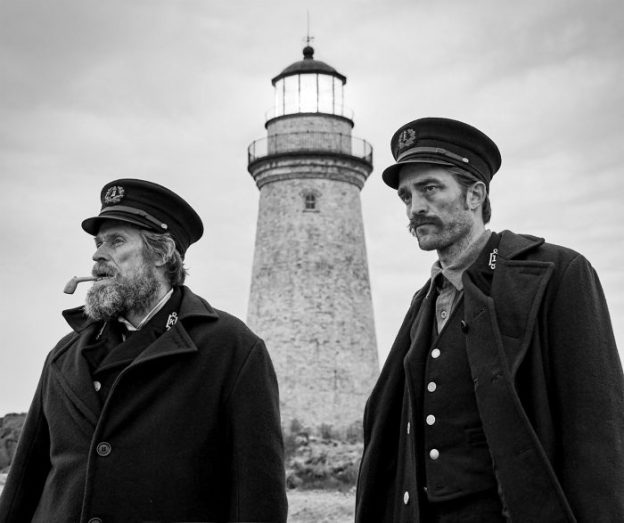
Robert Eggers’ The Lighthouse, a tale of two lighthouse keepers stranded during a storm, is a visual treat in black and white that stuns and engrosses us. A two-hander between Willem Dafoe’s irascible boss and Robert Pattinson’s secretive youngster, it invokes myth, gods, folk tales, the clash of male egos, compulsive psychosexuality, if not much, much more besides.
If its plot is simple, its story is complex, and we think our way through its characters’ personalities, wants, needs, and psychologies. José asks if the film is gothic, and we discuss the boss’s treatment of his assistant: is it just controlling, or abusive? Extraordinary imagery of mermaids, monsters, and gods suffuses the film with inescapable surreality and the turbulent minds of men overburdened with ego and sexual need. Eggers has an assured, confident sense of tone, layering the film with mood and atmosphere, making its remote island a pressure cooker.
The Lighthouse is a spectacular film, an audiovisual treat that you should not miss at the cinema. Its imagery is poetic, its characters complex – in its entirety, it is confusing but approachable, symbolic but not coded, allowing room for interpretation and emotional response. It’s brilliant.


 Eavesdropping at the Movies