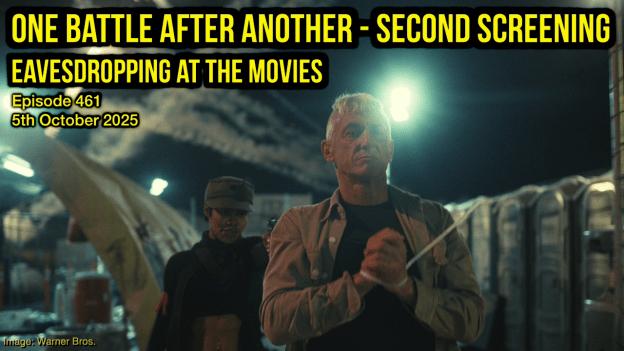
We’re joined by our resident Paul Thomas Anderson expert (and Mike’s brother), Stephen Glass, to whom we’ve previously spoken about Phantom Thread and Licorice Pizza, for another discussion of One Battle After Another. Stephen’s seen it in both VistaVision and IMAX 70mm, and can offer a sense of the experience Mike and José missed seeing it in IMAX Digital, and so begins a wide-ranging conversation about the film’s aesthetics, tone, politics, influences and more.
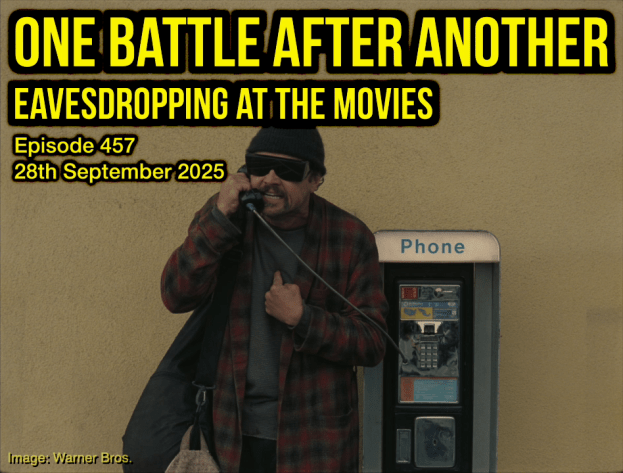
By far Paul Thomas Anderson’s most expensive film, with a budget some four or five times what he’s used to, and probably his most accessible, One Battle After Another entertains us enormously and effortlessly without sacrificing the complexity and nuance for which his work is known. Set in an alternate America oppressed by Christofascism, the alternate part is that there’s a very active militant revolutionary group, the French 75, setting bombs off and freeing detained minorities. Leonardo DiCaprio is part of it, and sixteen years after the conclusion of his group’s activities, their work has entered countercultural legend, but he’s become a drug-addicted, paranoid burnout, trying to raise a teenage daughter. When the powers that be come looking for them, they’re separated, all hell breaks loose, and he has to step up.
José finds One Battle After Another to be the film of the moment, the state of the nation film that Eddington could only dream of being, a powerful, invigorating expression of what ails America and what it means to resist. Mike is more cynical, seeing an element of mockery in the revolution that has no apparent intention to end and is carried out over generations. We love the easygoing style of filmmaking that Anderson seems to have grown into, comparing it to the rigid formality of his early work, and finding that he has a talent for action cinema that’s never quite come out before. We also discuss the film’s themes of youth and ageing, parenting, the Christian right and more.
One Battle After Another is an unmissable film, the kind that fifty years ago would have defined America’s national conversation. Cinema no longer holds that level of cultural cachet, sadly, but One Battle After Another is a powerful, energetic, and very funny reminder of what film can do at its best.
We’re remotely joined by filmmaker, previous guest, and, crucially, Mike’s brother, Stephen Glass, for a discussion of Paul Thomas Anderson’s period romance, Licorice Pizza. Stephen last helped us explore Anderson’s previous film, Phantom Thread, and again brings his knowledge of and passion for the director’s work to our discussion.
We consider the efficiency with which Anderson creates rich portraits of characters and their lives from few details; how the blossoming love between the protagonists, a boy of 15 and woman of 25, avoids feeling exploitative or uneasy as the age difference suggests it might; how the film is able to feel loose and free despite conforming to its genre; the likability, or otherwise, of the setting and era; Anderson’s focus on faces and use of reflective surfaces; and whether one particular running joke that begins as hilariously, stunningly outrageous, overplays its hand and ends up in the realm of the unacceptable.
Licorice Pizza is a sweet romance draped in a loving portrait of a particular place and time, and laced with good jokes. Still, your mileage may vary, as Mike’s devoted, grumpy intransigence in the face of José’s and Stephen’s enthusiasm demonstrates, but even he has to admit it’s a very good film.
Mike’s brother Stephen joins us to discuss Phantom Thread in further detail. We look at the power struggle between Alma and Cyril, the visual verticality that contributes to an Academy ratio feel, the film’s relationship to fairytales, the way the score augments the images, and whether the dresses are actually any good and why.
The podcast can be listened to in the player above or on iTunes.
Finally, we sink our teeth into Phantom Thread, Paul Thomas Anderson’s highly-anticipated romantic period drama. The performances, aesthetics, direction and so much more are simply enthralling and give us much to discuss. We consider Daniel Day-Lewis’s style and how likeable he is in this, Anderson’s mastery of tone and ability to lighten with unexpected humour what could be a rather dry film, the beauty of his cinematography, the range of female characters and some aspects of their portrayal, the way in which the work of an artist is depicted, and more. José is simply beside himself with the film’s beauty, and Mike questions its flirtations with cliché so often that he becomes a cliché himself.
It’s clear that there’s more to discover than one viewing can reveal, so we look forward to seeing the film again and talking on it more.
The podcast can be listened to in the player above or on iTunes.


 Eavesdropping at the Movies