DC, which for the best part of two decades has failed to put together a cinematic universe of comic book adaptations to rival Marvel’s MCU, regroups and goes again with director James Gunn in charge of what will be known as the DCU – and what better superhero to introduce the new brand than the original: Superman.
David Corenswet’s performance and physique are extremely appealing, recalling an era before steroids and dehydration were considered compulsory in order for a man to be thought of as sexy. We appreciate the film’s lightness of tone and sense of humour, although one of us argues that the whole experience is so audiovisually hyperactive and loud that the tone doesn’t support all the jokes, and it’s simply exhausting to endure. We also discuss wokeness, the right wing’s determination to have a culture war, and obvious parallels between Lex Luthor’s villainy and that of Donald Trump; destruction of cities and the concomitant human cost; what made the previous Lex Luthor interesting; and why putting on glasses is an effective method of disguise.
Writer-director Robert Eggers, whose reputation for aesthetically rich, deeply-researched and idiosyncratic horror precedes him, has long been working on a remake of F. W. Murnau’s Nosferatu, the 1922 German Expressionist classic whose influence has been felt in the horror genre for a century. It’s a big fish to try to take down, but it’s source material that feels like it exists especially for him – how does he do?
Very well, as it turns out… although, in classic fashion, we manage to talk around what a fantastic time we had by concentrating on our criticisms. Ignore them until you’ve taken yourself to the biggest cinema you can to see it – it’s an experience you should have. Then come back and listen to us discuss the debt Eggers’ Nosferatu owes to the colour tinting processes of the silent era, how the second half gets bogged down in tropes and plot, the delineation between sex and love, the pressure to be accessible, whether horror needs to be scary, and the important lesson we learned from Shrek Forever After.
A film whose brilliant conceit is so simple and compelling we can’t believe we’ve never seen it before, Juror #2 tells the story of a juror whose responsibility it is to assess the guilt of a defendant who he knows is innocent of murder – because it was the juror who did it.
Summoned to serve on a jury and quickly recognising the details of the case, Nicholas Hoult’s Justin realises that the deer he hit with his car one dark, stormy night was in fact the defendant’s girlfriend, for whose supposed murder he is on trial. So begins a morality play of sorts, Justin wanting to do the right thing and keep an innocent person from prison, but unwilling to expose himself as the real, if accidental, killer.
It’s a film that sets two institutions, the family and the court, at war. Justin’s wife has a baby on the way, and is there any wrong that can’t be justified by the protection of the family? We discuss this in the particular light of director Clint Eastwood’s reputation as a lifelong conservative, Mike suggesting that the distrust the film shows towards the legal system, a government institution, has precedent in Eastwood’s other work, but its critique of the sanctity of the family is surprising and invigorating.
Juror #2 is a thoroughly engrossing exploration of a terrific idea, and you’ll take its questions home with you long after it ends. What would you do? Are you sure? With José Arroyo of First Impressions and Michael Glass of Writing About Film.
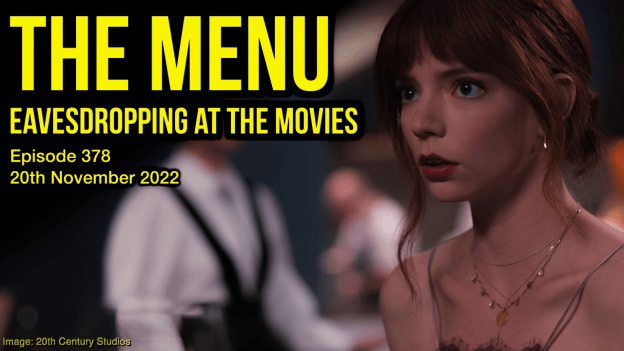
The Menu is a smörgåsbord both of scenes, its plot dropping ideas as soon as it picks them up in its rush to entertain, and of styles and genres, with black comedy, satire and horror combining. But while it’s witty and engaging, it’s also inconsistent, unfulfilling, and, although the flights of fancy with which it imbues some of its action are good fun, fairly trite. As is way The Menu thinks of the food it mocks, so is the film itself: it looks delicious at first blush but fails to impress under scrutiny. And such small portions!
Greek weirdo Yorgos Lanthimos, whose off-kilter thriller The Killing of a Sacred Deer divided and provoked us a year ago, brings us The Favourite, a wild dramatisation of the power games surrounding Queen Anne’s bedchamber in the early 18th century. It’s his first feature on which neither he nor his usual partner Efthymis Filippou is credited as a writer, and that might account for its liveliness compared to his previous work, which tends to offer significant downtime in which the audience can ponder what it’s seeing. The Favourite moves rapidly and fluidly, the shifting dynamics between Olivia Colman’s Queen Anne, Rachel Weisz’s Lady Marlborough, and Emma Stone’s Abigail Hill constantly exciting, with their plans always subject to change depending on who knows what about others. And on top of the intrigue, it’s really, really funny.
The Favourite offers us a brilliantly cast and even more brilliantly performing female trio, picking on a rare historical moment in which all the most important and influential people were women. (The men are all secondary, made physical jokes of, with their extravagant costumes and makeup outdoing the women’s.) Sex is always on the table and made to mean different things to different people: to Marlborough and Abigail it’s a tool to be used to manipulate and control the Queen, to whom it offers intimacy and emotional satisfaction she deeply craves and is allowed to feel she doesn’t deserve. The film doesn’t offer titillation, nor does it wish to shock or surprise with its depictions of sex or even the concept of the lesbian relationships. It’s actually quite remarkable how the film so casually avoids making it superficial and gratuitous.
We take our time to appreciate the cinematography, extraordinary wide-angle and occasionally fisheye shots that render characters, particularly the Queen, tiny playthings in a ludicrously ostentatious doll’s house. Mike remarks upon the way status is conferred by placing characters above and below each other and shooting at extreme angles to emphasise; José picks up on the costuming and its relationship to gender, mentioning in particular his admiration for Nicholas Hoult’s self-effacing, generous performance as Robert Harley, impressed by his willingness to make himself a feminised figure of fun.
There’s so much more we loved and we’re effusive throughout the podcast. And again. It’s a really, really, really, really, very very funny film indeed.
The podcast can be listened to in the players above or on iTunes.



 Eavesdropping at the Movies