Tag Archives: Nazi

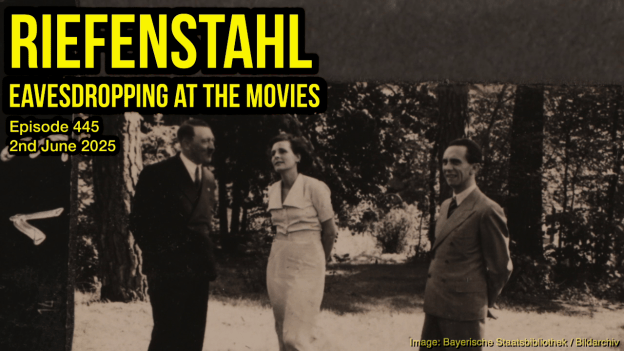
445 – Riefenstahl

Listen on the players above, Apple Podcasts, Audible, Spotify, or YouTube Music.

In the 1930s, Leni Riefenstahl infamously directed two propaganda films, Triumph of the Will and Olympia, for the Nazi Party. For the rest of her life, which ended in 2003, she denied knowledge of the regime’s crimes, including the Holocaust. In 2016, her heirs gave her estate, which included a vast collection of personal documents, correspondence, and film and tape recordings, to the Prussian Cultural Heritage Foundation, which itself gave permission to Sandra Maischberger and Andres Veiel, a journalist and filmmaker respectively, to use the material as the basis of a documentary. Riefenstahl, comprising countless elements of the archive, along with documents from other sources, builds a biography of a person who never came clean about what she knew about Nazi Germany, and never took responsibility for her part in it.

It’s a complex and layered examination of a life led between pride and denial, and has resonances today: take Riefenstahl’s television appearance in 1976 alongside Elfriede Kretschmer, an anti-Nazi activist and contemporary who refuses to believe her claims of ignorance during wartime, which is followed by recordings of phone calls to Riefenstahl in support of her stance and contempt for Kretschmer. The line between those calls and the metastasising popularity of extreme right-wing, “anti-woke” and similar ideologies today is self-evident, as is the difference between ideas expressed publicly and privately. Riefenstahl is more outspoken off the record than on it, demanding interviewers’ cameras be turned off to prevent them from capturing candid revelations. In this sense and others, her life provides a window into fascism – what drives it – her initial response to seeing and hearing Adolf Hitler speak is almost sexual – what it represents and offers to its adherents, and how it shrinks and cowers when it doesn’t get everything it wants.

It’s a problem for Mike that the film doesn’t seem to think that the artistic and cultural impact of Riefenstahl’s work is worth exploring, where to him it’s the most interesting thing about her. Not only were her films technically and artictically innovative – something claimed by subjects in the film but not explained or examined – but her work arguably gives the Nazis their key, and enduring, victory. As thuggish and vile as the regime was, and despite its collapse, through Triumph of the Will and Olympia it created an image of itself as glorious and powerful with which we continue to associate it, and to which neo-Nazis today aspire to emulate. Few filmmakers have left a cultural legacy of such significance and duration, but the documentary isn’t interested in the work – only the person.

Quibbles apart, Riefenstahl is an excellent example of how to tell a complex tale with intention, clarity, and concision, while allowing for interpretation of the material presented, and it’ll be the basis of endless conversations. Highly recommended.

With José Arroyo of First Impressions and Michael Glass of Writing About Film.

228 – To Be or Not to Be

Listen on the players above, on Apple Podcasts, or on Spotify.

Carole Lombard and Jack Benny lead chaos in 1942’s To Be or Not to Be, Ernst Lubitsch’s classic black comedy set amongst a group of actors turned resistors in occupied Poland. Considered to be in bad taste at the time, it was, to say the least, a bold film to make, one that mocked the very real and active threat of the Nazis to their faces. It’s also endlessly witty and truly hilarious, generous and kind. It’s a treat.

We think about it in comparison to other satire, in particular that of Mel Brooks, who José argues has an aggression and contempt that Lubitsch avoids, while Mike suggests that their work shares an absolute unambiguity as to the targets they set and the messages they convey. But there’s unquestionably a remarkable sensitivity of tone to To Be or Not to Be, as well as an effortlessly executed intelligence in plotting, with the love triangle of the opening leading cleverly, smoothly, and unpredictably, into the unmasking of a Gestapo spy.

José can’t speak highly enough of Lubitsch, above whom there sits nobody in the pantheon of the great filmmakers. And Mike likes him too.

P.S. Corrections and clarifications: Mike begs your forgiveness for incorrectly claiming that Sid Caesar famously played a comedy Nazi on television in the 1950s. He in fact played a German general. A comedy German general.

With José Arroyo of First Impressions and Michael Glass of Writing About Film.

205 – Jojo Rabbit

Its intentions are good, but we have trouble with Jojo Rabbit, Taika Waititi’s comedy about a young boy in Nazi Germany, a fanatical member of the Hitler Youth, who discovers a Jewish girl being given safe harbour by his mother. Our reservations stem from the state of the world and culture in which the film has been made, in which fascism is resurgent and increasingly worth taking seriously.

We discuss comedy’s ability to puncture that at which it takes aim, Mike arguing that we like to overstate its power, José lamenting cinema’s unwillingness to take today’s fascist figureheads on directly – by comparison, satirising Hitler and the Nazis is a safe choice. Mike criticises the film’s superficiality, finding that its depiction of the Nazi regime is skin deep, merely built on signifiers with which we’re familiar – there’s no attempt here to explore Jojo’s psychology, or how and why he’s been taught what he has. José argues that the film makes its Nazis too likeable, too goofy; the film wants to offer us a message that people are ultimately good, and in so doing gives its villains the opportunity of redemption, which they tend to take. It’s partially contextualised by the 1944 setting, the dying German war machine making sense of the cynicism in Sam Rockwell’s Nazi officer; setting the film during the Nazi regime’s strongest years would have been more interesting, and braver.

Despite all of this, Jojo Rabbit gets lots of laughs, and Waititi manages the tone well, the film making moves into some unexpectedly dark areas at times. But its successes never distract from the overall ideological problems we feel it has.

The podcast can be listened to in the players above or on iTunes.

With José Arroyo of First Impressions and Michael Glass of Writing About Film.