Tag Archives: Michelle Yeoh

401 – A Haunting in Venice

Listen on the players above, Apple Podcasts, Audible, Google Podcasts, or Spotify.

Kenneth Branagh continues to direct himself as Hercule Poirot in his ongoing project to make Agatha Christie’s classic whodunnits all about him. A Haunting in Venice has less focus on the process and nuances of investigation than its predecessors, Murder on the Orient Express and Death on the Nile – and those already felt the need to punctuate the procedural with action, lest the audience get bored – but shows just as much interest in Poirot’s story, at the expense of the suspects’ and victims’. It’s safe to say that these adaptations are not what they could, or should, be.

Branagh enthusiastically uses dramatic angles and camera movement; wonderful to see but for the fact that he does so with little motivation, failing to create with them the effects and mood that he could. The casting disappoints José, who looks to these sorts of films for the stars of yesteryear who fill the ensemble, bringing their histories and personas to their portrayals of the snooty dowagers, nervous accountants and so on; here, no such stars are present. A few current names pepper the cast list, but most of the players that this whodunnit hosts form a who’s who of “who’s that?”

We’re already into diminishing returns with Branagh’s Poirot series, the films increasingly missing the point of their genre – how can the audience play along with the mystery and marvel at the intricacy of its solution when we’re rushed past the details in favour of hearing about the detective’s inner life yet again? Mike found an element of that to like back in Murder on the Orient Express, but even a heart as large and generous as his can find no room for it any more. It’s simply not good enough.

With José Arroyo of First Impressions and Michael Glass of Writing About Film.
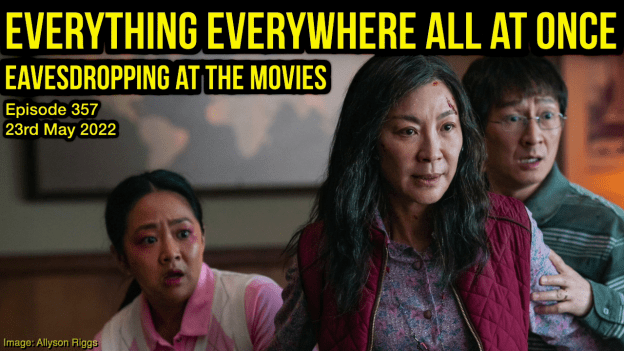
357 – Everything Everywhere All at Once

Listen on the players above, Apple Podcasts, Audible, Google Podcasts, or Spotify.

We’ve seen a lot of the multiverse lately, and Everything Everywhere All at Once brings to it a combination of Gen Z existential angst and mid-life where-did-things-go-wrong woe, in a frantic comic-action-sci-fi wrapper. It’s a lot of things in one, and we discuss as many of them as we can remember, including its campness, puerility, basis in multi-generational immigrant life, film references, endless endings, and much more. It’s full of life and imagination, and despite its unevenness, easy to recommend.

With José Arroyo of First Impressions and Michael Glass of Writing About Film.
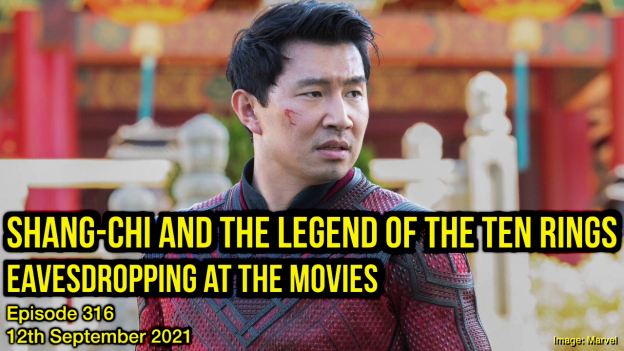
316 – Shang-Chi and the Legend of the Ten Rings

Listen on the players above, Apple Podcasts, Audible, Google Podcasts, or Spotify.

A new day, a new entry in the MCU, and on this occasion we’re introduced to an entirely new set of characters and mythos: Shang-Chi and the Legend of the Ten Rings fills us in on the history of a young Chinese-American man and his dad’s magical jewellery. Like Doctor Strange and Black Panther, it’s a film whose connection to the wider MCU is light, establishing characters, a setting, and story elements that are certain to tie in to subsequent films, but free of the obligation to prioritise them at the expense of itself. And like Doctor Strange and Black Panther, that freedom works in its favour – it’s of a piece, interesting, pretty, and entertaining.

We discuss the film’s setting in a Chinese-American immigrant context, comparing it in particular to The Farewell and Crazy Rich Asians: all three films dramatise the cultural differences between the new and old country, and the ways in which the younger generation might face challenges in visiting or returning to their ancestral home. Indeed, Awkwafina appears in all three films, and, even in supporting roles, expresses this subject all by herself. We also think about the MCU’s use of the film to address its own past, a character from Iron Man 3 returning: Shang-Chi not only rejects the way the earlier film totally reconfigured him from the comics, but also addresses the Orientalism with which he has historically been associated.

And there’s more besides – Tony Leung’s beautiful, evocative performance of a character that nonetheless doesn’t quite work; the quality of the action, much of it a cut above what we typically expect from Marvel; and that classic Disney trick – if in doubt, animate a cute animal. Shang-Chi and the Legend of the Ten Rings is a promising start to the MCU’s next phase, and we look forward to finding out how its world will integrate down the line, but it’s worth seeing on its own terms.

With José Arroyo of First Impressions and Michael Glass of Writing About Film.
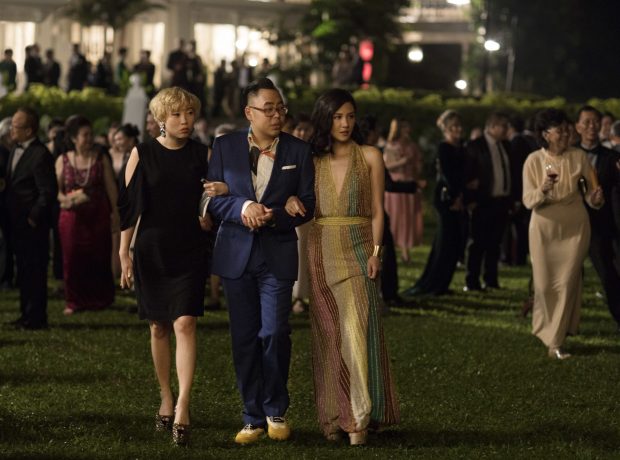
92 – Crazy Rich Asians

An utterly charming, friendly rom-com set in and amongst the very wealthiest of the Singaporean elite, Crazy Rich Asians is also full of odd tensions and problematic complexities. In one sense a highly specifically Chinese story of a second-generation American immigrant’s return to Asia and the conflict she experiences in negotiating her way into a world that finds her somewhat unwelcome; on the other a genre comedy that would feel no different were the characters all white. It’s a friction that bubbles under everything, but the film is so light and likeable that it never spoils anything.

We find Michelle Yeoh’s performance as the intimidating mother-in-law a delight, her character completely avoiding the one-dimensional dragon mom stereotype. On the other hand, there are stereotypes in which the film does indulge, though we disagree on how critical we should be of that. Thinking back to Searching, Mike feels that that film’s joy of seeing ethnicity have no bearing at all on anything is not replicated here, as the film’s insistence on themes of separation from one’s background and identity come into conflict with its desire to be no different from any generic white rom-com. Jose doesn’t find this an issue, instead sinking into the diasporic aura of the film. We discuss the film’s occasional TV movie feel, its use of music, its depiction of class through accents, and the way the opening sets up a much darker, more subversive film than we get.

And above all, it’s really, really funny.

The podcast can be listened to in the players above or on iTunes.

With José Arroyo of First Impressions and Michael Glass of Writing About Film.