Tag Archives: Mark Ruffalo

440 – Mickey 17

Listen on the players above, Apple Podcasts, Audible, Spotify, or YouTube Music.

After a little time off, we’re back at the cinema to see Bong Joon Ho’s sci-fi comedy, Mickey 17, in which Robert Pattinson dies. Repeatedly. Leaving Earth on a spaceship seeking to colonise an icy planet, Pattinson’s Mickey is an “Expendable”: a disposable worker given lethal assignments, regenerated by a biological printer, and sent out to die again. But when the 17th version of Mickey fails to die at the mandibles of the local fauna, he finds his way back to the colony, only to find that he’s already been reprinted as Mickey 18 – and clone coexistence is strictly prohibited.

We’re disappointed by what looked like a marvellously energetic, knockabout comedy and social satire from the trailer. Even considering the film’s very broad tone, there’s too little in the characterisation to really buy in to, a severe lack of pace, and an ending that betrays it. Nonetheless, as failures go, it’s an interesting one, playing with plenty of ideas, and featuring more than enough good jokes to support it. Our recommendation of Mickey 17 is far from whole-hearted, but you ought to give it a whirl.

With José Arroyo of First Impressions and Michael Glass of Writing About Film.
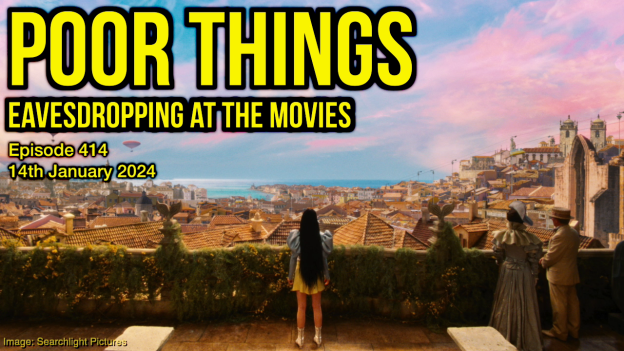
414 – Poor Things

Listen on the players above, Apple Podcasts, Audible, Google Podcasts, or Spotify.

Yorgos Lanthimos’ latest absurd comedy, Poor Things, creates a wonderful confluence of themes, all through the lens of Bella, a grown woman with a child’s brain, experiencing the world anew and detached from emotion. We discuss Bella’s attitude to the world she encounters, the men who try to control and cage her, Lanthimos’ idiosyncratic visual style and comedic sensibility, the examination of the nuances of sex, what Mike finds lacking in the brothel scenes, and more.

With José Arroyo of First Impressions and Michael Glass of Writing About Film.

216 – Dark Waters

Listen on the players above, on Apple Podcasts, or on Spotify.

A legal drama about the biggest corruption scandal you’ve never heard of, Dark Waters tells the story of lawyer Robert Bilott’s twenty year long fight to expose chemical manufacturer DuPont’s decades of knowing and unapologetic poisoning of a town, a country, and the entire world. Visited by a West Virginian farmer named Wilbur Tennant, whose livestock are falling prey to unusual medical conditions and dying, Bilott – a corporate lawyer who works to help chemical companies pollute within the law – files a lawsuit, and slowly begins to uncover the company’s secrets.

For José, it’s a film that fits neatly amongst director Todd Haynes’ previous work, which often focuses on power relations and the struggles of the oppressed, sidelined or disenfranchised. For Mike, it might be a new Spotlight, another film about the exposure of vast, historical, institutional wrongdoing. But don’t believe the trailer that makes it look all blood and thunder – Dark Waters, though compelling and dramatic, is a slow burner, methodical and careful, and with a scope that looks beyond the details of the law. The town of Parkersburg, WV is shown in portrait, with shots evocative of Depression-era photography, and Bilott is an interesting character, a man who appears uncomfortable within his own body, whose determination to uncover the truth grows alongside his paranoia that something bad will happen to him, and whose relationship with his wife is a constant that is reframed intriguingly in the film’s final movement.

Dark Waters is a fascinating, intelligent, complex thriller that gives its themes room to express themselves and is full of details and moments that speak to entire inner lives and ways of thinking. Make sure you see it.

(Mike would also like to apologise to Bucky Bailey, one of DuPont’s most unfortunate victims and perhaps the film’s central emotional tentpole, for referring to him as Bucky Barnes, who is the guy from the Avengers films who sports a prosthetic arm and does nothing interesting.)

With José Arroyo of First Impressions and Michael Glass of Writing About Film.

148 – Avengers: Endgame

A big one. The Marvel Cinematic Universe closes a chapter – kind of – with Endgame, a three-hour behemoth that concludes stories that have been told over 21 films in 11 years. It’s elegiac, both of its characters’ fates following the end of Infinity War, and of itself, offering a good deal of fan service to its vast, devoted audience, some members of which have grown up knowing nothing other than the MCU as the dominant mode of cinema. We take our time to discuss it in a two-part podcast.

The first part is, as usual, recorded upon our return from the cinema, the film still ringing in our ears. We saw it in a packed screening, the room filled with excited fans from whom the film elicited exactly the vocal and rich emotional responses that bring such occasions to life. Though three hours is a demanding duration by anyone’s standards, and could certainly be seen to speak to a certain self-importance, the film makes very good use of its time, particularly in the opening hour, in which we are given copious time to understand the ways in which the world has changed following Thanos’ fatal snap, and the remaining Avengers’ responses to it all. We discuss whether the Russo brothers, the film’s directors, offer much by way of creative visuals – to Mike, the film’s visual core is simply about scale, while José remarks that some of the compositions appealingly evoke comic book panels. Mike brings up the way the MCU overall has to some degree always been about competition between Iron Man and Captain America, and how Endgame concludes that both in the story and metatextually, giving Robert Downey Jr. and Chris Evans respectively their own emotional moments.

The second half, recorded three days later, largely builds on a roundtable article in the New York Times, in which five of their pop culture writers discuss both Endgame itself and the MCU’s impact on cinema culture over the last decade. It brings up a number of interesting subjects, particularly those that consider the MCU as a cinematic phenomenon rather than the specific content of the stories themselves.

So. It’s a big film and a big podcast to go with it. We found it worthwhile to take our time to think over some of the cultural issues the MCU raises, and as for arguing about this character or that scene, well, sometimes it’s fun to indulge.

The podcast can be listened to in the players above or on iTunes.

With José Arroyo of First Impressions and Michael Glass of Writing About Film.