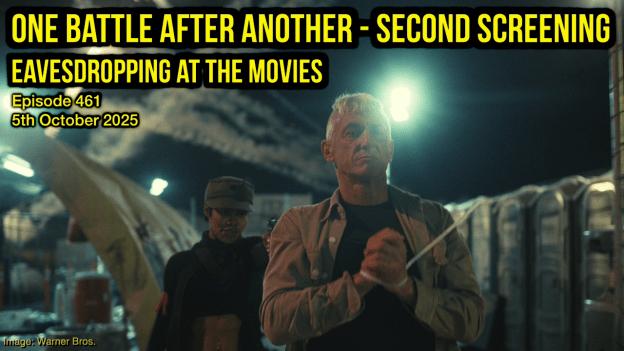
We’re joined by our resident Paul Thomas Anderson expert (and Mike’s brother), Stephen Glass, to whom we’ve previously spoken about Phantom Thread and Licorice Pizza, for another discussion of One Battle After Another. Stephen’s seen it in both VistaVision and IMAX 70mm, and can offer a sense of the experience Mike and José missed seeing it in IMAX Digital, and so begins a wide-ranging conversation about the film’s aesthetics, tone, politics, influences and more.
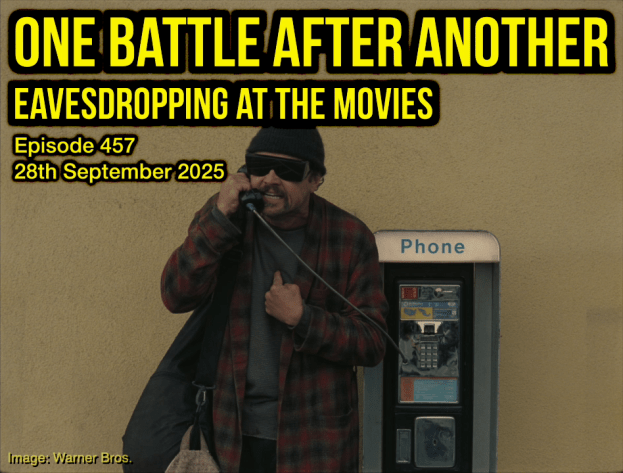
By far Paul Thomas Anderson’s most expensive film, with a budget some four or five times what he’s used to, and probably his most accessible, One Battle After Another entertains us enormously and effortlessly without sacrificing the complexity and nuance for which his work is known. Set in an alternate America oppressed by Christofascism, the alternate part is that there’s a very active militant revolutionary group, the French 75, setting bombs off and freeing detained minorities. Leonardo DiCaprio is part of it, and sixteen years after the conclusion of his group’s activities, their work has entered countercultural legend, but he’s become a drug-addicted, paranoid burnout, trying to raise a teenage daughter. When the powers that be come looking for them, they’re separated, all hell breaks loose, and he has to step up.
José finds One Battle After Another to be the film of the moment, the state of the nation film that Eddington could only dream of being, a powerful, invigorating expression of what ails America and what it means to resist. Mike is more cynical, seeing an element of mockery in the revolution that has no apparent intention to end and is carried out over generations. We love the easygoing style of filmmaking that Anderson seems to have grown into, comparing it to the rigid formality of his early work, and finding that he has a talent for action cinema that’s never quite come out before. We also discuss the film’s themes of youth and ageing, parenting, the Christian right and more.
One Battle After Another is an unmissable film, the kind that fifty years ago would have defined America’s national conversation. Cinema no longer holds that level of cultural cachet, sadly, but One Battle After Another is a powerful, energetic, and very funny reminder of what film can do at its best.
Based on true events, Killers of the Flower Moon tells a story that invokes the foundational genocide upon which the USA was built, but has its own peculiarities. The Osage Nation, a Native American tribe and unusually the owners of their reservation in Oklahoma, became extraordinarily wealthy in the early 20th century upon finding their land gushing oil – but in pursuit of their riches, the white population in the region devised a plan to rob them of their individual land rights, which were only allowed to be inherited. In telling this story, Killers of the Flower Moon justifies its three and a half hours of runtime – though there’s no reason not to include an intermission! – and Leonardo DiCaprio, in particular, has never been better.
We discuss the specific events depicted and the wider history to which they relate and that they evoke in microcosm; the complexities in DiCaprio’s character, who participates knowingly in hideous crimes but truly loves his wife, whose community and family he’s devastating, all the while not quite having the mental acuity to understand the full extent of what he’s involved in; the quality and qualities of the performances and characterisations; the visual design, effects of lighting, and evocation of the feeling of so many mid-20th century Westerns through subtle and specific elements of the cinematography; and the idiosyncratic ending and what it has to say to its audience.
We’ve enjoyed Adam McKay’s previous couple of films, The Big Short and Vice, in which he dramatises real events in a pointed, opinionated, satirical manner. He now brings the same attitude to the apocalypse, painting a picture of a world in which an asteroid is headed on a collision course with Earth, poised to end the human race’s existence unless something is done… and nobody cares.
We debate its merits and failures, agreeing that it’s a comedy with few laughs, but José arguing for its place in the national theatre of ideas that cinema has always been in America, and as a response to that question we’ve been hearing asked for several years now – how can you satirise a reality that’s this absurd to begin with? Mike asks why McKay’s previous films worked where this fails, and suggests that it’s an inability to be indirect, to work in poetic ways – something that’s effective when being openly sarcastic, as in The Big Short and Vice, but that falls short in Don’t Look Up‘s appeal for earnestness and depth of character.
An ambitious film, then, attempting to holistically satirise the state of things as they currently stand – but at best, a mixed bag.
Could we have found a Christopher Nolan film that José actually enjoys? We explore the brilliantly imagined and executed Inception, a heist movie set inside the human mind, talking up the intelligence and creativity with which the central concept is used, the elegant and effective intercutting and structure, and the noirish, expressive romance that underpins the entire affair.
We’ve had some disappointments with Interstellar and the DarkKnighttrilogy, but Inception was just the antidote. Boy, are we fired up for Tenet now.
Making spoof Inception trailers was all the rage around the time of its release, and here are the two Mike made.
Mike feared it might be the most tasteless film ever made. José doesn’t look forward to Quentin Tarantino films. But we both came away from this fantastical reimagining of a near-mythological era of Hollywood history having had a great time. Tellingly, for a film that exceeds two and a half hours, we both felt the time fly by.
Tarantino’s love for and expert knowledge of Hollywood and cinema informs all of his work, and arguably not that consequentially – he cribs shots, pastiches genres, and evokes styles and tones specific to cinema, but to debatable significant effect beyond the superficial. But in Once Upon a Time in Hollywood (OUATIH for brevity’s sake), the decision to bring this passion to the surface and tell a story directly about Hollywood results in Tarantino’s most meaningful and personal film. What he values is brazenly displayed here, and, Mike suggests, isn’t entirely pleasant to examine. He finds OUATIH initially troubling in this regard – with a day’s reflection on it, he comes to see it as deeply conservative and protective of privilege. In digging this up, we discuss its sexual politics, the way it uses race, and the clash it represents between the old and the new in a rapidly changing 1969 Hollywood. Mike argues that, as in 2009’s Inglourious Basterds, Tarantino’s revisionism revealingly reflects his fantasy of what an ideal world would look like and contain, and in this case it’s a little uneasy to stomach. He also takes issue with the way the Manson family are used, but not, as he feared, for reasons of taste – Charles Manson wasn’t in Hollywood by chance, he wanted stardom, and for a film in which the desire for and loss of stardom are interests, to show no interest in drawing a thematic link here, instead only wanting to use the Manson family to rag on hippies, is more evidence of Tarantino’s retrograde attitude.
The flip side to this coin is that the things Tarantino loves are wonderfully, warmly depicted. OUATIH is as much about television as it is cinema, if not more so, and Tarantino offers imagined and reimagined TV shows of many types in evoking in detail the time and place in which he grew up. To José, about the same age as Tarantino, there abound countless nostalgic pleasures; to Mike, disgustingly born 30 years too late, the film’s enthusiasm and obvious knowledge about its setting rubs off easily. The film easily convinces you to love what it loves, be it silly, overblown action movies; cheesy, overblown TV acting; or Brad Pitt’s Hawaiian shirt, which in one scene blows off.
Speaking of Pitt, José considers this his best performance, one in which he switches from evoking coolness and control to dumb and tripping balls. But for all the little touches and tone he brings to his character, Leonardo DiCaprio brings entirely different registers. His performance is a tour de force, his Rick, a declining Western star, constantly performing, even only to himself at times, and at every moment his emotions and thoughts are crystal clear, even under layer upon layer of performance. DiCaprio practically shapeshifts in sketches depicting Rick’s old movies and television appearances, and offers a sympathetic portrait of a star unable to adapt to his changing environment. It’s a rich, demanding role, and DiCaprio is spellbinding in meeting its challenge.
You’d be doing yourself a disservice missing Once Upon a Time in Hollywood at the cinema. It’s an excited, passionate trip through a Hollywood fantasy, hilarious, light, and thoroughly enjoyable – though, like so many fantasies, its underbelly is dark.
The podcast can be listened to in the players above or on iTunes.


 Eavesdropping at the Movies