Tag Archives: Japanese

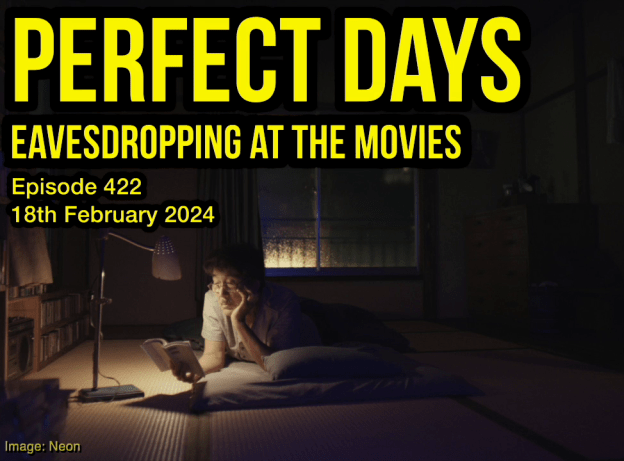
422 – Perfect Days

Listen on the players above, Apple Podcasts, Audible, Google Podcasts, or Spotify.

Wim Wenders finds inspiration in Japanese public lavatories in Perfect Days, a slice of life drama about Hirayama, a janitor who finds quiet happiness in his routine of travelling from public convenience to public convenience cleaning, photographing trees in the park, being welcomed at restaurants by proprietors who fetch him his usuals, and reading books before bed. We discuss Wenders’ delicate touch and observational eye, Kōji Yakusho’s central performance, for which he was named Best Actor at Cannes, how small moments indicate whole avenues of a person’s life, and the film’s theme of connections between the individual worlds in which we live.

With José Arroyo of First Impressions and Michael Glass of Writing About Film.
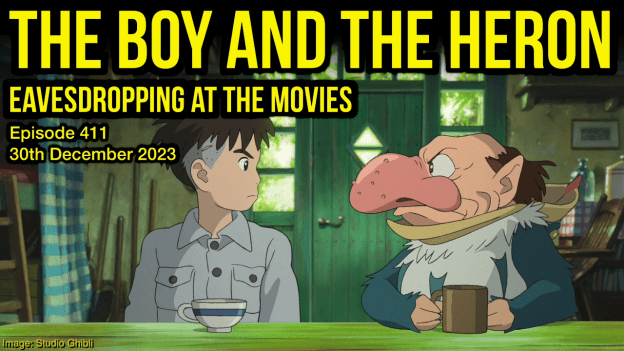
411 – The Boy and the Heron

Listen on the players above, Apple Podcasts, Audible, Google Podcasts, or Spotify.

Hayao Miyazaki, the legendary Japanese animator and co-founder of Studio Ghibli, who has previously announced his retirement three times, tells us all that The Boy and the Heron (as it’s titled in most of the world; How Do You Live? in Japan) is really, honestly, for real this time, I’m super serious, his last film. His longtime producer, Toshio Suzuki, has already cast doubt on this new claim, but for now, here we have Miyazaki’s final film, which tells the story of Mahito, a young boy in wartime Japan, who loses his mother in a fire and is evacuated to his aunt’s countryside estate, whereupon he meets a talking grey heron that promises that his mother is alive.

José sees The Boy and the Heron as a masterpiece of cinema, a film that does things that other films have forgotten to do, a doorway to thinking about life, loss, and worlds within worlds. Mike… didn’t really get on with it, but he puts it down to taste and maybe mood – any objection he has can be equally levelled at things he loves. We easily agree that Miyazaki’s and Ghibli’s reputation for visual design and craft holds, with image upon image here that dazzles. As for what it all adds up to? Take José’s side. It’s better to like things than be bored by them.

With José Arroyo of First Impressions and Michael Glass of Writing About Film.

408 – Godzilla Minus One

Listen on the players above, Apple Podcasts, Audible, Google Podcasts, or Spotify.

A new, low-budget, Japanese-produced Godzilla movie takes us by surprise. Toho, with whom the series began in 1954 and who have produced over 30 Godzilla films since, have given Godzilla Minus One a wider release than usual, and we’re glad of it. Unburdened by the lore and worldbuilding of the Legendary Pictures MonsterVerse films, writer-director Takashi Yamazaki tells a story of Japan’s post-World War II depression, a spiritual and blood debt a pilot feels for shirking his wartime duty, and a community brought together in defiance of both a culture that treated their lives as expendable, and of course, a monster attacking their city.

Godzilla Minus One looks sensational for a film of its budget – reported to be under $15 million – and while hitting all the beats you’d expect of a blockbuster, arguably exhibits a subtly different pace and style of storytelling than Western audiences are used to, Mike suggesting that it gives an audience tired of having relentlessly convoluted cinematic universes foisted upon them a change in cinematic attitude for which they’re hungry. It’s not a perfect film – some of the performances let its emotional moments down, and there’s little you can’t see coming – but Godzilla Minus One is thoughtful entertainment that’s really worth seeing at a cinema.

With José Arroyo of First Impressions and Michael Glass of Writing About Film.
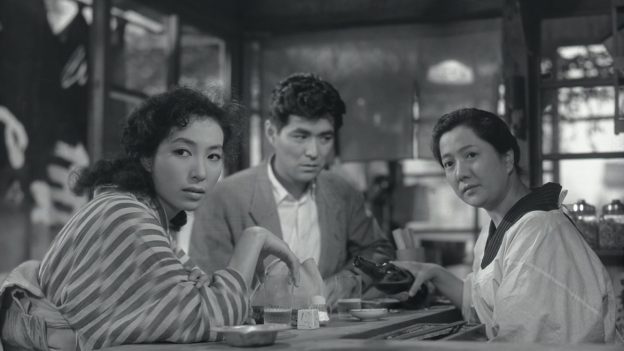
273 – Suzaki Paradise: Akashingō

Listen on the players above, Apple Podcasts, Google Podcasts, or Spotify.

A young, destitute couple seek survival and stability in Yuzo Kawashima’s 1956 drama, Suzaki Paradise: Akashingō (in English, this subtitle is given as Red Light, or Red Light District). Tsutae and Yoshiji spend their last few yen on a bus to anywhere, ending up on the outskirts of Tokyo’s red light district, separated from it only by an ominous bridge that is spoken of by the locals as though fearful, dreaded, even mythical. They take to their new home differently: Tsutae easily finds work as a waitress at a bar, comfortable for reasons that become clear; Yoshiji, a former office worker, has trouble adjusting, and, though it’s not put into words as such, spends much of the film depressed.

We discuss the portrayal of Tokyo’s unfortunates, their attitudes to life and to each other, and the tightrope Kawashima walks between wallowing in poverty porn and sentimentalising the couple’s situation. The motif of the bridge is a potent one, recurring throughout, and we consider how it’s used, what it signifies, and how it combines with the film’s theme of patriarchy and how it oppresses both women and men.

Suzaki Paradise is a concise and potent film, an intelligent dramatisation of social and economic issues in post-war Japan, and an expressive melodrama. It’s worth seeking out.

With José Arroyo of First Impressions and Michael Glass of Writing About Film.

189 – Ring

A horror film that everyone knew about when Mike was a teenager, but nobody seemed to have seen, we finally see 1998’s Ring – or Ringu, to transliterate the Japanese title. It’s been beautifully restored in 4K and we were keen to see what all the fuss was about.

And, truthfully, we’re left still asking that. Its influence is obvious, Mike suggesting that alongside 1999’s The Blair Witch Project it defined a new generation of horror cinema, but we don’t find it all that creepy, let alone scary. We suggest a number of factors in its iconic status: its place in the West as a foreign curio, an oddity; its brilliant conceit, a videotape that gives you seven days to live after you watch it, giving it an urban myth quality, rather like the found footage form of The Blair Witch Project convincing people of that film’s reality. And perhaps what was different and interesting about Ring at the time of its release has become commonplace enough to no longer appear so.

However, none of this is to say that we disliked the film, which would be a lie. It remains an intriguing and compelling mystery that makes excellent use of its central idea and creates some truly iconic imagery. We’re glad to have finally seen it, and if you have any interest in horror, this 4K restoration gives you renewed reason to revisit, or visit for the first time, this foundational film.

The podcast can be listened to in the players above or on iTunes.

With José Arroyo of First Impressions and Michael Glass of Writing About Film.