Tag Archives: Bridge of Spies

466 – Nuremberg

Listen on the players above, Apple Podcasts, Audible, Spotify, or YouTube Music.

Russell Crowe shines in Nuremberg as Hermann Göring, who became the face of the Nazi Party following Hitler’s suicide and the end of the war, as he’s held in custody and probed by a psychiatrist as the titular trials approach. Indeed, while a mediocre film, its actors’ performances are a pleasure – with the exception of Rami Malek, whose psychiatrist is twitchy, busy, and a failure. A shame that he’s the protagonist, then.

We discuss the film’s structure and screenplay: José contends that Malek’s character is not just badly played but an irrelevance, and the drama would be much better served by focusing on Michael Shannon’s prosecutor; Mike criticises what he claims is a stupid person’s idea of clever writing.

And there’s more to think about: how Nuremberg compares to Bridge of Spies, which similarly depicted a novel trial that had obvious implications beyond the courtroom, and Judgment at Nuremberg, the other major dramatisation of the trials; the film’s tone, which is able to handle moments of humour but sometimes veers into the overly glib and kitsch; the present-day rise of fascism and the genocide in Gaza to which the film speaks; the use of real footage of Holocaust victims and the purpose to which it’s put; and whether we think that its critique of the Catholic Church for its support of the Nazis, and suggestion that dropping the atomic bomb on Japan was an unjustifiable atrocity, are surprising and bold things for a mainstream American film to do… or not particularly impressive, and shouldn’t people just know this stuff anyway?

With José Arroyo of First Impressions and Michael Glass of Writing About Film.

315 – The Courier

Listen on the players above, Apple Podcasts, Audible, Google Podcasts, or Spotify.

Benedict Cumberbatch gets himself embroiled in the Cuban Missile Crisis in The Courier, a dramatisation of the true story of Greville Wynne, a British businessman recruited by MI6 to smuggle Soviet secrets provided by high-ranking GRU officer Oleg Penkovsky. It’s a film that offers pleasures in its performances and in the telling of a story you likely haven’t heard, but its storytelling is often banal and sometimes unclear, and, José contends, it’s full of tricks and tropes that are just there for effect – and often not very good ones. Steven Spielberg’s Bridge of Spies, set in a similar period of the Cold War and also telling a true story of a citizen’s recruitment to engage in an overseas mission, is an obvious point of comparison, and perhaps The Courier‘s greatest gift is that its mediocrity helps to show off just how assured and polished is Spielberg’s cinematic technique, even if the ideological purposes to which he puts it leave us rolling our eyes.

The Courier isn’t a terrible film, and its performances do make it worth a look… but it isn’t a very good film, either.

With José Arroyo of First Impressions and Michael Glass of Writing About Film.
37 – The Post

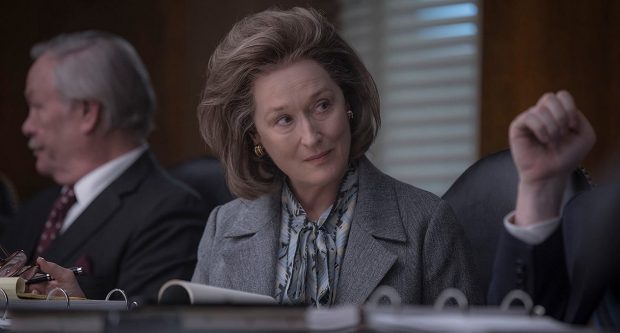
Spielberg. Streep. Hanks. Nixon. A political thriller that adopts some clichés and slightly sidesteps some expectations, The Post is a historical drama that follows the internal conflict at the Washington Post during the Pentagon Papers scandal. We find plenty to talk about in its parallels with the Trump White House and the current President’s attacks on the news media; its careful but stilted style; its relationship to the 70s cinema it evokes; its central figure of a woman out of place in a world of men; and the balance between its nationalistic boosterism of the US Constitution and American exceptionalism on the one hand, and on the other, its surprisingly direct denunciation of the powers that be in Washington. You can literally hear Mike learning about the Nixon era, live!

Also discussed: Mike loves Bridge of Spies, José doesn’t love Bridge of Spies, Mike thinks Spotlight is uniquely brilliant, José espouses his theory on Meryl Streep’s stardom, and old people are pricks.

The podcast can be listened to in the player above or at this link.

With José Arroyo of First Impressions and Michael Glass of Writing About Film.