Tag Archives: Brad Pitt

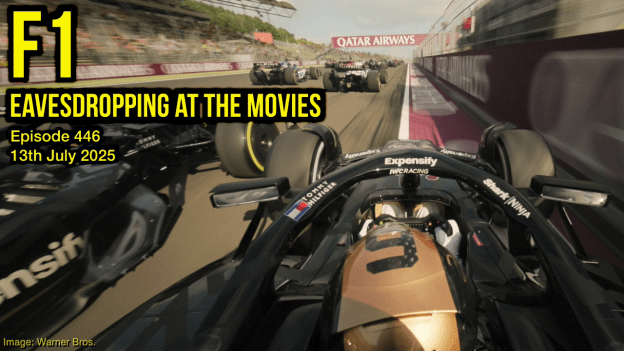
446 – F1

Listen on the players above, Apple Podcasts, Audible, Spotify, or YouTube Music.

Hollywood collaborates with the FIA, the motorsport governing body, to try to convince us that Formula One is not, in fact, televised Microsoft Excel, but actually very exciting indeed. To this end, it brings in accomplished genre action director Joseph Kosinski, star Brad Pitt, and every cliché under the sun. And it’s great fun.

There’s hardly anything realistic about this story of a sixtysomething has-been given an unexpected shot at glory in racing’s most prestigious competition, despite the extraordinary effort that’s been made to evoke the world of F1, including shooting during real races and race events, with real drivers filling the scenes and even the real commentary team of Crofty and Brundle talking us through the action. The ironic curse of such detail is that the audience most attuned to recognising it is precisely that which will take issue with the film’s inaccuracies; José, on the other hand, doesn’t know F1 from a hole in the ground, and has no such problem.

We discuss the incredibly intense action and praise the cinematography that captures it; Pitt’s perfect fit for the role of a veteran driver who once had promise, made a series of mistakes, but nonetheless carries himself with a casual, appealing ease; whether the film is a corporate biopic, a term Mike is pretty sure he invented and is desperate to catch on; how you can’t call yourself an artist when you’re just selling a product; and whether Kosinski can make a film that depicts complex human interactions.

F1 is far from a great film, but it pretends to be nothing other than what it is: a deeply derivative, expensively made, fabulously shot and entertaining advert for Formula One. It’s easy to recommend. See it!

With José Arroyo of First Impressions and Michael Glass of Writing About Film.

387 – Babylon

Listen on the players above, Apple Podcasts, Audible, Google Podcasts, or Spotify.

A film Mike was doing his damndest to avoid seeing but eventually agreed to, Babylon is an epic period comedy-drama about the excess and industrialisation of Hollywood in the ’20s and ’30s, and an epic bomb at the box office. Its aesthetics, characterisations, use of race and class, vulgarity, set pieces, bizarre ending and more are up for discussion. Did Mike have as terrible a time as he anticipated?

With José Arroyo of First Impressions and Michael Glass of Writing About Film.

369 – Bullet Train

Listen on the players above, Apple Podcasts, Audible, Google Podcasts, or Spotify.

David Leitch, who directed the surprisingly enjoyable Hobbs & Shaw, delivers another surprisingly enjoyable action comedy. Bullet Train is set upon the eponymous Japanese train, which, for two hours, hosts an assortment of assassins getting into scraps and scrapes at the behest of their various employers. It’s stylish, funny, smart, and features a wonderful central comic presence from Brad Pitt, who seems to have relaxed into himself in recent years, his performances exhibiting a delightful spontaneity. Definitely worth a watch, and going on the trailers, Mike really didn’t think he’d be saying that.

With José Arroyo of First Impressions and Michael Glass of Writing About Film.

176 – Fight Club

A film that jogs memories for Mike, as in the process of revisiting Fight Club he realises what an impact it had on him as a teenager. David Fincher’s outrageously stylish and visceral story of a generation of dispossessed men finding purpose in violence has only increased in relevance in the twenty years since its release, drawing comparisons to incels and school shooters, but it also leads Mike to recall how it affected his interests and attitudes in his youth. José, who saw it on its release, was on the positive side of its mixed response and recalls trying to convince his friends of its greatness – and is proud to have been proven right in the years since, in which it rapidly became perhaps the defining cult hit.

Mike is surprised to discover a sexual dimension to it that he hadn’t quite realised was there – obviously, Tyler and Marla’s ceiling-shaking lovemaking sessions hadn’t escaped his attention, but it wasn’t until this screening that he saw Marla as desirable and human, rather than simply present and symbolic. She’s weary but hopeful, fiery and alive but constantly flirting with death, and with the benefit of knowing the film’s infamous twist, deeply sympathetic. Mike argues, too, for a strain of homoeroticism in the fighting and particularly in Brad Pitt’s appearance – more than powerful and intimidating, he’s attractive, the narrator’s ideal self (though we don’t, as José points out, see him topless and sweaty nearly as often as we might remember).

It’s not without its problems. The question of exactly what it says, and indeed how deliberately it says it, is dependant perhaps on the viewer’s mood and cultural context as much as anything. Fight Club wants to be thought of as a satire, that’s clear, but of what – and is it as much of a satire as it thinks it is? Mike suggests that much of what drives this problematic area of debate is the effectiveness with which the film brings us into the narrator’s mental state, conveying beautifully his attitudes, desires, repressions, regardless of whether we might think of them as positive or negative. Were the film more objective, more willing to offer judgement of its characters, these questions would be less troubling but the film would have none of its potency.

We agree that Fight Club is a considerable piece of work – José less enthusiastically, but it would be hard to be as turned on by it as Mike is. To have seen it on the big screen is a treat – every one of its compositions is electrifying, beautiful, considered and inventive – and the themes it explores have only grown in relevance since 1999. If it comes round, don’t hesitate to buy front row tickets. If it doesn’t, dig out the DVD, which you definitely own, and watch it again.

The podcast can be listened to in the players above or on iTunes.

With José Arroyo of First Impressions and Michael Glass of Writing About Film.
173 – Ad Astra

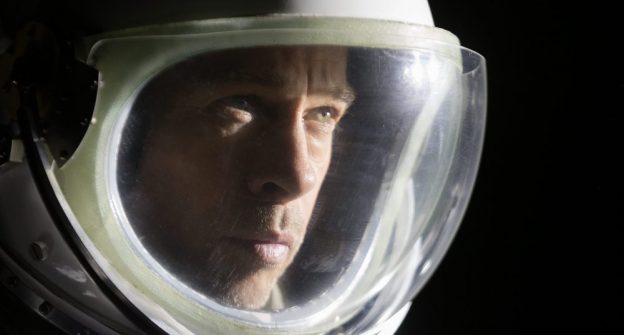
Ad Astra sees a withdrawn, isolated Brad Pitt take to the stars as Roy McBride, an astronaut in search of his father, and with him writer-director James Gray shows us stunning imagery and brings us brilliantly into McBride’s suppressed mental state. José is head over heels in love with the film’s epic feel, its exploration of universal human problems, the way in which it imagines a human race that, in spreading to and taming other planets and moons, brings its pre-existing problems with it, and the way in which Gray expresses McBride’s inner turmoil through action. Mike is less keen, particularly arguing for the weakness of the film’s first act, and asking questions of the film’s gender theming, but finds much to love too.

Ad Astra is a vast, careful, $100m art movie, the likes of which only Christopher Nolan normally gets to make. It’s very much worth your time. See it on the largest screen you can.

The podcast can be listened to in the players above or on iTunes.

With José Arroyo of First Impressions and Michael Glass of Writing About Film.

163 – Once Upon a Time in Hollywood

Mike feared it might be the most tasteless film ever made. José doesn’t look forward to Quentin Tarantino films. But we both came away from this fantastical reimagining of a near-mythological era of Hollywood history having had a great time. Tellingly, for a film that exceeds two and a half hours, we both felt the time fly by.

Tarantino’s love for and expert knowledge of Hollywood and cinema informs all of his work, and arguably not that consequentially – he cribs shots, pastiches genres, and evokes styles and tones specific to cinema, but to debatable significant effect beyond the superficial. But in Once Upon a Time in Hollywood (OUATIH for brevity’s sake), the decision to bring this passion to the surface and tell a story directly about Hollywood results in Tarantino’s most meaningful and personal film. What he values is brazenly displayed here, and, Mike suggests, isn’t entirely pleasant to examine. He finds OUATIH initially troubling in this regard – with a day’s reflection on it, he comes to see it as deeply conservative and protective of privilege. In digging this up, we discuss its sexual politics, the way it uses race, and the clash it represents between the old and the new in a rapidly changing 1969 Hollywood. Mike argues that, as in 2009’s Inglourious Basterds, Tarantino’s revisionism revealingly reflects his fantasy of what an ideal world would look like and contain, and in this case it’s a little uneasy to stomach. He also takes issue with the way the Manson family are used, but not, as he feared, for reasons of taste – Charles Manson wasn’t in Hollywood by chance, he wanted stardom, and for a film in which the desire for and loss of stardom are interests, to show no interest in drawing a thematic link here, instead only wanting to use the Manson family to rag on hippies, is more evidence of Tarantino’s retrograde attitude.

The flip side to this coin is that the things Tarantino loves are wonderfully, warmly depicted. OUATIH is as much about television as it is cinema, if not more so, and Tarantino offers imagined and reimagined TV shows of many types in evoking in detail the time and place in which he grew up. To José, about the same age as Tarantino, there abound countless nostalgic pleasures; to Mike, disgustingly born 30 years too late, the film’s enthusiasm and obvious knowledge about its setting rubs off easily. The film easily convinces you to love what it loves, be it silly, overblown action movies; cheesy, overblown TV acting; or Brad Pitt’s Hawaiian shirt, which in one scene blows off.

Speaking of Pitt, José considers this his best performance, one in which he switches from evoking coolness and control to dumb and tripping balls. But for all the little touches and tone he brings to his character, Leonardo DiCaprio brings entirely different registers. His performance is a tour de force, his Rick, a declining Western star, constantly performing, even only to himself at times, and at every moment his emotions and thoughts are crystal clear, even under layer upon layer of performance. DiCaprio practically shapeshifts in sketches depicting Rick’s old movies and television appearances, and offers a sympathetic portrait of a star unable to adapt to his changing environment. It’s a rich, demanding role, and DiCaprio is spellbinding in meeting its challenge.

You’d be doing yourself a disservice missing Once Upon a Time in Hollywood at the cinema. It’s an excited, passionate trip through a Hollywood fantasy, hilarious, light, and thoroughly enjoyable – though, like so many fantasies, its underbelly is dark.

The podcast can be listened to in the players above or on iTunes.

With José Arroyo of First Impressions and Michael Glass of Writing About Film.