283 – Dear Zachary: A Letter to a Son About His Father

Listen on the players above, Apple Podcasts, Google Podcasts, or Spotify.

Ethics and truth in the land of documentary come under the microscope in our discussion of Dear Zachary: A Letter to a Son About His Father. Filmmaker Kurt Kuenne’s love letter to his childhood friend, Andrew Bagby, is a sensational and moving film that you should know as little as possible about before watching. It’s exceptionally effective, built out of a combination of interviews, home footage, still photos and more, masterfully edited to generate emotional affect – but despite its qualities, there are real issues fundamental to its form. It’s a hybrid of two types of film that find themselves in competition here: it’s a documentary, a form about openness and truth; and a thriller, withholding information until it reshapes everything you’ve learned so far. It’s a tension that may well be impossible to avoid – to resolve it might be to totally change Dear Zachary from the deeply personal, passionately made film it is.

The story Dear Zachary tells is powerful, moving and utterly gripping, and the conversation to which it will lead you is rich and illuminating. We recommend it without reservation, even though we have serious reservations about it.

With José Arroyo of First Impressions and Michael Glass of Writing About Film.
282 – Lapsis

Listen on the players above, Apple Podcasts, Google Podcasts, or Spotify.

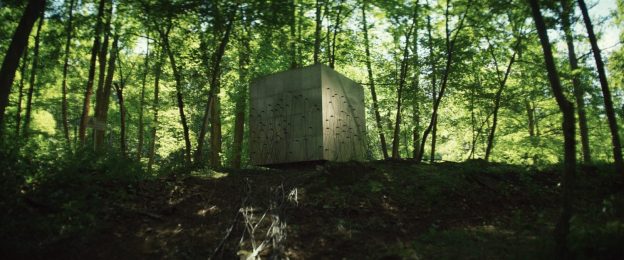
First-time writer-director Noah Hutton imagines, in Lapsis, a near-future gig economy dystopia that isn’t that different from our own. Unable to pay for his brother’s healthcare, Dean Imperial’s Ray takes on contracting work for a Google-esque tech giant, hiking through forests laying cables. Imperial’s performance is a standout, his Ray always sympathetic and legible, and Hutton’s sketchy, piecemeal world-building suits the film – until it doesn’t. Lapsis creates a recognisable milieu and has a leftist politics with which we broadly agree and are happy to see, but as its story develops it wants to evoke the feeling of doom one would expect of a revealed conspiracy, without the burden of having to bring together its disparate subplots and building blocks in order to explain anything.

Despite our reservations, we enjoyed Lapsis and are glad to have seen it, and are keen to see what comes next for Noah Hutton and Dean Imperial.

With José Arroyo of First Impressions and Michael Glass of Writing About Film.
281 – The Day of the Locust

Listen on the players above, Apple Podcasts, Google Podcasts, or Spotify.

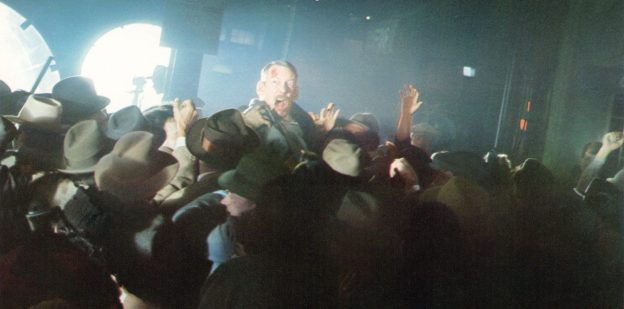
An expensive flop in its day, The Day of the Locust maintains a cult intrigue for its critique of Hollywood and descent into madness. It’s new for both of us, and we discuss the qualities its cast brings, what could be better about its industry commentary, its moments of surprisingly graphic violence, and who, or what, its titular locusts are.

With José Arroyo of First Impressions and Michael Glass of Writing About Film.

280 – A Sun

Listen on the players above, Apple Podcasts, Google Podcasts, or Spotify.

We explore a wonderful Taiwanese film that Netflix forgot it had, A Sun. An intimate yet epic drama about the effects of a single mistake that reverberate through a family and down the years, it’s gorgeously lit and shot, and although it feels as long as it is, every moment is earned and valuable. It asks fundamental questions of its characters and of us, the most important of which is: What does it mean to be a good person?

With José Arroyo of First Impressions and Michael Glass of Writing About Film.

279 – Rocky – Part II: The Rocky series

Listen on the players above, Apple Podcasts, Google Podcasts, or Spotify.

Listen to part one of our Rocky podcast here.

Our two-part discussion of Rocky concludes with a look at the entire series of eight films, including the two Creed movies. It’s a series that’s deeply interested in its own history, regularly referring to it in montages of characters’ memories, journeys back to iconic locations, and the reintroduction of one particular character in Creed II. The series rewards its audience for its investment, although despite featuring a soap opera-like series of melodramatic plot developments over its many films, almost everything that refers to a previous film refers to the first one. Other than the events of 1976’s Rocky, which laid the foundation for the series, only Apollo Creed’s death and Ivan Drago’s defeat in Rocky IV have lasting impact on later films.

We discuss how, following his superhero-like physicality in the Eighties, the character of Rocky is brought back down to Earth in his old age, his body ravaged by time, his life broken by loss. And we think about how the milieu evolves over time, the music, for instance, changing from barbershop/a capella singing in the Seventies, through power ballads in the Eighties, to rap and hip-hop in the 2010s. And we discuss much more besides.

You can track significant changes in cinema and culture over the last fifty years through the Rocky films. Each one feels like a snapshot of American life at its time. We can’t recommend most of the films as examples of great film art, but the last three, Rocky Balboa, Creed and Creed II, stand above the first five, the Creeds especially feeling like a breath of fresh air with the directorial talent on display. But it’s a fascinating series to work through, earnest and open-hearted throughout, and immensely likeable.

With José Arroyo of First Impressions and Michael Glass of Writing About Film.
278 – Rocky – Part I: Rocky

Listen on the players above, Apple Podcasts, Google Podcasts, or Spotify.

Listen to part two of our Rocky podcast here.

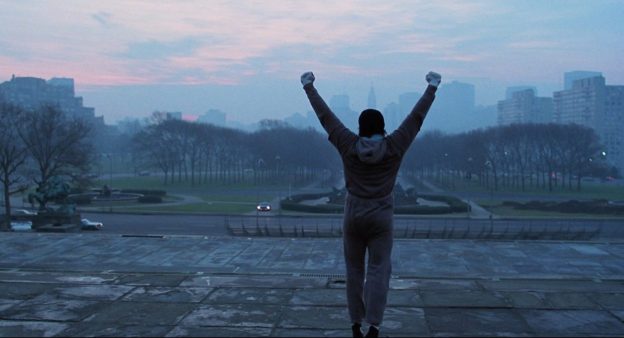
In this first of our two-part discussion of the Rocky films, we look at the film that began the series almost 50 years ago. There’s a lot about 1976’s Rocky that… isn’t that good. John G. Avildsen’s direction is drab, the story basic, the themes rudimentary – but with that comes a roughness and a sincerity to the whole affair that might be just what makes it work after all. Sylvester Stallone’s Rocky is a physical brute, softened by his unusual – and unusually pretty – features, his inability to avoid trying to befriend any animal that crosses his path, his demeanour that’s at once confident and shy, and his intellectual simplicity. José argues that the boxing is a diversion, a Trojan horse within which to sneak Rocky and Adrian’s love story. And we think about the character of Apollo Creed, his use as a substitute for Muhammad Ali, and why he couldn’t have been white.

Rocky was a phenomenon upon its release, an immediate cultural touchstone that contains images and scenes so iconic that, five decades on, we continue to attach the same emotions to them and draw the same pleasure from recalling them. Well, we say “we”, but, as is typical, Mike has never seen it before. So while José revisits, Mike joins the party for the first time, and we discuss the quality, significance and impact of this iconic film.

With José Arroyo of First Impressions and Michael Glass of Writing About Film.
277 – News of the World

Listen on the players above, Apple Podcasts, Google Podcasts, or Spotify.

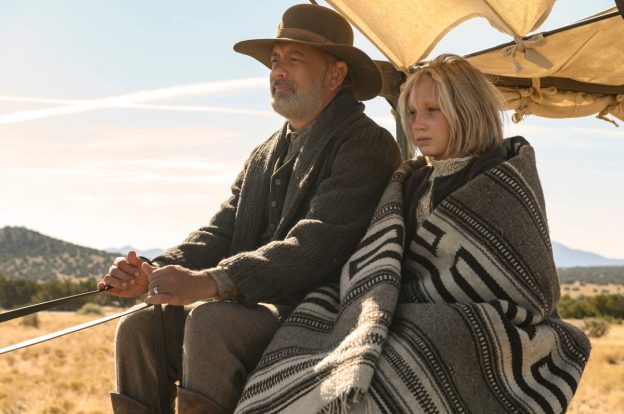
Why this film was made… is rather beyond us. News of the World invokes the era of fake news in name only, its premise – following the Civil War, a former Confederate captain travels the American south reading out newspapers for a living – interesting in principle but almost entirely ignored in favour of a by-the-numbers, surrogate father-daughter road movie. Paul Greengrass’ direction, eschewing the style and energy that made him famous, is barely an impersonation of that of classic Westerns, full of landscapes and sunsets, signifying nothing; Tom Hanks is as tediously noble and upstanding as ever, his character’s supposedly shady past alluded to rather than detailed, allowing us to feel pleased for his redemption without ever having to dislike him for what he needs to be redeemed for. Helena Zengel, the German youngster who plays Hanks’ mysterious companion, is a highlight, a presence you can’t take your eyes off – though her character is as thinly sketched as everything else.

News of the World is bad, but not offensively so. It’s an unending stampede of clichés and tropes, unthinkingly employed and uncreatively executed. We don’t like to advise people stay away from films, but if this is next on your list, we assume you have already seen every other film ever made.

With José Arroyo of First Impressions and Michael Glass of Writing About Film.

276 – The Birdcage

Listen on the players above, Apple Podcasts, Google Podcasts, or Spotify.

Mike Nichols and Elaine May, whose partnership in the 50s and 60s helped define American comedy, collaborate on a film for the first time in 1996, as director and screenwriter respectively, giving us a comedy so sharp and outrageous that José’s laughter made Mike miss half the dialogue. An adaptation of the French farce, La Cage aux Folles, The Birdcage sees Robin Williams’ South Beach drag club owner, Armand, attempt to force his life into the closet for one night, for the sake of his son, Val, whose deeply conservative in-laws are set to visit for dinner. But Nathan Lane’s flamboyant Albert, Armand’s longtime partner, is unable, and at first unwilling, to participate in the subterfuge as requested, and chaos ensues.

The Birdcage relies heavily on stereotypes – it’s not only theatrical but a farce, in which everything is heightened – and though they’re enjoyably insane in themselves, the film’s brilliance is in how it reveals the real people within them, people whose love and pain are rendered sensitively and richly, through the truly genius performances from Williams and Lane, which work together beautifully while in two different registers, the former internal, the latter external. José suggests that the film’s outlook, despite embodying so vividly a pro-gay message, is nonetheless normative of a certain kind of structure of love, the only difference between the film’s two families being that the mother in one is male – and even then, Albert is occasionally referred to as Armand’s wife and Val’s mother. He even, at one particularly stressful moment early on, claims that he is a woman. (“You’re not a woman”, replies Armand, to which Albert cries, “You bastard!”) But although this could be suggestive of a trans identity, and the drag club certainly houses trans people, 1996 is a little early for such complexity – publicly coming out as gay, never mind trans, was still rare, shocking, and even dangerous.

There’s a lot more to discuss, including the portrayals of Gene Hackman’s conservative, scandal-embroiled senator, Hank Azaria’s Guatemalan houseboy, and Val, who Mike thinks is a bit mean and smug, and Mike Nichols’ overall filmography, which José has been considering of late, having been reading his recently released biography by Mark Harris. The Birdcage sits high among his oeuvre, for José, and it’s not hard to see why – he’s literally never laughed as much in his life.

With José Arroyo of First Impressions and Michael Glass of Writing About Film.
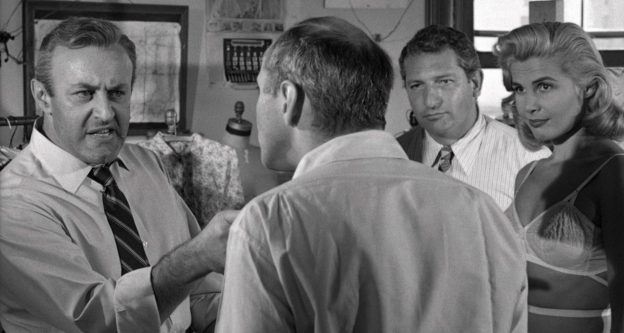
275 – The Garment Jungle

Listen on the players above, Apple Podcasts, Google Podcasts, or Spotify.

A pro-union, pulpy noir in 1957, not long after the House Un-American Activities Committee was at its height, is nothing to be sniffed at, even if its stance is to align union interests with business, and blame most of the bad things that happen on organised crime. The Garment Jungle dramatises the infiltration of the mob into New York’s Garment District with arguably surprising elegance, particularly considering its shaky production in which the first director, Robert Aldrich, was fired and replaced with Vincent Sherman. We discuss its significant use of location filming, implied – or otherwise – moral failings of its characters, Robert Loggia’s driven union organiser, the lack of quality of its dialogue and acting, and what appeal there is in it today, beyond an academic interest in the period. It has, after all, been lovingly restored as part of Columbia Noir #1, a six-film boxset – but we’re glad it has.

With José Arroyo of First Impressions and Michael Glass of Writing About Film.
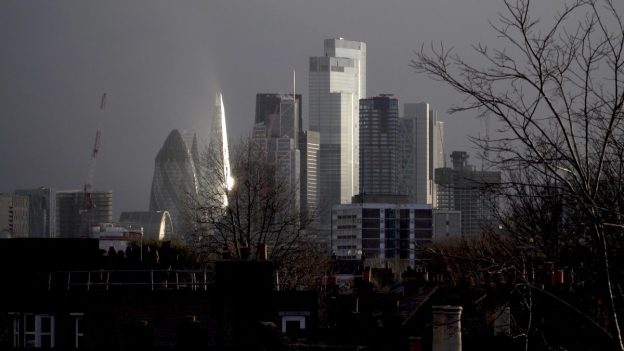
274 – Citadel

Listen on the players above, Apple Podcasts, Google Podcasts, or Spotify.

John Smith’s 16-minute short, Citadel, gives voice to the City of London – Prime Minister Boris Johnson’s voice, specifically. Filmed during the first few months of lockdown in 2020, it builds an oppositional portrait of British life under Johnson’s blustery leadership – it’s Boris Johnson vs. the British people, and the City vs. the British people.

But in tying Johnson to the City, it ignores his shockingly unsympathetic stance, for a Tory leader, towards business – summed up succinctly in his overheard comment in June 2018: “Fuck business“. Late on, it depicts the British public as lambs to the slaughter as Johnson decrees they must return to work, but while Smith employs a soundtrack of outdoor construction, the homes he is able to show us are suggestive of the middle class, their inhabitants likely able to work from home.

Still, Smith only has so much to work with, stuck at home as he is, and Citadel is an evocative and concise film, cleverly conceived, shot, and edited. Its simplifications are small in comparison to the pleasures of its imagery, wit and tone. A treat.

With José Arroyo of First Impressions and Michael Glass of Writing About Film.